Institute of Molecular Virology, Ulm University Medical Center, 89081, Ulm, Germany.
Institute of Electrochemistry, Ulm University, 89081, Ulm, Germany.
Nat Commun. 2021 Nov 25;12(1):6855. doi: 10.1038/s41467-021-27180-0.
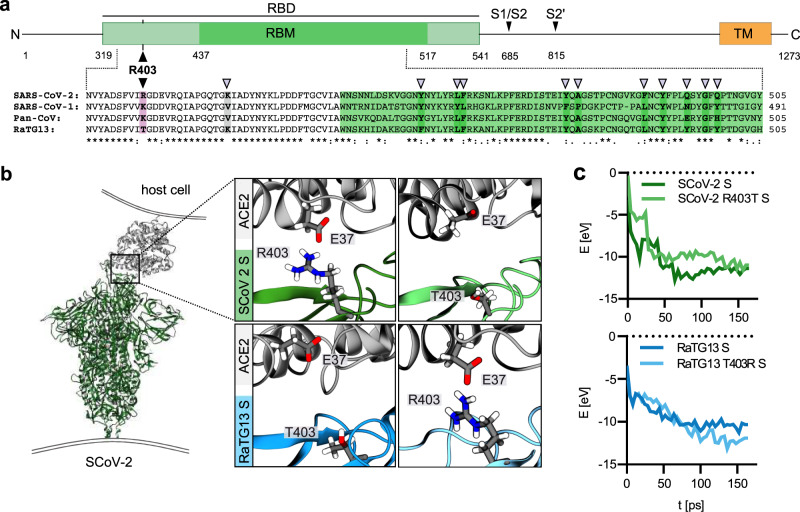
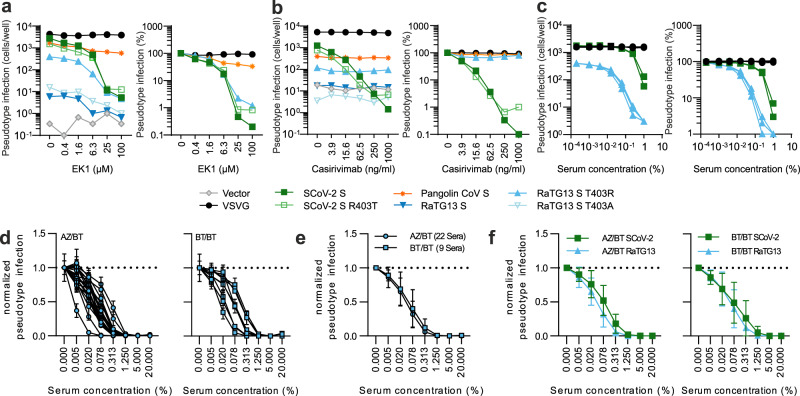
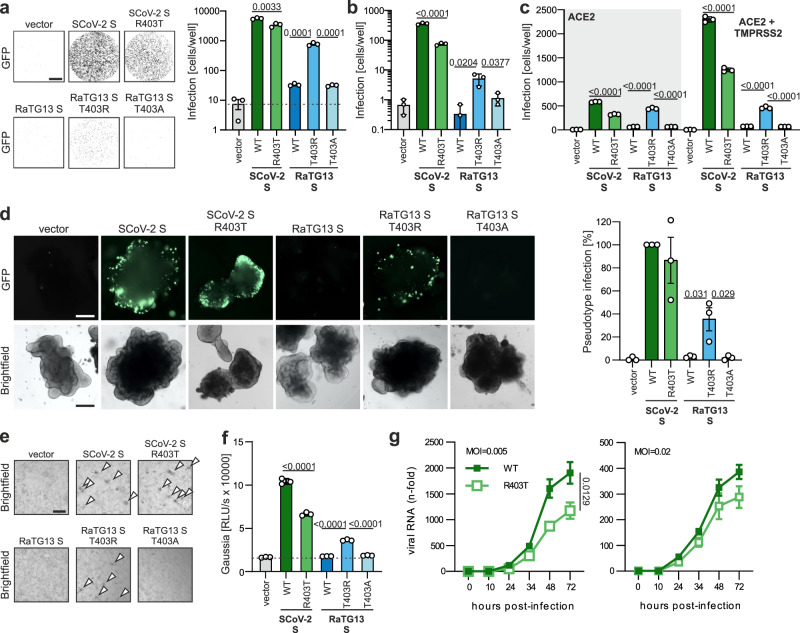
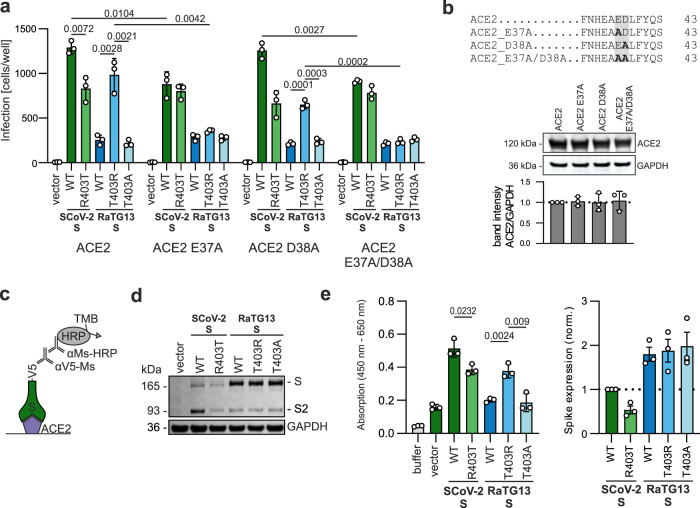
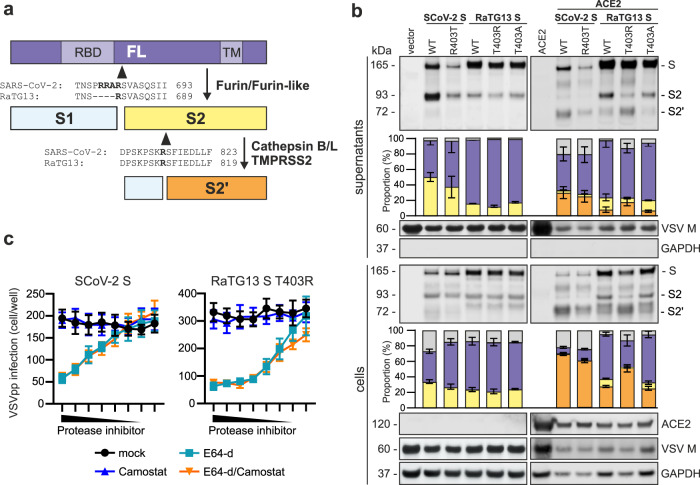
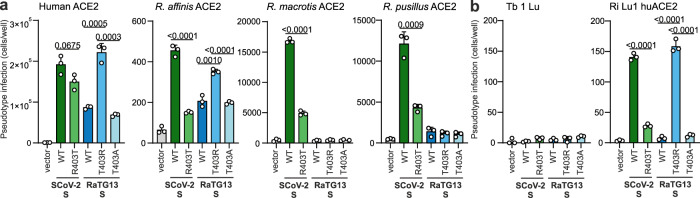
The bat sarbecovirus RaTG13 is a close relative of SARS-CoV-2, the cause of the COVID-19 pandemic. However, this bat virus was most likely unable to directly infect humans since its Spike (S) protein does not interact efficiently with the human ACE2 receptor. Here, we show that a single T403R mutation increases binding of RaTG13 S to human ACE2 and allows VSV pseudoparticle infection of human lung cells and intestinal organoids. Conversely, mutation of R403T in the SARS-CoV-2 S reduces pseudoparticle infection and viral replication. The T403R RaTG13 S is neutralized by sera from individuals vaccinated against COVID-19 indicating that vaccination might protect against future zoonoses. Our data suggest that a positively charged amino acid at position 403 in the S protein is critical for efficient utilization of human ACE2 by S proteins of bat coronaviruses. This finding could help to better predict the zoonotic potential of animal coronaviruses.
蝙蝠沙贝病毒 RaTG13 是引发 COVID-19 大流行的 SARS-CoV-2 的近亲。然而,由于其 Spike(S)蛋白不能有效地与人类 ACE2 受体相互作用,这种蝙蝠病毒可能无法直接感染人类。在这里,我们表明,单个 T403R 突变增加了 RaTG13 S 与人 ACE2 的结合,并允许 VSV 假病毒感染人肺细胞和肠类器官。相反,SARS-CoV-2 S 中的 R403T 突变减少了假病毒感染和病毒复制。针对 COVID-19 接种疫苗的个体的血清中和了 T403R RaTG13 S,表明接种疫苗可能预防未来的人畜共患病。我们的数据表明,S 蛋白第 403 位的带正电荷的氨基酸对于蝙蝠冠状病毒的 S 蛋白有效利用人类 ACE2 至关重要。这一发现有助于更好地预测动物冠状病毒的人畜共患潜力。