Laurini Erik, Marson Domenico, Aulic Suzana, Fermeglia Alice, Pricl Sabrina
Molecular Biology and Nanotechnology Laboratory (MolBNL@UniTS), DEA, University of Trieste, 34127 Trieste, Italy.
Department of General Biophysics, Faculty of Biology and Environmental Protection, University of Lodz, 90-136 Lodz, Poland.
ACS Nano. 2021 Apr 27;15(4):6929-6948. doi: 10.1021/acsnano.0c10833. Epub 2021 Mar 18.
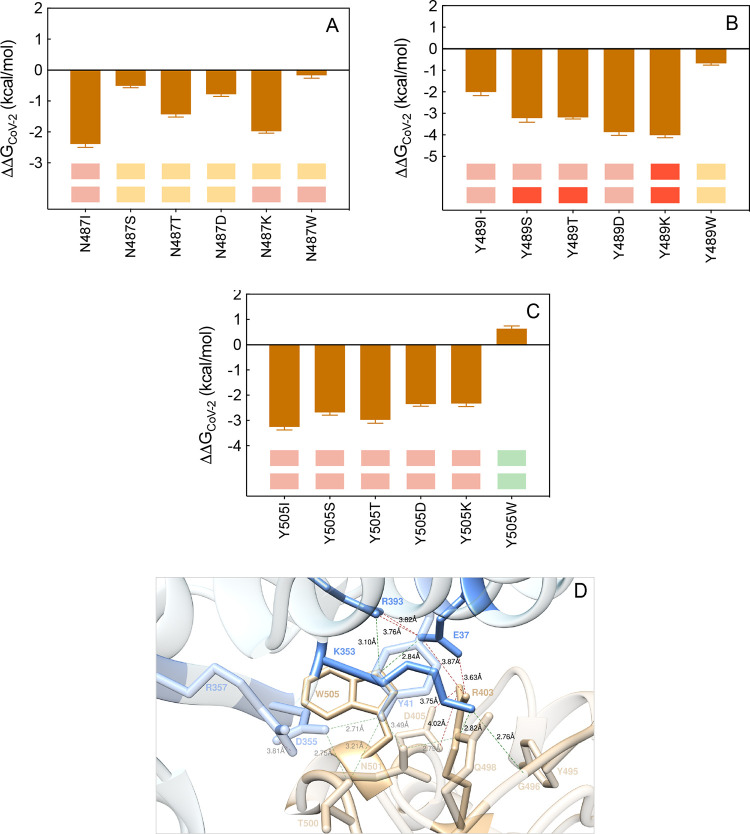
The coronavirus disease-2019 (COVID-19) pandemic, caused by the pathogen severe acute respiratory syndrome coronavirus 2 (SARS-CoV-2), started in China during late 2019 and swiftly spread worldwide. Since COVID-19 emergence, many therapeutic regimens have been relentlessly explored, and although two vaccines have just received emergency use authorization by different governmental agencies, antiviral therapeutics based neutralizing antibodies and small-drug inhibitors can still be vital viable options to prevent and treat SARS-CoV-2 infections. The viral spike glycoprotein (S-protein) is the key molecular player that promotes human host cellular invasion via recognition of and binding to the angiotensin-converting enzyme 2 gene (ACE2). In this work, we report the results obtained by mutating the 18 ACE2 residues and the 14 S-protein receptor binding domain (S-RBD) residues that contribute to the receptor/viral protein binding interface. Specifically, each wild-type protein-protein interface residue was replaced by a hydrophobic (isoleucine), polar (serine and threonine), charged (aspartic acid/glutamic acid and lysine/arginine), and bulky (tryptophan) residue, respectively, in order to study the different effects exerted by nature, shape, and dimensions of the mutant amino acids on the structure and strength of the resulting binding interface. The computational results were next validated against the corresponding experimental data, yielding an overall agreement of 92%. Interestingly, a non-negligible number of mis-sense variations were predicted to enhance ACE2/S-RBD binding, including the variants Q24T, T27D/K/W, D30E, H34S7T/K, E35D, Q42K, L79I/W, R357K, and R393K on ACE2 and L455D/W, F456K/W, Q493K, N501T, and Y505W on S-RBD, respectively.
2019年冠状病毒病(COVID-19)大流行由病原体严重急性呼吸综合征冠状病毒2(SARS-CoV-2)引起,于2019年末在中国爆发,并迅速蔓延至全球。自COVID-19出现以来,人们一直在不懈探索多种治疗方案,尽管已有两种疫苗刚刚获得不同政府机构的紧急使用授权,但基于中和抗体和小分子药物抑制剂的抗病毒疗法对于预防和治疗SARS-CoV-2感染而言,仍然是至关重要的可行选择。病毒刺突糖蛋白(S蛋白)是通过识别并结合血管紧张素转换酶2基因(ACE2)来促进侵入人类宿主细胞的关键分子。在本研究中,我们报告了对18个ACE2残基和14个S蛋白受体结合域(S-RBD)残基进行突变的结果,这些残基构成了受体/病毒蛋白结合界面。具体而言,分别将每个野生型蛋白-蛋白界面残基替换为一个疏水(异亮氨酸)、极性(丝氨酸和苏氨酸)、带电荷(天冬氨酸/谷氨酸和赖氨酸/精氨酸)和体积较大(色氨酸)的残基,以研究突变氨基酸的性质、形状和尺寸对所得结合界面的结构和强度产生的不同影响。接下来,将计算结果与相应的实验数据进行验证,总体一致性达92%。有趣的是,预测有相当数量的错义变异会增强ACE2/S-RBD结合,包括ACE2上的Q24T、T27D/K/W、D30E、H34S7T/K、E35D、Q42K、L79I/W、R357K和R393K变异,以及S-RBD上的L455D/W、F456K/W、Q493K、N501T和Y505W变异。