Baca Mateusz, Popović Danijela, Lemanik Anna, Fewlass Helen, Talamo Sahra, Zima Jan, Ridush Bogdan, Popov Vasil, Nadachowski Adam
Centre of New Technologies University of Warsaw Warszawa Poland.
Institute of Systematics and Evolution of Animals Polish Academy of Sciences Kraków Poland.
Ecol Evol. 2021 Nov 4;11(22):16113-16125. doi: 10.1002/ece3.8289. eCollection 2021 Nov.
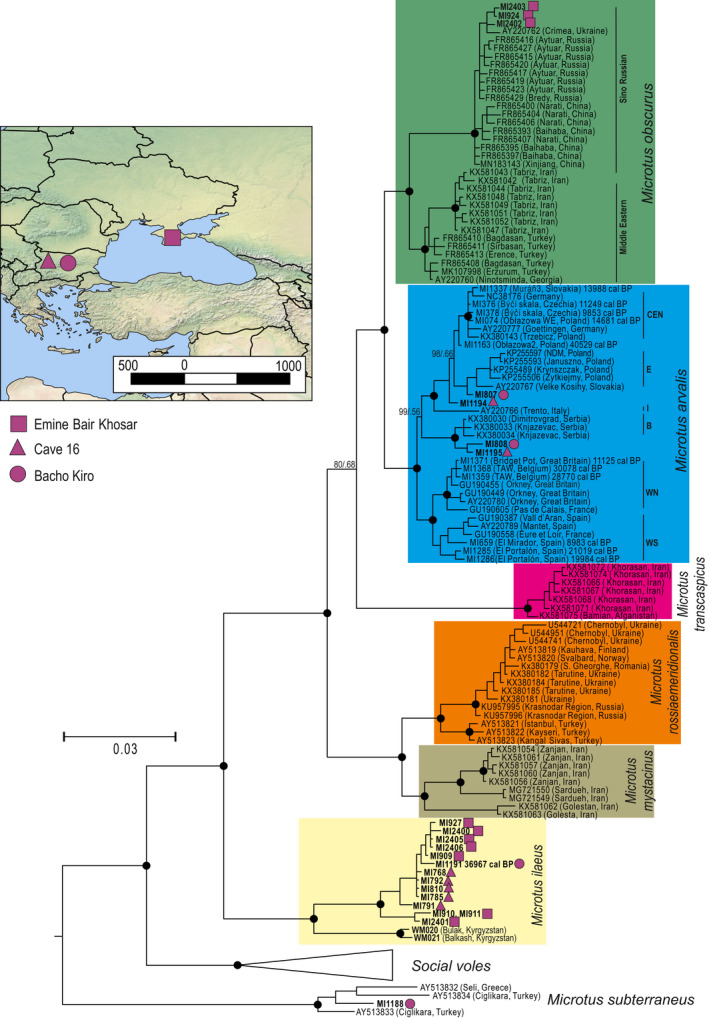
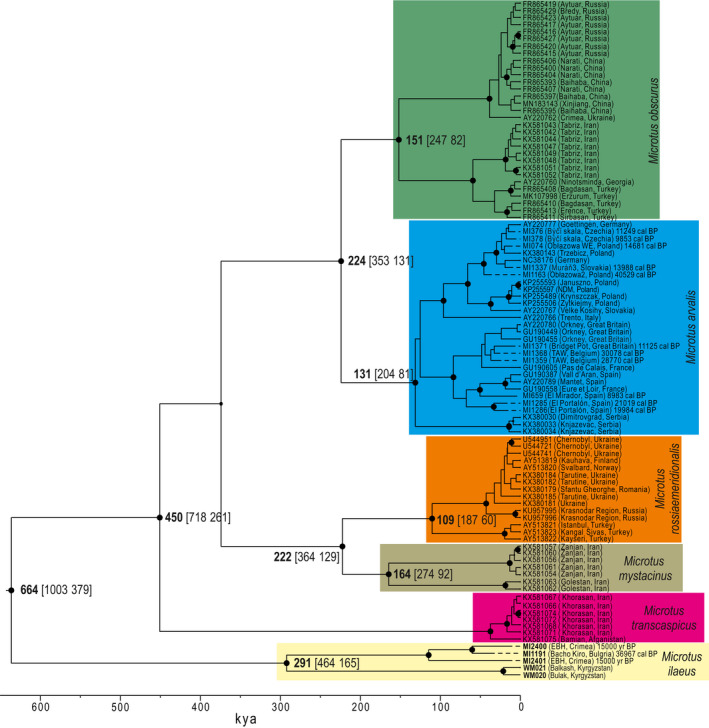
Grey voles (subgenus ) represent a complex of at least seven closely related and partly cryptic species. The range of these species extends from the Atlantic to the Altai Mountains, but most of them occur east of the Black Sea. Using ancient DNA analyses of the Late Pleistocene specimens, we identified a new mtDNA lineage of grey voles in Europe. Phylogenetic analysis of mitochondrial DNA cytochrome sequences from 23 voles from three caves, namely, Emine-Bair-Khosar (Crimea, Ukraine), Cave 16 (Bulgaria), and Bacho Kiro (Bulgaria), showed that 14 specimens form a previously unrecognized lineage, sister to the Tien Shan vole. The average sequence divergence of this lineage and the extant Tien Shan vole was 4.8%, which is similar to the divergence of grey vole forms, which are considered distinct species or being on the verge of speciation; . and . or . and . . We estimated the time to the most recent common ancestor of the grey voles to be 0.66 Ma, which is over twice the recent estimates, while the divergence of the extant Tien Shan vole and the new lineage to be 0.29 Ma. Our discovery suggests that grey voles may have been more diversified in the past and that their ranges may have differed substantially from current ones. It also underlines the utility of ancient DNA to decipher the evolutionary history of voles.
灰田鼠(亚属 )代表了至少七个密切相关且部分难以区分的物种复合体。这些物种的分布范围从大西洋延伸至阿尔泰山脉,但它们大多分布在黑海以东。通过对晚更新世标本进行古DNA分析,我们在欧洲确定了一个新的灰田鼠线粒体DNA谱系。对来自三个洞穴(即埃米内 - 拜尔 - 霍萨尔(乌克兰克里米亚)、16号洞穴(保加利亚)和巴乔基罗洞穴(保加利亚))的23只田鼠的线粒体细胞色素 序列进行系统发育分析表明,14个标本形成了一个先前未被识别的谱系,是天山田鼠的姐妹谱系。该谱系与现存天山田鼠的平均序列差异为4.8%,这与被认为是不同物种或处于物种形成边缘的灰田鼠形态之间的差异相似; 以及 。 或 。 以及 。 。我们估计灰田鼠最近共同祖先的时间为0.66百万年前,这是最近估计值的两倍多,而现存天山田鼠与新谱系的分歧时间为0.29百万年前。我们的发现表明,灰田鼠在过去可能更加多样化且其分布范围可能与当前有很大不同。这也凸显了古DNA在解读田鼠进化历史方面的作用。