Harwood Clare R, Sykes David A, Hoare Bradley L, Heydenreich Franziska M, Uddin Romez, Poyner David R, Briddon Stephen J, Veprintsev D B
Centre of Membrane Proteins and Receptors (COMPARE), University of Birmingham and University of Nottingham, Midlands NG7 2UH, UK.
Division of Physiology, Pharmacology and Neuroscience, School of Life Sciences, Queen's Medical Centre, University of Nottingham, Nottingham NG7 2UH, UK.
iScience. 2021 Oct 28;24(12):103362. doi: 10.1016/j.isci.2021.103362. eCollection 2021 Dec 17.
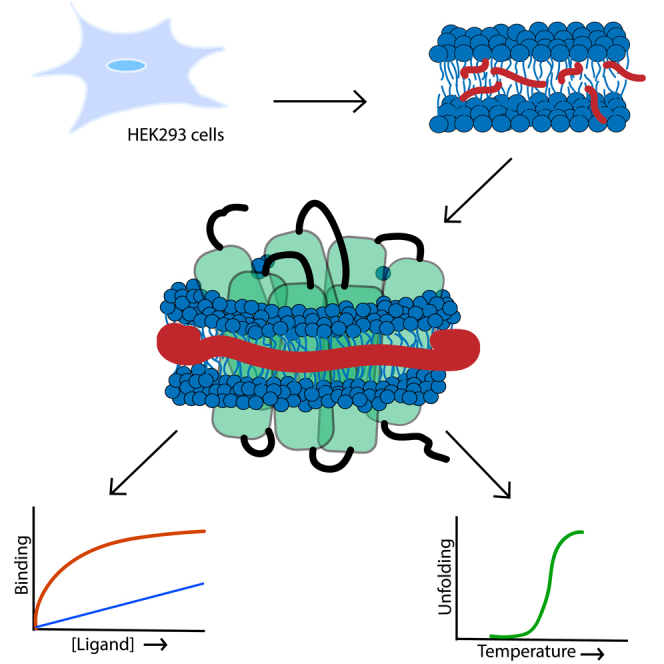
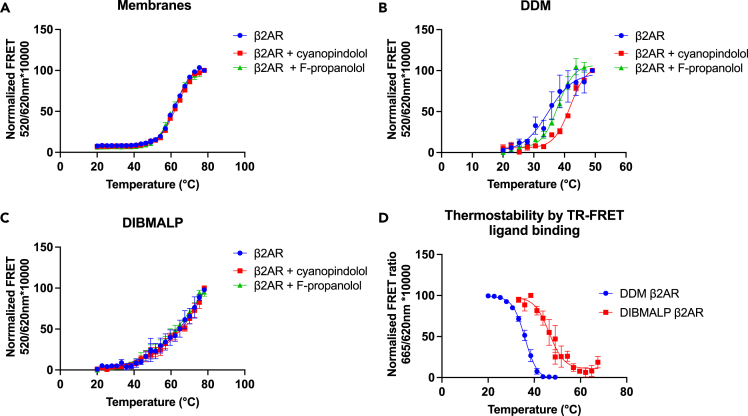
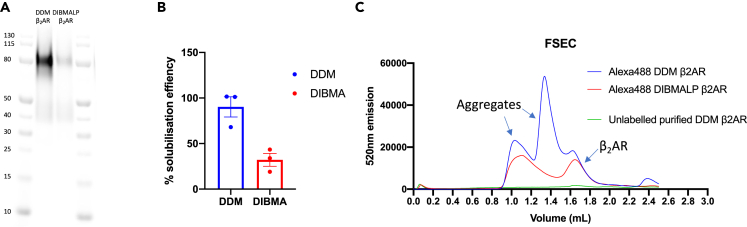
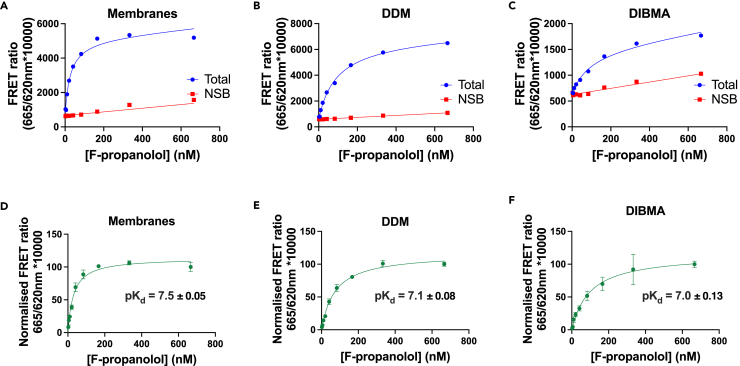
The β2-adrenoceptor (β2AR) is a well-established target in asthma and a prototypical G protein-coupled receptor for biophysical studies. Solubilization of membrane proteins has classically involved the use of detergents. However, the detergent environment differs from the native membrane environment and often destabilizes membrane proteins. Use of amphiphilic copolymers is a promising strategy to solubilize membrane proteins within their native lipid environment in the complete absence of detergents. Here we show the isolation of the βAR in the polymer diisobutylene maleic acid (DIBMA). We demonstrate that βAR remains functional in the DIBMA lipid particle and shows improved thermal stability compared with the n-dodecyl-β-D-maltopyranoside detergent-solubilized βAR. This unique method of extracting βAR offers significant advantages over previous methods routinely employed such as the introduction of thermostabilizing mutations and the use of detergents, particularly for functional biophysical studies.
β2肾上腺素能受体(β2AR)是哮喘治疗中一个已被充分确立的靶点,也是用于生物物理研究的典型G蛋白偶联受体。传统上,膜蛋白的增溶涉及使用去污剂。然而,去污剂环境不同于天然膜环境,且常常会使膜蛋白不稳定。使用两亲性共聚物是在完全不使用去污剂的情况下,在其天然脂质环境中增溶膜蛋白的一种很有前景的策略。在此,我们展示了在聚合物聚异丁烯马来酸(DIBMA)中分离βAR的过程。我们证明,βAR在DIBMA脂质颗粒中仍保持功能,并且与用正十二烷基-β-D-麦芽糖苷去污剂增溶的βAR相比,显示出更高的热稳定性。这种提取βAR的独特方法比以前常规使用的方法具有显著优势,例如引入热稳定突变和使用去污剂,特别是在功能性生物物理研究方面。