Davis Booker T, Islam Mecca B A R, Das Promi, Gilbert Jack A, Ho Karen J, Schwulst Steven J
Department of Surgery, Division of Trauma and Critical Care; Northwestern University, Chicago Il, USA.
Department of Pediatrics and Scripps Institution of Oceanography, University of California San Diego, La Jolla, CA, USA.
J Exp Neurol. 2021;2(3):120-130. doi: 10.33696/neurol.2.044.
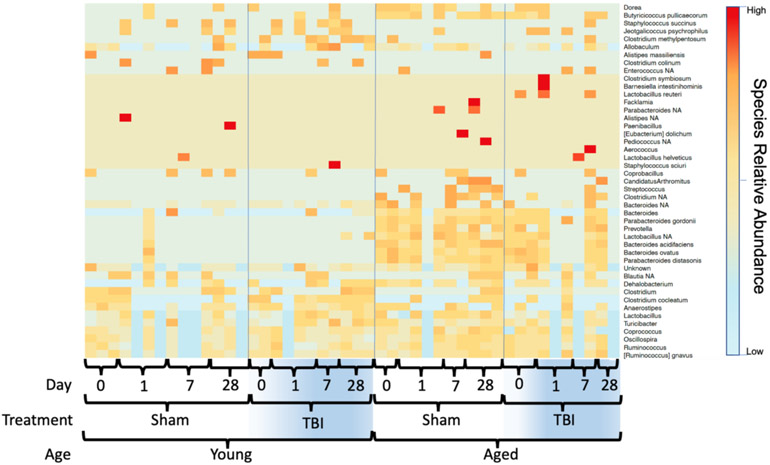
Traumatic brain injury (TBI) has a bimodal age distribution with peak incidence at age 24 and age 65 with worse outcomes developing in aged populations. Few studies have specifically addressed age at the time of injury as an independent biologic variable in TBI-associated secondary pathology. Within the framework of our published work, identifying age related effects of TBI on neuropathology, cognition, memory and motor function we analyzed fecal pellets collected from young and aged TBI animals to assess for age-induced effects in TBI induced dysbiosis. In this follow up, work we hypothesized increased dysbiosis after TBI in aged (80-week-old, N=10) versus young (14-week-old, N=10) mice. C57BL/6 males received a sham incision or TBI via open-head controlled cortical impact. Fresh stool pellets were collected 1-day pre-TBI, then 1, 7, and 28-days post-TBI for 16S rRNA gene sequencing and taxonomic analysis. Data revealed an age induced increase in disease associated microbial species which were exacerbated by injury. Consistent with our hypothesis, aged mice demonstrated a high number of disease associated changes to the gut microbiome pre- and post-injury. Our data suggest divergent microbiome phenotypes in injury between young and aged reflecting a previously unknown interaction between age, TBI, and the gut-brain axis implying the need for different treatment strategies.
创伤性脑损伤(TBI)具有双峰年龄分布,发病高峰在24岁和65岁,老年人群的预后更差。很少有研究专门将受伤时的年龄作为TBI相关继发性病理中的一个独立生物学变量来探讨。在我们已发表工作的框架内,为了确定TBI对神经病理学、认知、记忆和运动功能的年龄相关影响,我们分析了从年轻和老年TBI动物收集的粪便颗粒,以评估TBI诱导的生态失调中年龄诱导的影响。在这项后续工作中,我们假设老年(80周龄,N = 10)小鼠与年轻(14周龄,N = 10)小鼠相比,TBI后生态失调增加。C57BL/6雄性小鼠接受假手术切口或通过开颅控制皮质撞击造成TBI。在TBI前1天、然后在TBI后1天、7天和28天收集新鲜粪便颗粒,用于16S rRNA基因测序和分类分析。数据显示,与疾病相关的微生物种类随年龄增加,且损伤会使其加剧。与我们的假设一致,老年小鼠在受伤前后肠道微生物组出现大量与疾病相关的变化。我们的数据表明,年轻和老年小鼠在损伤后的微生物组表型不同,这反映了年龄、TBI和肠脑轴之间以前未知的相互作用,这意味着需要不同的治疗策略。