Musa Laura, Proietti Patrizia Casagrande, Marenzoni Maria Luisa, Stefanetti Valentina, Kika Tana Shtylla, Blasi Francesca, Magistrali Chiara Francesca, Toppi Valeria, Ranucci David, Branciari Raffaella, Franciosini Maria Pia
Department of Veterinary Medicine, Via S. Costanzo 4, 06126 Perugia, Italy.
Department of Veterinary Public Health, Faculty of Veterinary Medicine, Agricultural University of Tirana, Koder Kamez, 1029 Tirana, Albania.
Antibiotics (Basel). 2021 Oct 29;10(11):1321. doi: 10.3390/antibiotics10111321.
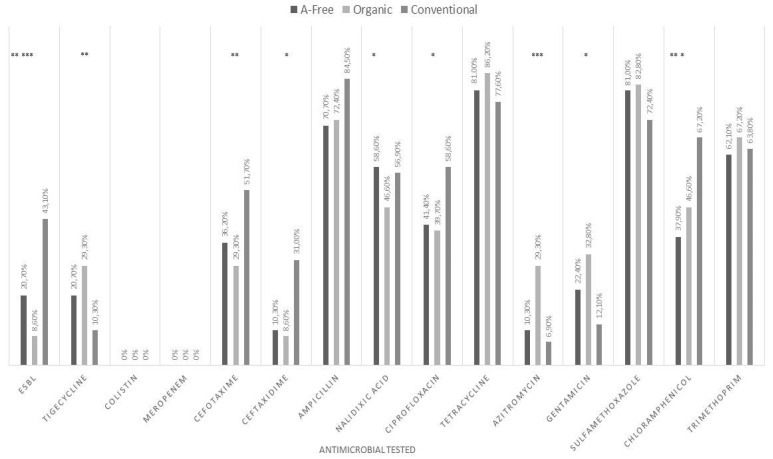
The spread of resistant bacteria from livestock to the food industry promoted an increase of alternative poultry production systems, such as organic and antibiotic-free ones, based on the lack of antimicrobial use, except in cases in which welfare is compromised. We aimed to investigate the antibiotic susceptibility of commensal isolated from organic, antibiotic-free, and conventional broiler farms and slaughterhouses toward several antimicrobials critically important for human health. To assess antimicrobial susceptibility, all isolates and extended spectrum beta-lactamase (ESBL) were analysed by the microdilution method. The prevalence of tigecycline, azithromycin and gentamicin -resistant strains was highest in organic samplings. Conversely, the lowest prevalence of resistant strains was observed for cefotaxime, ceftazidime and ciprofloxacin in organic systems, representing a significant protective factor compared to conventional systems. All strains were colistin-susceptible. Contamination of the external environment by drug-resistant bacteria could play a role in the presence of resistant strains detected in organic systems. Of interest is the highest prevalence of cephalosporin resistance of in conventional samplings, since they are not permitted in poultry. Our results suggest that monitoring of antibiotic resistance of the production chain may be helpful to detect "risks" inherent to different rearing systems.
由于除福利受损情况外禁止使用抗菌药物,耐药菌从家畜向食品行业的传播促使了替代性家禽生产系统的增加,如有机和无抗生素生产系统。我们旨在调查从有机、无抗生素和传统肉鸡养殖场及屠宰场分离出的共生菌对几种对人类健康至关重要的抗菌药物的敏感性。为评估抗菌药物敏感性,采用微量稀释法对所有分离株和超广谱β-内酰胺酶(ESBL)进行了分析。在有机样本中,对替加环素、阿奇霉素和庆大霉素耐药菌株的流行率最高。相反,在有机系统中,头孢噻肟、头孢他啶和环丙沙星耐药菌株的流行率最低,与传统系统相比,这是一个显著的保护因素。所有分离株对黏菌素敏感。耐药菌对外部环境的污染可能是在有机系统中检测到耐药菌株的一个原因。值得关注的是,在传统样本中,头孢菌素耐药性的流行率最高,因为家禽中不允许使用头孢菌素。我们的结果表明,监测生产链的抗生素耐药性可能有助于发现不同饲养系统固有的“风险”。