Lei Donna, Tan Kenneth, Malhotra Atul
Department of Paediatrics, Monash University, Melbourne, VIC 3168, Australia.
Monash Newborn, Monash Children's Hospital, Melbourne, VIC 3168, Australia.
Children (Basel). 2021 Nov 19;8(11):1068. doi: 10.3390/children8111068.
To determine whether incorporating BEMPU TempWatch into the care of LBW/SGA neonates for continuous temperature monitoring decreases the rate of hypothermia requiring escalation of care.
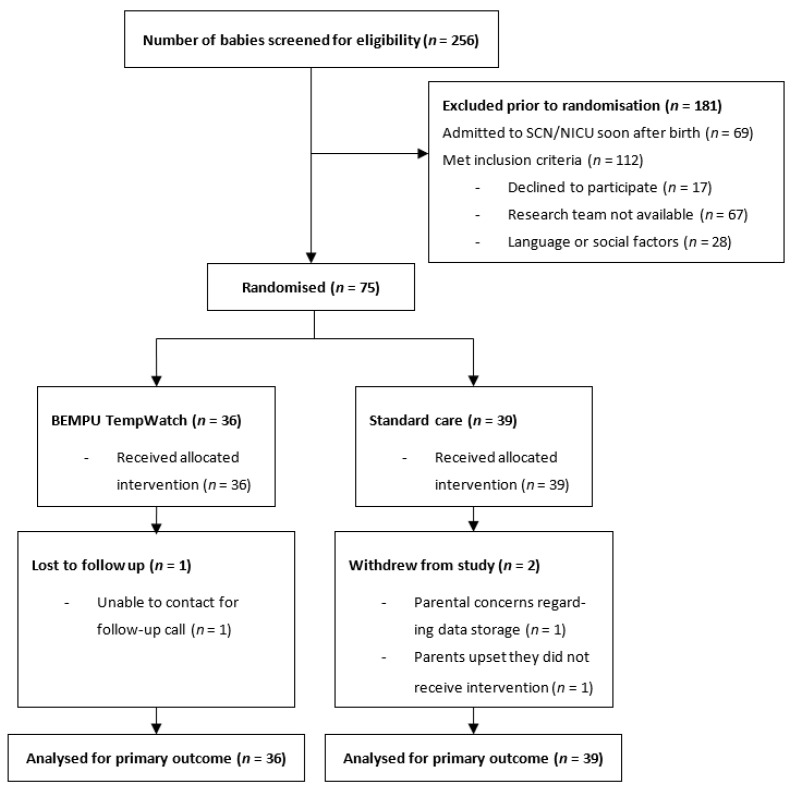
This was a randomised controlled trial conducted in a tertiary hospital in Melbourne, Australia. Participants were late preterm and term LBW/SGA neonates on the postnatal wards. Neonates were randomly assigned to receive either the BEMPU TempWatch in addition to standard care, or to receive standard care alone for the first 28 days of life. The primary outcome was hypothermia requiring escalation of care during initial hospital stay after birth.
Trial was discontinued after planned interim feasibility analysis, due to very low rates of hypothermia requiring escalation of care. In total, 75 neonates were included, with 36 in the intervention (TempWatch) group and 39 in the control group. The rate of hypothermia requiring escalation of care was 2/36 (5.6%) in the TempWatch group and 1/39 (2.6%) in the control group (relative risk (RR) 2.17, 95% CI 0.21 to 22.89). Rates of exclusive breastfeeding at discharge were 22/36 (61.1%) in the TempWatch and 13/39 (33.3%) in the control group (RR 1.83, 95% CI 1.10 to 3.07, = 0.02). All other secondary outcomes were similar between the groups.
Low rates of hypothermia requiring escalation of care in a tertiary, high-income setting meant it was not feasible for studying the effects of the TempWatch for this outcome. TempWatch may have a role in promoting exclusive breastfeeding, and this needs to be explored further.
确定在低出生体重/小于胎龄儿(LBW/SGA)新生儿护理中使用BEMPU体温监测仪进行持续体温监测是否能降低需要加强护理的体温过低发生率。
这是一项在澳大利亚墨尔本一家三级医院进行的随机对照试验。参与者为产后病房中的晚期早产儿和足月儿LBW/SGA新生儿。新生儿被随机分配,在出生后的前28天,一组除接受标准护理外还使用BEMPU体温监测仪,另一组仅接受标准护理。主要结局是出生后初次住院期间需要加强护理的体温过低情况。
在计划的中期可行性分析后,试验因需要加强护理的体温过低发生率极低而停止。总共纳入了75名新生儿,干预(体温监测仪)组36名,对照组39名。体温监测仪组需要加强护理的体温过低发生率为2/36(5.6%),对照组为1/39(2.6%)(相对风险(RR)2.17,95%置信区间0.21至22.89)。出院时纯母乳喂养率在体温监测仪组为22/36(61.1%),对照组为13/39(33.3%)(RR 1.83,95%置信区间1.10至3.07,P = 0.02)。两组之间所有其他次要结局相似。
在高收入的三级医疗机构中,需要加强护理的体温过低发生率较低,这意味着研究体温监测仪对此结局的影响不可行。体温监测仪可能在促进纯母乳喂养方面发挥作用,这需要进一步探索。