Corona Piermaria, Frangipane Maria Teresa, Moscetti Roberto, Lo Feudo Gabriella, Castellotti Tatiana, Massantini Riccardo
Department for Innovation in Biological, Agro-Food and Forest Systems (DIBAF), University of Tuscia, Via San Camillo de Lellis, 01100 Viterbo, Italy.
CREA Research Centre for Forestry and Wood, 52100 Arezzo, Italy.
Foods. 2021 Oct 26;10(11):2575. doi: 10.3390/foods10112575.
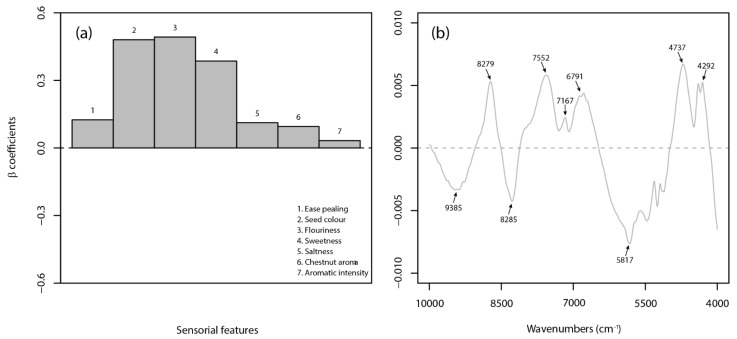
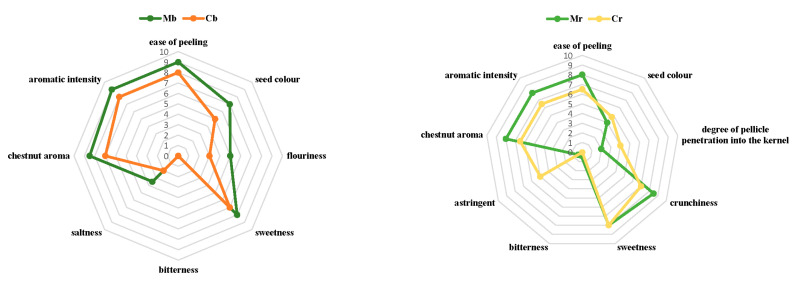
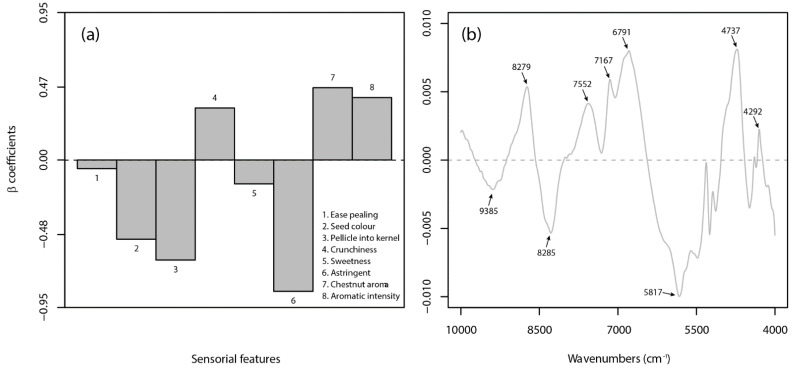
The world production of chestnuts has significantly grown in recent decades. Consumer attitudes, increasingly turned towards healthy foods, show a greater interest in chestnuts due to their health benefits. Consequently, it is important to develop reliable methods for the selection of high-quality products, both from a qualitative and sensory point of view. In this study, Castanea spp. fruits from Italy, namely Sweet chestnut cultivar and the Marrone cultivar, were evaluated by an official panel, and the responses for sensory attributes were used to verify the correlation to the near-infrared spectra. Data fusion strategies have been applied to take advantage of the synergistic effect of the information obtained from NIR and sensory analysis. Large nuts, easy pellicle removal, chestnut aroma, and aromatic intensity render Marrone cv fruits suitable for both the fresh market and candying, i.e., marron glacé. Whereas, sweet chestnut samples, due to their characteristics, have the potential to be used for secondary food products, such as jam, mash chestnut, and flour. The research lays the foundations for a superior data fusion approach for chestnut identification in terms of classification sensitivity and specificity, in which sensory and spectral approaches compensate each other's drawbacks, synergistically contributing to an excellent result.
近几十年来,全球栗子产量显著增长。消费者的态度越来越倾向于健康食品,由于栗子对健康有益,他们对栗子表现出更大的兴趣。因此,从质量和感官角度开发可靠的优质产品选择方法非常重要。在本研究中,意大利的栗属果实,即甜栗品种和马罗内品种,由一个官方小组进行评估,并将感官属性的反应用于验证与近红外光谱的相关性。已应用数据融合策略以利用从近红外和感官分析获得的信息的协同效应。大坚果、易于去除表皮、栗子香气和香气强度使马罗内品种的果实适合新鲜市场和糖渍,即糖渍栗子。而甜栗样品由于其特性,有可能用于二次食品,如果酱、栗子泥和面粉。该研究为一种卓越的数据融合方法奠定了基础,该方法在分类敏感性和特异性方面用于栗子识别,其中感官和光谱方法相互弥补对方的缺点,协同促成优异的结果。