Hemmendinger Maud, Sauvain Jean-Jacques, Hopf Nancy B, Wild Pascal, Suárez Guillaume, Guseva Canu Irina
Center for Primary Care and Public Health (Unisanté), Department of Occupational and Environmental Health, University of Lausanne, 1066 Lausanne, Switzerland.
National Research and Safety Institute (INRS), 54500 Vandœuvre-lès-Nancy, France.
Antioxidants (Basel). 2021 Oct 22;10(11):1661. doi: 10.3390/antiox10111661.
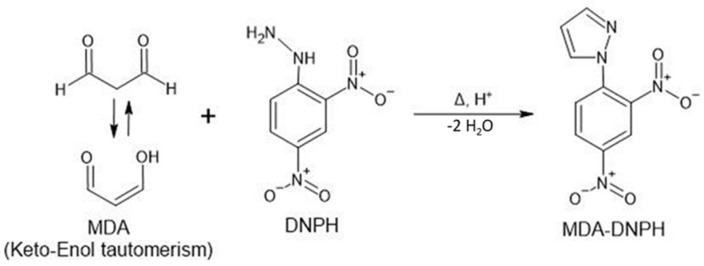
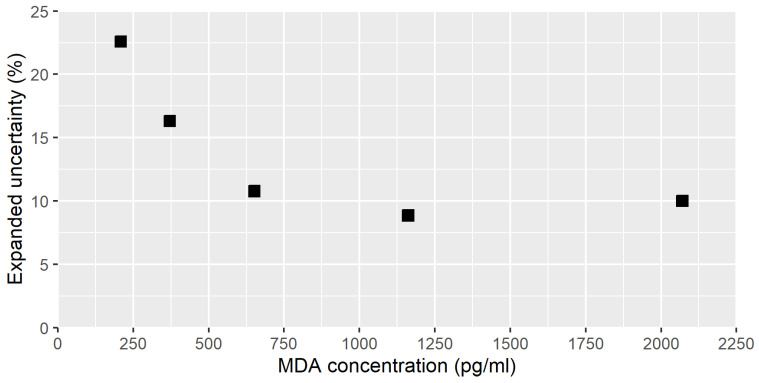
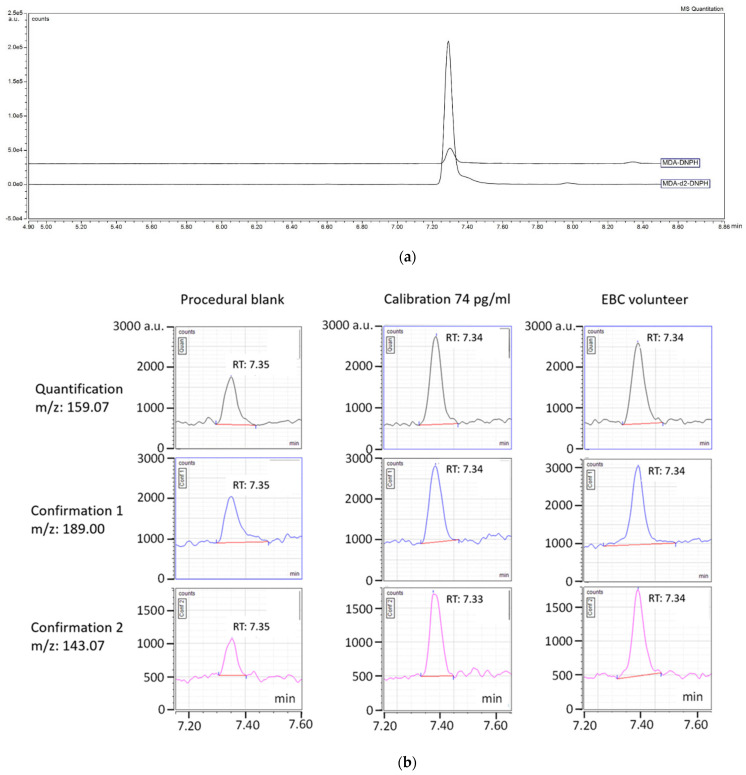
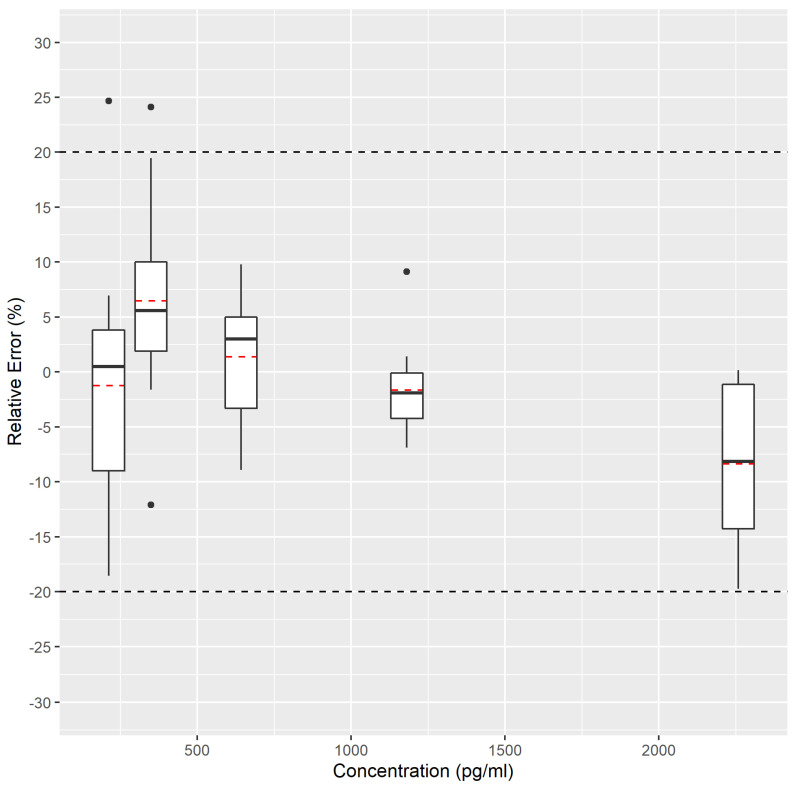
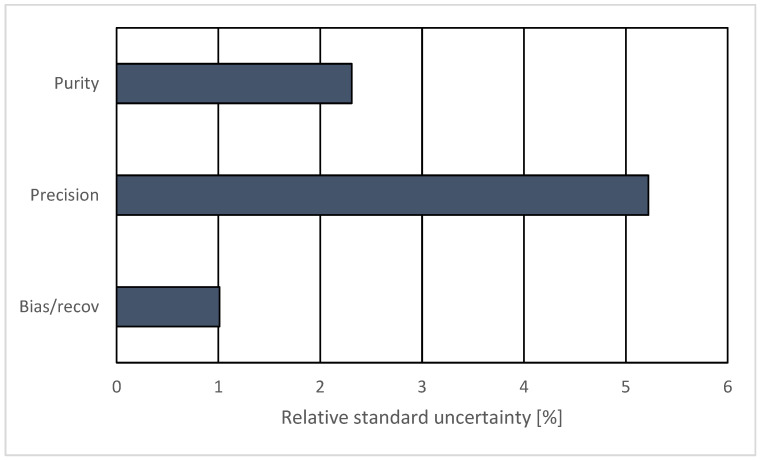
There are several methods for quantifying malondialdehyde (MDA), an oxidative stress biomarker, in exhaled breath condensate (EBC). However, due to the very diluted nature of this biological matrix, a high variability is observed at low concentrations. We aimed to optimize a 2,4-dinitrophenylhydrazine-based method using liquid chromatography coupled to tandem mass spectrometry and characterize the uncertainty associated with this method. We investigated the following parameters for the method validation: calibration linearity, limit of detection (LOD), precision, recovery, and matrix effect. The results were used to identify the main sources of uncertainty and calculating the combined uncertainty. The applicability of this method was evaluated in an ongoing epidemiological study by analyzing 164 EBC samples collected from different professional groups in subway environments. The optimized method was sensitive (LOD: 70 pg/mL), precise (inter-day variation < 19%) and accurate (recovery range: 92-106.5%). The calculated analytical uncertainty was the highest at the LOQ level and reached 23%. Although the analytical uncertainty was high at low MDA concentrations, it was significantly lower than that the observed inter-individual variability. Hence, this method performs sufficiently well and can be recommended for future use in epidemiological researches relying on between-subject differences.
有几种方法可用于定量呼出气体冷凝物(EBC)中的氧化应激生物标志物丙二醛(MDA)。然而,由于这种生物基质的性质非常稀释,在低浓度下会观察到高变异性。我们旨在优化一种基于2,4-二硝基苯肼的方法,该方法采用液相色谱-串联质谱联用,并表征与该方法相关的不确定度。我们研究了以下方法验证参数:校准线性、检测限(LOD)、精密度、回收率和基质效应。结果用于确定不确定度的主要来源并计算合成不确定度。通过分析从地铁环境中不同职业群体收集的164份EBC样本,在一项正在进行的流行病学研究中评估了该方法的适用性。优化后的方法灵敏(LOD:70 pg/mL)、精确(日间变化<19%)且准确(回收率范围:92-106.5%)。计算得到的分析不确定度在定量限(LOQ)水平最高,达到23%。尽管在低MDA浓度下分析不确定度较高,但明显低于观察到的个体间变异性。因此,该方法表现良好,可推荐用于未来依赖个体间差异的流行病学研究。