
应激和应激弹性下促肾上腺皮质激素释放因子的下丘脑调节。
Hypothalamic Regulation of Corticotropin-Releasing Factor under Stress and Stress Resilience.
机构信息
Department of Endocrinology and Metabolism, Hirosaki University Graduate School of Medicine, 5 Zaifu-cho, Hirosaki 036-8562, Aomori, Japan.
Department of Clinical Nutrition Management Nutrition Course, Faculty of Health Science, Suzuka University of Medical Science, 1001-1 Kishioka-cho, Suzuka 510-0293, Mie, Japan.
出版信息
Int J Mol Sci. 2021 Nov 12;22(22):12242. doi: 10.3390/ijms222212242.
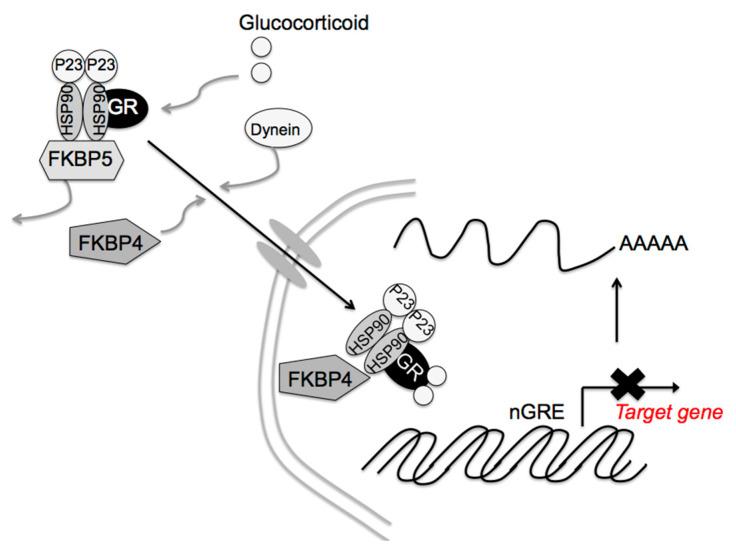
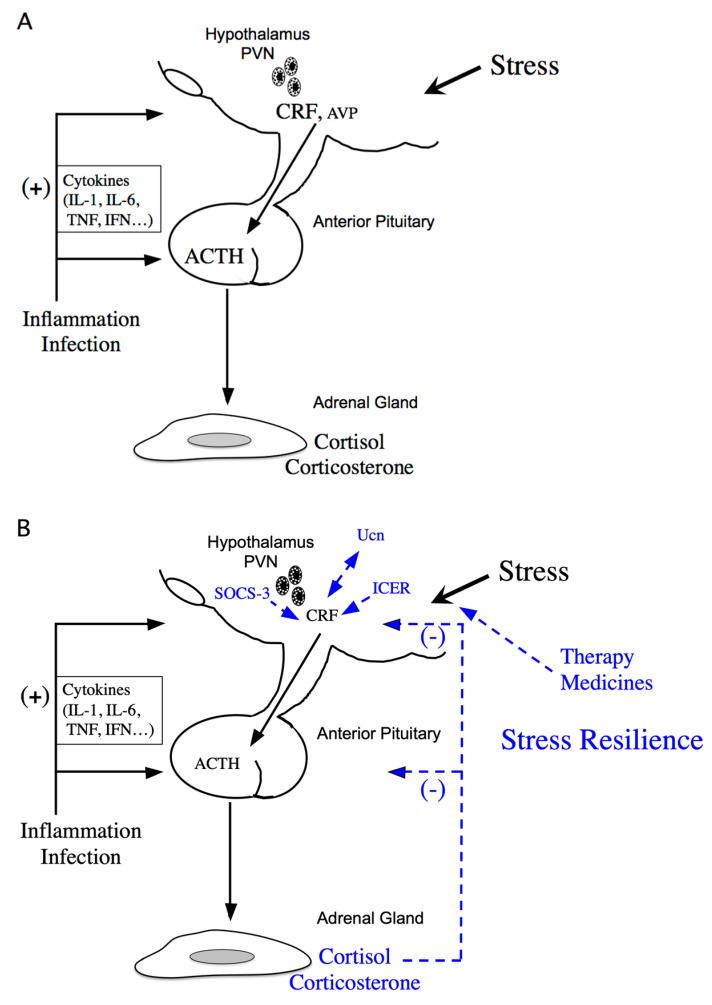
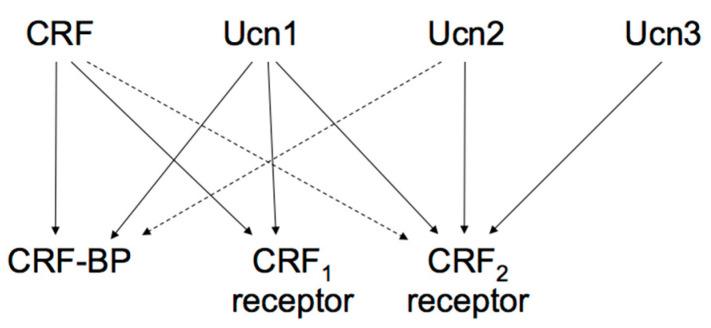
This review addresses the molecular mechanisms of corticotropin-releasing factor (CRF) regulation in the hypothalamus under stress and stress resilience. CRF in the hypothalamus plays a central role in regulating the stress response. CRF stimulates adrenocorticotropic hormone (ACTH) release from the anterior pituitary. ACTH stimulates glucocorticoid secretion from the adrenal glands. Glucocorticoids are essential for stress coping, stress resilience, and homeostasis. The activated hypothalamic-pituitary-adrenal axis is suppressed by the negative feedback from glucocorticoids. Glucocorticoid-dependent repression of cAMP-stimulated promoter activity is mediated by both the negative glucocorticoid response element and the serum response element. Conversely, the inducible cAMP-early repressor can suppress the stress response via inhibition of the cAMP-dependent gene, as can the suppressor of cytokine signaling-3 in the hypothalamus. CRF receptor type 1 is mainly involved in a stress response, depression, anorexia, and seizure, while CRF receptor type 2 mediates "stress coping" mechanisms such as anxiolysis in the brain. Differential effects of FK506-binding immunophilins, FKBP4 and FKBP5, contribute to the efficiency of glucocorticoids under stress resilience. Together, a variety of factors contribute to stress resilience. All these factors would have the differential roles under stress resilience.
这篇综述探讨了应激和应激弹性下下丘脑促肾上腺皮质激素释放因子(CRF)调节的分子机制。下丘脑的 CRF 在调节应激反应中起着核心作用。CRF 刺激垂体前叶释放促肾上腺皮质激素(ACTH)。ACTH 刺激肾上腺分泌糖皮质激素。糖皮质激素对于应对压力、具有应激弹性和维持体内平衡至关重要。激活的下丘脑-垂体-肾上腺轴受到糖皮质激素的负反馈抑制。糖皮质激素依赖性抑制 cAMP 刺激的启动子活性是由负糖皮质激素反应元件和血清反应元件介导的。相反,诱导型 cAMP-早期阻遏物可以通过抑制 cAMP 依赖性基因来抑制应激反应,下丘脑中的细胞因子信号转导抑制剂-3 也可以。CRF 受体 1 主要参与应激反应、抑郁、厌食和癫痫,而 CRF 受体 2 则介导大脑中的“应激应对”机制,如焦虑缓解。FK506 结合免疫亲和素 FKBP4 和 FKBP5 的差异效应有助于应激弹性下糖皮质激素的效率。综上所述,多种因素有助于应激弹性。所有这些因素在应激弹性下都具有不同的作用。

 Zotero 插件