Cell Therapy Production Unit, Neurology Unit, UCV, Neurological Institute "C. Besta" IRCCS Foundation, Via Celoria 11, 20133 Milan, Italy.
Int J Mol Sci. 2021 Nov 15;22(22):12339. doi: 10.3390/ijms222212339.
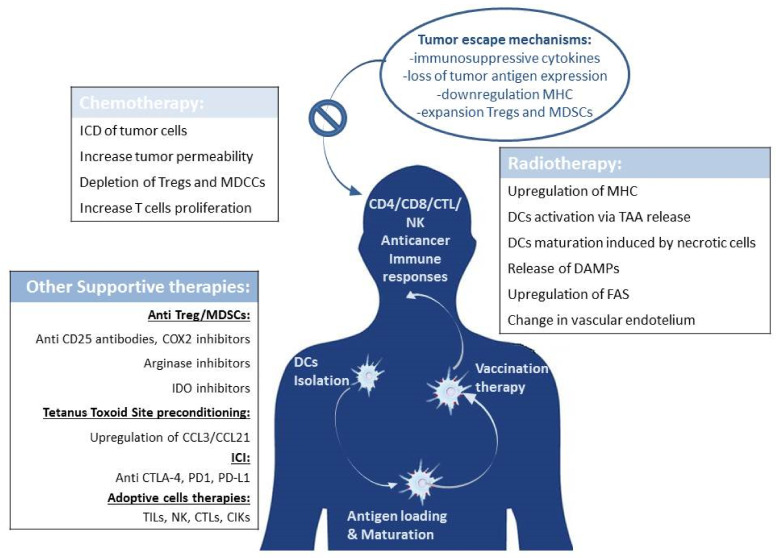
Dendritic cells (DCs) are immune specialized cells playing a critical role in promoting immune response against antigens, and may represent important targets for therapeutic interventions in cancer. DCs can be stimulated ex vivo with pro-inflammatory molecules and loaded with tumor-specific antigen(s). Protocols describing the specific details of DCs vaccination manufacturing vary widely, but regardless of the employed protocol, the DCs vaccination safety and its ability to induce antitumor responses is clearly established. Many years of studies have focused on the ability of DCs to provide overall survival benefits at least for a selection of cancer patients. Lessons learned from early trials lead to the hypothesis that, to improve the efficacy of DCs-based immunotherapy, this should be combined with other treatments. Thus, the vaccine's ultimate role may lie in the combinatorial approaches of DCs-based immunotherapy with chemotherapy and radiotherapy, more than in monotherapy. In this review, we address some key questions regarding the integration of DCs vaccination with multimodality therapy approaches for cancer treatment paradigms.
树突状细胞(DCs)是一种具有免疫特异性的细胞,在促进针对抗原的免疫反应方面发挥着关键作用,并且可能是癌症治疗干预的重要靶点。DCs 可以用促炎分子在体外刺激,并负载肿瘤特异性抗原(s)。描述 DC 疫苗接种制造具体细节的方案差异很大,但无论采用何种方案,DC 疫苗接种的安全性及其诱导抗肿瘤反应的能力都是明确的。多年的研究集中在 DC 提供整体生存益处的能力上,至少对一部分癌症患者是如此。从早期试验中吸取的经验教训导致了这样一种假设,即要提高基于 DC 的免疫疗法的疗效,应该将其与其他治疗方法相结合。因此,疫苗的最终作用可能在于将基于 DC 的免疫疗法与化疗和放疗的组合应用,而不仅仅是单一疗法。在这篇综述中,我们探讨了一些关于将 DC 疫苗接种与多模式治疗方法整合用于癌症治疗模式的关键问题。