Division of Nephrology, Clinical Hospital, Federal University of Pernambuco, Recife 50670-901, Brazil.
Laboratory of Immunopathology Keizo Asami (LIKA), Federal University of Pernambuco, Recife 50670-901, Brazil.
Int J Mol Sci. 2021 Nov 19;22(22):12476. doi: 10.3390/ijms222212476.
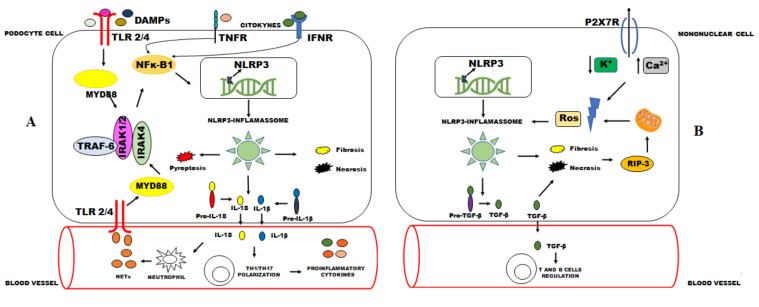
Lupus nephritis (LN) is the most frequent and severe of systemic lupus erythematosus (SLE) clinical manifestations and contributes to the increase of morbidity and mortality of patients due to chronic kidney disease. The NLRP3 (NLR pyrin domain containing 3) is a member of the NLR (NOD-like receptors), and its activation results in the production of pro-inflammatory cytokines, which can contribute to the pathogenesis of LN. In this review manuscript, we approach the relation between the NLRP3 inflammasome, SLE, and LN, highlighting the influence of genetic susceptibility of NLRP3 polymorphisms in the disease; the main functional studies using cellular and animal models of NLRP3 activation; and finally, some mechanisms of NLRP3 inhibition for the development of possible therapeutic drugs for LN.
狼疮性肾炎(LN)是系统性红斑狼疮(SLE)最常见和最严重的临床表现之一,由于慢性肾脏病的发生,导致患者的发病率和死亡率增加。NLRP3(NLR 含pyrin 结构域蛋白 3)是 NLR(NOD 样受体)的成员之一,其激活导致促炎细胞因子的产生,这可能有助于 LN 的发病机制。在这篇综述手稿中,我们探讨了 NLRP3 炎性小体、SLE 和 LN 之间的关系,强调了 NLRP3 多态性的遗传易感性对疾病的影响;使用 NLRP3 激活的细胞和动物模型进行的主要功能研究;最后,探讨了 NLRP3 抑制的一些机制,以期为 LN 开发潜在的治疗药物。