Boldt Andrew M, Di Sole Francesca
Physiology and Pharmacology Department, Des Moines University, Des Moines, IA, United States.
Front Physiol. 2025 Jun 3;16:1614438. doi: 10.3389/fphys.2025.1614438. eCollection 2025.
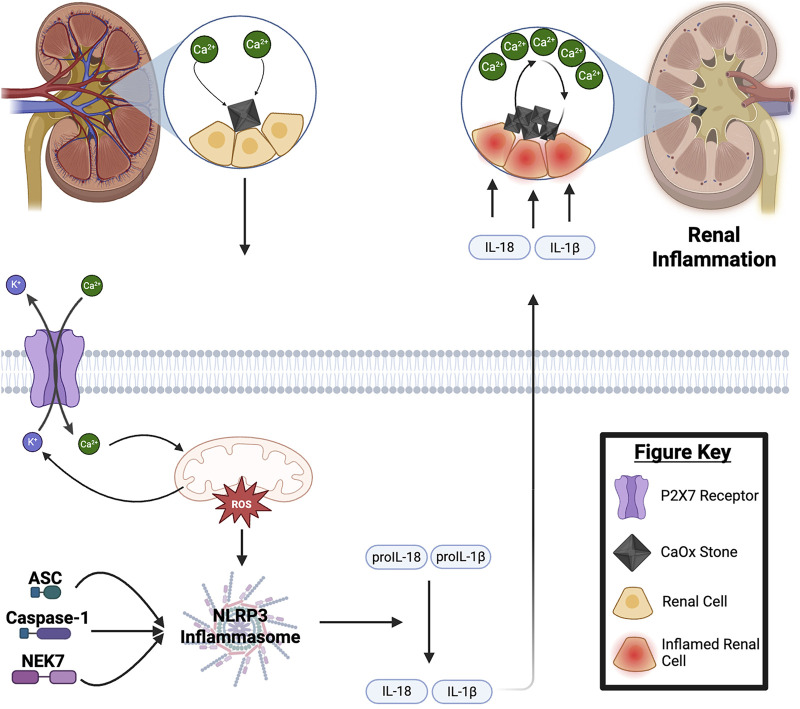
Kidney stone disease (nephrolithiasis) is a widespread condition affecting millions worldwide, with its prevalence rising due to dietary changes, obesity, and climate-related factors. The formation of kidney stones is driven by urinary solute supersaturation, metabolic abnormalities, and environmental influences. Calcium oxalate stones, the most common type, result from hypercalciuria, hyperoxaluria, and hypocitraturia, often exacerbated by high dietary protein intake and hormonal imbalances such as hyperparathyroidism. A significant complication of kidney stones is their association with chronic kidney disease (CKD). Recurrent stone formation contributes to renal scarring, urinary obstruction, and inflammation, ultimately leading to long-term kidney damage. This review explores the pivotal role of the NLRP3 inflammasome in kidney stone-related inflammation. Activated by calcium oxalate crystals and oxidative stress, NLRP3 triggers the release of pro-inflammatory cytokines (IL-1β and IL-18), exacerbating renal injury and fibrosis. Persistent NLRP3 activation is linked to CKD progression and an increased risk of end-stage renal disease. Emerging therapies targeting NLRP3 offer potential strategies to mitigate kidney stone-induced inflammation and CKD progression. Direct inhibitors such as MCC950 and CP-456773 block inflammasome activation, reducing inflammatory cytokine release. Indirect approaches, including atorvastatin and phenylbutyric acid, address oxidative stress and mitochondrial dysfunction to lower stone formation risk. While these treatments show promise in preclinical studies, further research is needed to validate their clinical efficacy. Future studies should focus on optimizing NLRP3-targeted therapies, assessing their long-term effects on kidney stone prevention and CKD progression. Combining NLRP3 inhibitors with antioxidants may enhance renal protection, providing new avenues for therapeutic intervention.
肾结石病(肾石症)是一种广泛存在的疾病,全球数以百万计的人受其影响,由于饮食变化、肥胖和气候相关因素,其患病率正在上升。肾结石的形成是由尿溶质过饱和、代谢异常和环境影响驱动的。草酸钙结石是最常见的类型,由高钙尿症、高草酸尿症和低枸橼酸尿症引起,高膳食蛋白质摄入和甲状旁腺功能亢进等激素失衡常常会加剧这些情况。肾结石的一个重要并发症是它们与慢性肾脏病(CKD)的关联。复发性结石形成会导致肾瘢痕形成、尿路梗阻和炎症,最终导致长期肾脏损害。本综述探讨了NLRP3炎性小体在肾结石相关炎症中的关键作用。NLRP3由草酸钙晶体和氧化应激激活,触发促炎细胞因子(IL-1β和IL-18)的释放,加剧肾损伤和纤维化。持续的NLRP3激活与CKD进展和终末期肾病风险增加有关。针对NLRP3的新兴疗法提供了减轻肾结石诱导的炎症和CKD进展的潜在策略。直接抑制剂如MCC950和CP-456773可阻断炎性小体激活,减少炎性细胞因子释放。间接方法,包括阿托伐他汀和苯丁酸,可解决氧化应激和线粒体功能障碍问题,以降低结石形成风险。虽然这些治疗在临床前研究中显示出前景,但需要进一步研究来验证其临床疗效。未来的研究应侧重于优化针对NLRP3的疗法,评估它们对肾结石预防和CKD进展的长期影响。将NLRP3抑制剂与抗氧化剂联合使用可能会增强肾脏保护作用,为治疗干预提供新途径。