Kim Hyeon Jin, Lee Han Na, Jeong Mi Suk, Jang Se Bok
Department of Molecular Biology, College of Natural Sciences, Pusan National University, Jangjeon-dong, Geumjeong-gu, Busan 46241, Korea.
Institute for Plastic Information and Energy Materials and Sustainable Utilization of Photovoltaic Energy Research Center, Pusan National University, Jangjeon-dong, Geumjeong-gu, Busan 46241, Korea.
Cancers (Basel). 2021 Nov 9;13(22):5599. doi: 10.3390/cancers13225599.
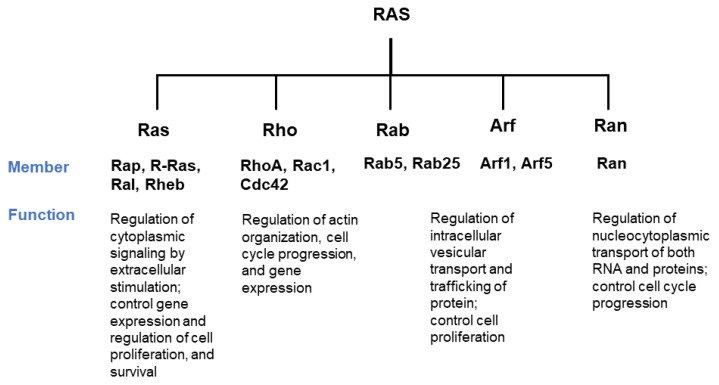
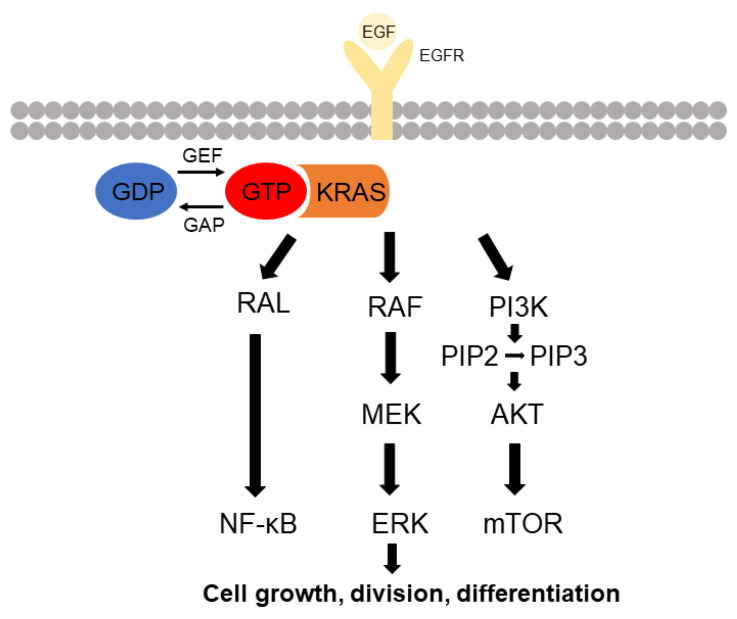
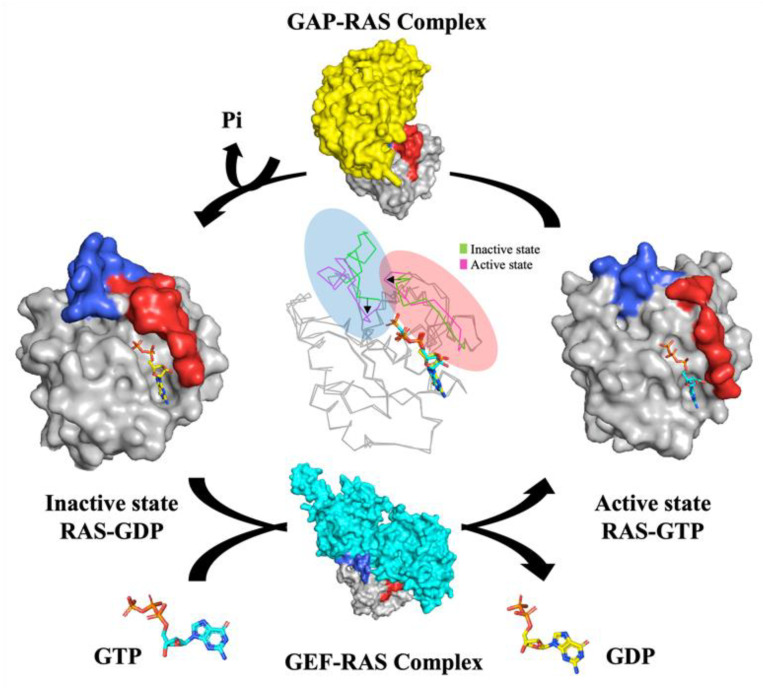
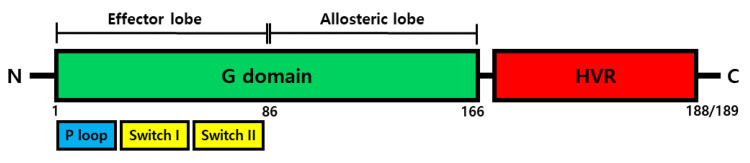
RAS proteins play a role in many physiological signals transduction processes, including cell growth, division, and survival. The Ras protein has amino acids 188-189 and functions as GTPase. These proteins are switch molecules that cycle between inactive GDP-bound and active GTP-bound by guanine nucleotide exchange factors (GEFs). KRAS is one of the Ras superfamily isoforms (N-RAS, H-RAS, and K-RAS) that frequently mutate in cancer. The mutation of KRAS is essentially performing the transformation in humans. Since most RAS proteins belong to GTPase, mutated and GTP-bound active RAS is found in many cancers. Despite KRAS being an important molecule in mostly human cancer, including pancreatic and breast, numerous efforts in years past have persisted in cancer therapy targeting KRAS mutant. This review summarizes the biological characteristics of these proteins and the recent progress in the exploration of KRAS-targeted anticancer, leading to new insight.
RAS蛋白在许多生理信号转导过程中发挥作用,包括细胞生长、分裂和存活。Ras蛋白含有188 - 189个氨基酸,作为GTP酶发挥作用。这些蛋白质是开关分子,通过鸟嘌呤核苷酸交换因子(GEF)在无活性的GDP结合形式和活性的GTP结合形式之间循环。KRAS是Ras超家族异构体(N-RAS、H-RAS和K-RAS)之一,在癌症中经常发生突变。KRAS的突变在人类中基本上起着转化作用。由于大多数RAS蛋白属于GTP酶,在许多癌症中都发现了突变的且与GTP结合的活性RAS。尽管KRAS在大多数人类癌症(包括胰腺癌和乳腺癌)中是一个重要分子,但过去多年来针对KRAS突变体的癌症治疗仍在持续进行大量研究。本综述总结了这些蛋白质的生物学特性以及KRAS靶向抗癌研究的最新进展,从而带来新的见解。