Mörchen Britta, Shkura Oleksandr, Stoll Raphael, Helfrich Iris
Skin Cancer Unit of the Dermatology Department, Medical Faculty, University Duisburg-Essen, West German Cancer Center, Essen 45147, Germany.
German Cancer Consortium (DKTK) partner site Düsseldorf/Essen, Essen 45147, Germany.
Cancer Drug Resist. 2019 Sep 19;2(3):813-826. doi: 10.20517/cdr.2019.21. eCollection 2019.
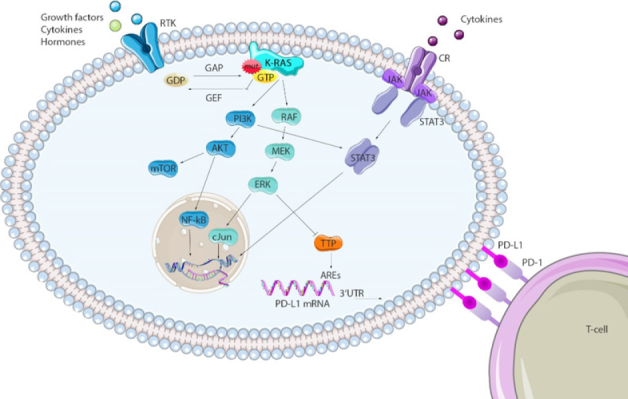
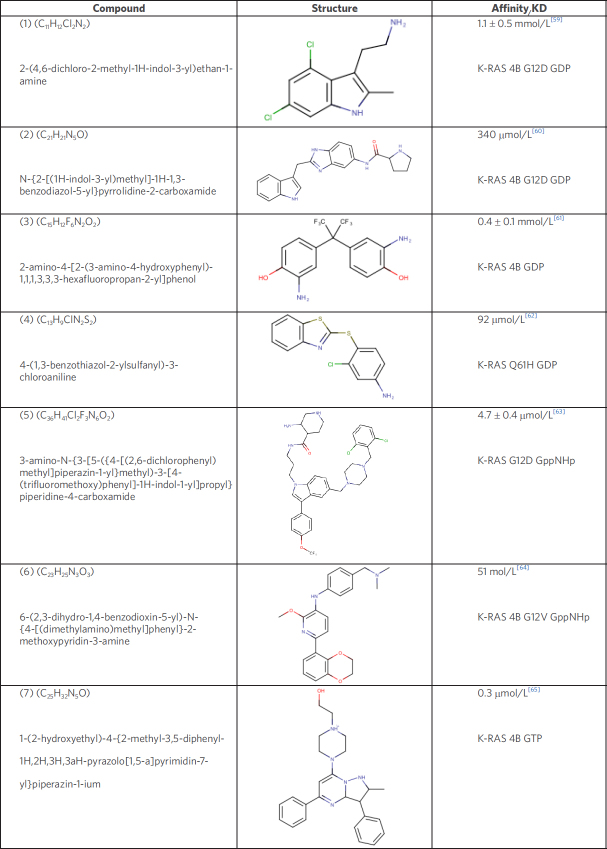
is the most frequently mutated oncogene in solid tumors, such as pancreatic, colon or lung cancer. The GTPase K-RAS can either be in an active (GTP-loaded) or inactive (GDP-loaded) form. In its active form K-RAS forwards signals from growth factors, cytokines or hormones to the nucleus, regulating essential pathways, such as cell proliferation and differentiation. In turn, activating somatic mutations of this proto-oncogene deregulate the complex interplay between GAP (GTPase-activating) - and GEF (Guanine nucleotide exchange factor) - proteins, driving neoplastic transformation. Due to a rather shallow surface, K-RAS lacks proper binding pockets for small molecules, hindering drug development over the past thirty years. This review summarizes recent progress in the development of low molecular antagonists and further shows insights of a newly described interaction between mutant K-RAS signaling and PD-L1 induced immunosuppression, giving new hope for future treatments of mutated cancer.
是实体瘤中最常发生突变的致癌基因,如胰腺癌、结肠癌或肺癌。GTP酶K-RAS可以处于活性(结合GTP)或非活性(结合GDP)形式。处于活性形式的K-RAS将来自生长因子、细胞因子或激素的信号传递至细胞核,调节细胞增殖和分化等重要途径。反过来,该原癌基因的激活体细胞突变会破坏GAP(GTP酶激活)蛋白和GEF(鸟嘌呤核苷酸交换因子)蛋白之间的复杂相互作用,驱动肿瘤转化。由于表面相当平坦,K-RAS缺乏适合小分子的结合口袋,在过去三十年中阻碍了药物开发。本综述总结了低分子拮抗剂开发的最新进展,并进一步展示了突变型K-RAS信号传导与PD-L1诱导的免疫抑制之间新描述的相互作用的见解,为未来治疗突变癌症带来了新希望。