Pinto Lia, Baidarjad Hanane, Entz-Werlé Natacha, Van Dyck Eric
DNA Repair and Chemoresistance, Department of Oncology, Luxembourg Institute of Health, L-1526 Luxembourg, Luxembourg.
Faculty of Science, Technology and Medicine, University of Luxembourg, L-4365 Luxembourg, Luxembourg.
Cancers (Basel). 2021 Nov 12;13(22):5678. doi: 10.3390/cancers13225678.
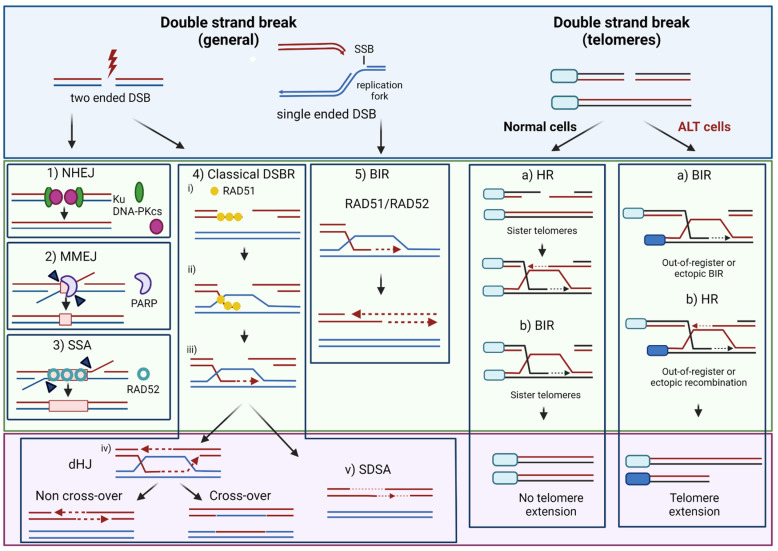
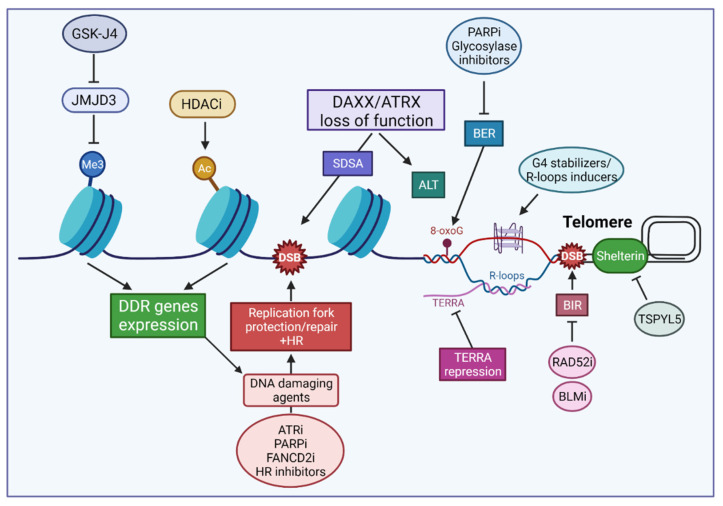
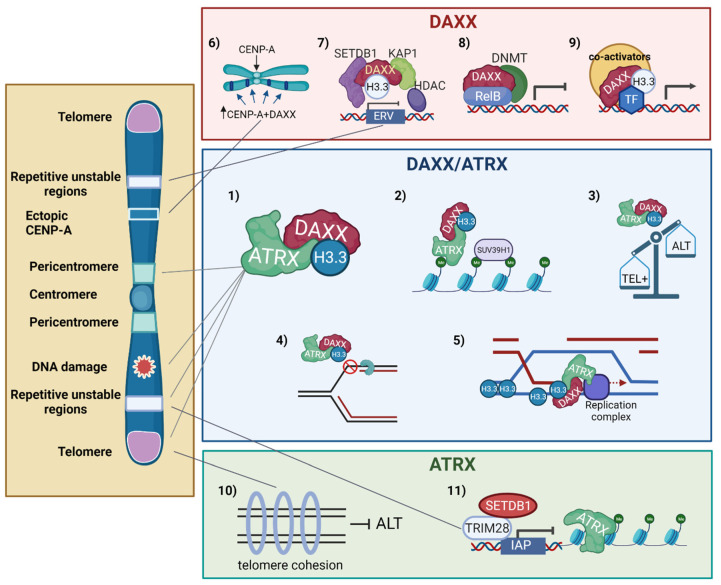
Despite their low incidence, pediatric high-grade gliomas (pHGGs), including diffuse intrinsic pontine gliomas (DIPGs), are the leading cause of mortality in pediatric neuro-oncology. Recurrent, mutually exclusive mutations affecting K27 (K27M) and G34 (G34R/V) in the N-terminal tail of histones H3.3 and H3.1 act as key biological drivers of pHGGs. Notably, mutations in H3.3 are frequently associated with mutations affecting and DAXX, which encode a chaperone complex that deposits H3.3 into heterochromatic regions, including telomeres. The K27M and G34R/V mutations lead to distinct epigenetic reprogramming, telomere maintenance mechanisms, and oncogenesis scenarios, resulting in distinct subgroups of patients characterized by differences in tumor localization, clinical outcome, as well as concurrent epigenetic and genetic alterations. Contrasting with our understanding of the molecular biology of pHGGs, there has been little improvement in the treatment of pHGGs, with the current mainstays of therapy-genotoxic chemotherapy and ionizing radiation (IR)-facing the development of tumor resistance driven by complex DNA repair pathways. Chromatin and nucleosome dynamics constitute important modulators of the DNA damage response (DDR). Here, we summarize the major DNA repair pathways that contribute to resistance to current DNA damaging agent-based therapeutic strategies and describe the telomere maintenance mechanisms encountered in pHGGs. We then review the functions of H3.3 and its chaperones in chromatin dynamics and DNA repair, as well as examining the impact of their mutation/alteration on these processes. Finally, we discuss potential strategies targeting DNA repair and epigenetic mechanisms as well as telomere maintenance mechanisms, to improve the treatment of pHGGs.
尽管儿童高级别胶质瘤(pHGGs),包括弥漫性脑桥内在型胶质瘤(DIPGs)的发病率较低,但却是儿童神经肿瘤学中死亡的主要原因。影响组蛋白H3.3和H3.1 N端尾巴中K27(K27M)和G34(G34R/V)的复发性、相互排斥的突变是pHGGs的关键生物学驱动因素。值得注意的是,H3.3中的突变通常与影响 和DAXX的突变相关,DAXX编码一种伴侣复合体,该复合体将H3.3沉积到包括端粒在内的异染色质区域。K27M和G34R/V突变导致不同的表观遗传重编程、端粒维持机制和肿瘤发生情况,从而产生不同的患者亚组,其特征在于肿瘤定位、临床结果以及同时存在的表观遗传和基因改变方面的差异。与我们对pHGGs分子生物学的理解形成对比的是,pHGGs的治疗几乎没有改善,目前的主要治疗方法——基因毒性化疗和电离辐射(IR)——面临着由复杂的DNA修复途径驱动的肿瘤耐药性的发展。染色质和核小体动力学构成了DNA损伤反应(DDR)的重要调节因子。在这里,我们总结了导致对当前基于DNA损伤剂的治疗策略产生耐药性的主要DNA修复途径,并描述了pHGGs中遇到的端粒维持机制。然后,我们回顾了H3.3及其伴侣在染色质动力学和DNA修复中的功能,并研究了它们的突变/改变对这些过程的影响。最后,我们讨论了针对DNA修复和表观遗传机制以及端粒维持机制的潜在策略,以改善pHGGs的治疗。