Department of Orthopaedic and Trauma Surgery, Campus Bio-Medico University, 00128 Rome, Italy.
1st Orthopedic Division, Department of Translational Research and New Technologies in Medicine and Surgery, University of Pisa, 56126 Pisa, Italy.
Int J Environ Res Public Health. 2021 Nov 16;18(22):12026. doi: 10.3390/ijerph182212026.
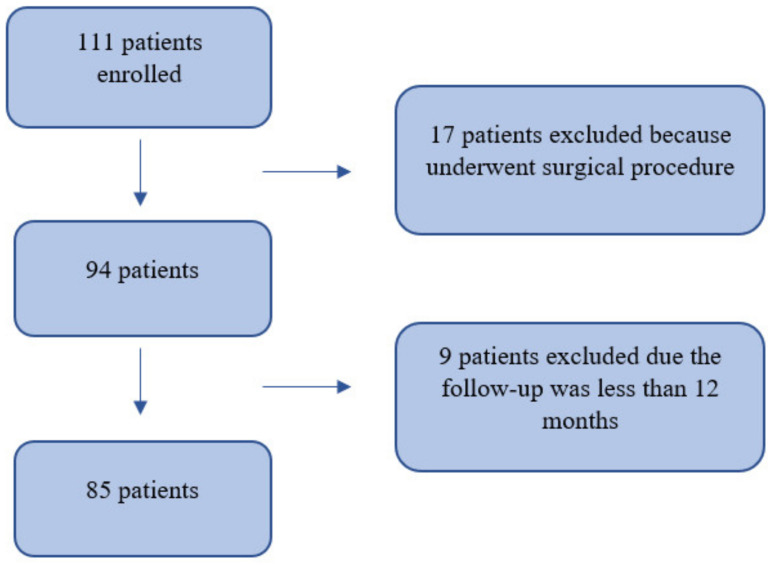
The first purpose of this study was to verify the association between Instability Severity Index Score (ISIS) and Recurrent Shoulder Dislocation (RSD) after a first episode treated conservatively. The second aim is to identify the risk factors associated with RSD after a primary acute shoulder anterior dislocation treated conservatively. A total of 111 patients with first traumatic anterior shoulder dislocation treated at a single trauma centre between January 2014 and March 2016 were enrolled. The main predictive variables of risk factors and the ISIS score were calculated. Among the 85 patients included, 26 cases of RSD were observed (30.6%). Considering the whole population, no significant association between ISIS and RSD were reported. Regarding other risk factors, high-risk working activities and rotator cuff injury had a significantly higher RSD risk. Sex, dominant limb, familiar history, hyperlaxity, contact or overhead sports, competitive sport, post-reduction physiokinesitherapy, return to sports activity time, Hill-Sachs lesion, bony Bankart lesion and great tuberosity fracture did not seem to influence the risk of RSD. No correlation between ISIS score and RSD in patients treated conservatively after a first episode of shoulder dislocation were reported. The only risk factors with a significant association to RSD were high-risk working activities and rotator cuff injury.
本研究的首要目的是验证初次保守治疗后不稳定严重程度指数评分(ISIS)与复发性肩关节脱位(RSD)之间的关联。第二个目的是确定初次急性肩关节前脱位经保守治疗后与 RSD 相关的危险因素。共纳入 2014 年 1 月至 2016 年 3 月在一家创伤中心接受初次创伤性前肩脱位治疗的 111 例患者。计算了主要预测变量和 ISIS 评分的危险因素。在纳入的 85 例患者中,观察到 26 例 RSD(30.6%)。考虑到整个人群,ISIS 与 RSD 之间无显著相关性。对于其他危险因素,高风险工作活动和肩袖损伤的 RSD 风险显著增加。性别、优势肢体、家族史、过度松弛、接触性或过头运动、竞技运动、复位后物理治疗、重返运动时间、Hill-Sachs 损伤、骨 Bankart 损伤和大结节骨折似乎并不影响 RSD 的风险。未报告初次肩部脱位后保守治疗患者的 ISIS 评分与 RSD 之间存在相关性。与 RSD 显著相关的唯一危险因素是高风险工作活动和肩袖损伤。