Mülner Pascal, Schwarz Elisa, Dietel Kristin, Herfort Stefanie, Jähne Jennifer, Lasch Peter, Cernava Tomislav, Berg Gabriele, Vater Joachim
ABITEP GmbH, Glienicker Weg 185, 12489 Berlin, Germany.
Institute of Environmental Biotechnology, Graz University of Technology, Petergasse 12, 8010 Graz, Austria.
Pathogens. 2021 Nov 15;10(11):1485. doi: 10.3390/pathogens10111485.
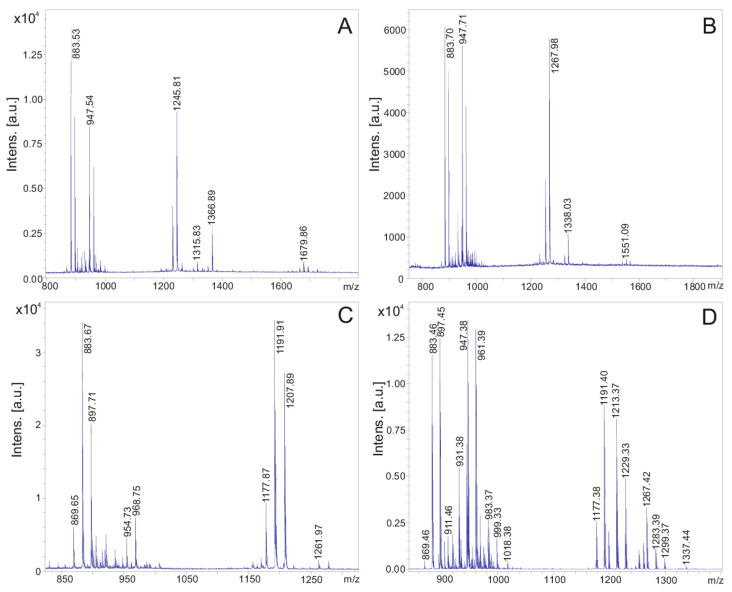
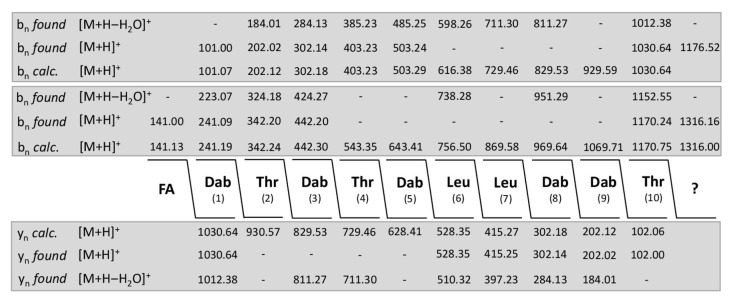
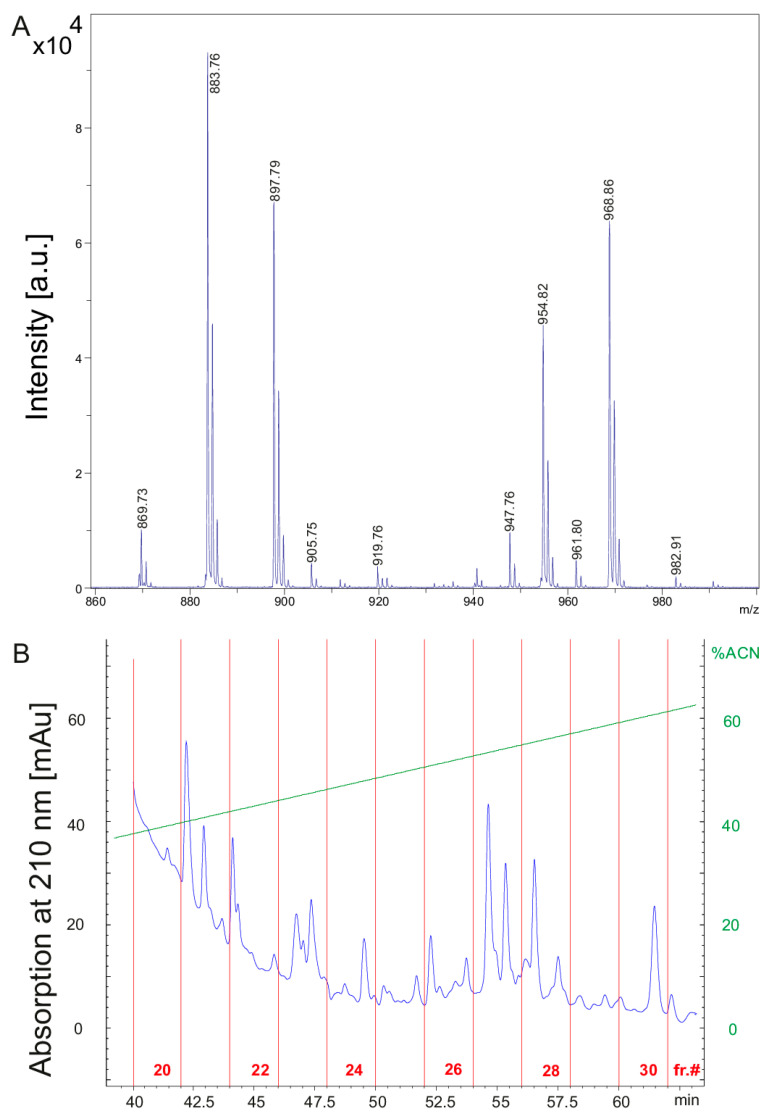
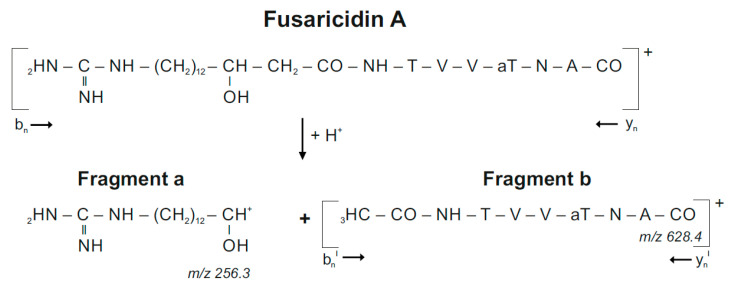
are efficient producers of potent agents against bacterial and fungal pathogens, which are of great interest both for therapeutic applications in medicine as well as in agrobiotechnology. Lipopeptides produced by such organisms play a major role in their potential to inactivate pathogens. In this work we investigated two lipopeptide complexes, the fusaricidins and the polymyxins, produced by strains DSM 32871 and M1 by MALDI-TOF mass spectrometry. The fusaricidins show potent antifungal activities and are distinguished by an unusual variability. For strain DSM 32871 we identified numerous yet unknown variants mass spectrometrically. DSM 32871 produces polymyxins of type E (colistins), while M1 forms polymyxins P. For both strains, novel but not yet completely characterized polymyxin species were detected, which possibly are glycosylated. These compounds may be of interest therapeutically, because polymyxins have gained increasing attention as last-resort antibiotics against multiresistant pathogenic Gram-negative bacteria. In addition, the volatilomes of DSM 32781 and M1 were investigated with a GC-MS approach using different cultivation media. Production of volatile organic compounds (VOCs) was strain and medium dependent. In particular, strain M1 manifested as an efficient VOC-producer that exhibited formation of 25 volatiles in total. A characteristic feature of is the formation of volatile pyrazine derivatives.
它们是针对细菌和真菌病原体的强效药物的高效生产者,这在医学治疗应用以及农业生物技术中都具有重大意义。此类生物产生的脂肽在其使病原体失活的潜力中发挥着主要作用。在这项工作中,我们通过基质辅助激光解吸电离飞行时间质谱法(MALDI-TOF)研究了由DSM 32871菌株和M1菌株产生的两种脂肽复合物,即镰孢菌素和多粘菌素。镰孢菌素显示出强大的抗真菌活性,并且具有不寻常的变异性。对于DSM 32871菌株,我们通过质谱鉴定出了许多未知变体。DSM 32871产生E型多粘菌素(粘菌素),而M1产生P型多粘菌素。对于这两种菌株,都检测到了新型但尚未完全表征的多粘菌素种类,它们可能是糖基化的。这些化合物在治疗方面可能具有重要意义,因为多粘菌素作为针对多重耐药革兰氏阴性病原菌的最后手段抗生素,越来越受到关注。此外,我们使用不同的培养基,通过气相色谱-质谱联用(GC-MS)方法研究了DSM 32781和M1的挥发物组。挥发性有机化合物(VOCs)的产生取决于菌株和培养基。特别是,M1菌株表现为一种高效的VOC生产者,总共表现出25种挥发物的形成。其一个特征是挥发性吡嗪衍生物的形成。