Georgoutsou-Spyridonos Maria, Filippidou Myrto, Kaprou Georgia D, Mastellos Dimitrios C, Chatzandroulis Stavros, Tserepi Angeliki
Institute of Nanoscience and Nanotechnology, NCSR-Demokritos, Patriarchou Gregoriou E' and 27 Neapoleos Str., Aghia Paraskevi, Attiki, 15341 Athens, Greece.
Institute of Nuclear & Radiological Sciences and Technology, Energy & Safety, NCSR-Demokritos, Patriarchou Gregoriou E' and 27 Neapoleos Str., Aghia Paraskevi, Attiki, 15341 Athens, Greece.
Micromachines (Basel). 2021 Nov 12;12(11):1387. doi: 10.3390/mi12111387.
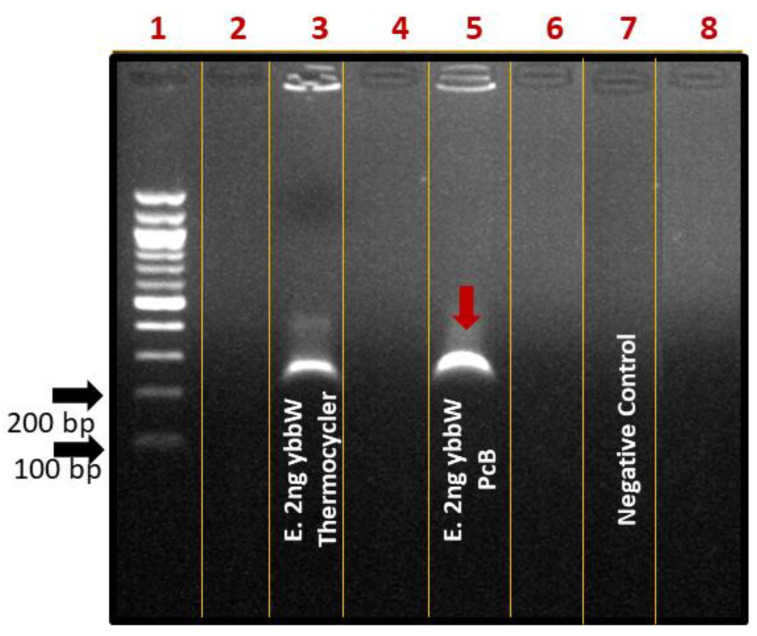
Printed circuit board (PCB) technology has been recently proposed as a convenient platform for seamlessly integrating electronics and microfluidics in the same substrate, thus facilitating the introduction of integrated and low-cost microfluidic devices to the market, thanks to the inherent upscaling potential of the PCB industry. Herein, a microfluidic chip, encompassing on PCB both a meandering microchannel and microheaters to accommodate recombinase polymerase amplification (RPA), is designed and commercially fabricated for the first time on PCB. The developed microchip is validated for RPA-based amplification of two target genes compared to a conventional thermocycler. The RPA performance of the PCB microchip was found to be well-comparable to that of a thermocycler yet with a remarkably lower power consumption (0.6 W). This microchip is intended for seamless integration with biosensors in the same PCB substrate for the development of a point-of-care (POC) molecular diagnostics platform.
印刷电路板(PCB)技术最近被提议作为一个便捷平台,用于在同一基板上无缝集成电子器件和微流体,从而借助PCB行业固有的扩大生产规模的潜力,推动集成且低成本的微流体装置进入市场。在此,首次设计并在商业上制造了一种微流体芯片,该芯片在印刷电路板上同时包含一个蜿蜒的微通道和微加热器,以进行重组酶聚合酶扩增(RPA)。与传统热循环仪相比,所开发的微芯片针对基于RPA的两个靶基因扩增进行了验证。发现印刷电路板微芯片的RPA性能与热循环仪相当,但功耗显著更低(0.6瓦)。该微芯片旨在与同一印刷电路板基板上的生物传感器无缝集成,以开发即时护理(POC)分子诊断平台。