Buškus Kazimieras, Vaičiukynas Evaldas, Verikas Antanas, Medelytė Saulė, Šiaulys Andrius, Šaškov Aleksej
Faculty of Mathematics and Natural Sciences, Kaunas University of Technology, Studentu 50, LT-51368 Kaunas, Lithuania.
Faculty of Informatics, Kaunas University of Technology, Studentu 50, LT-51368 Kaunas, Lithuania.
Sensors (Basel). 2021 Nov 16;21(22):7598. doi: 10.3390/s21227598.
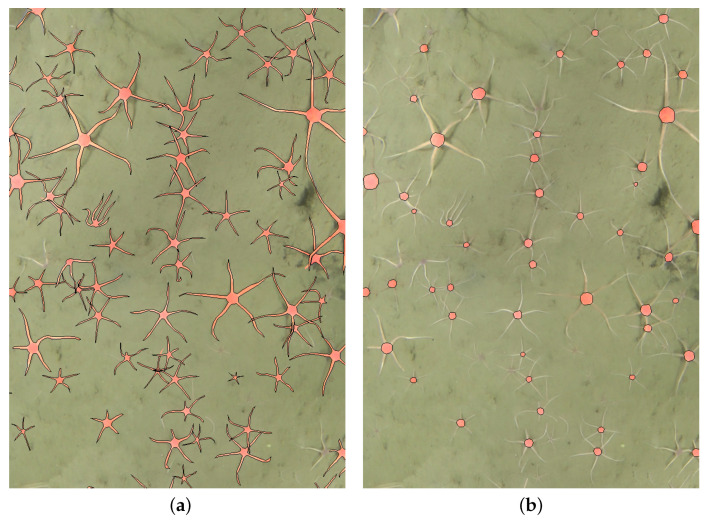
Underwater video surveys play a significant role in marine benthic research. Usually, surveys are filmed in transects, which are stitched into 2D mosaic maps for further analysis. Due to the massive amount of video data and time-consuming analysis, the need for automatic image segmentation and quantitative evaluation arises. This paper investigates such techniques on annotated mosaic maps containing hundreds of instances of brittle stars. By harnessing a deep convolutional neural network with pre-trained weights and post-processing results with a common blob detection technique, we investigate the effectiveness and potential of such segment-and-count approach by assessing the segmentation and counting success. Discs could be recommended instead of full shape masks for brittle stars due to faster annotation among marker variants tested. Underwater image enhancement techniques could not improve segmentation results noticeably, but some might be useful for augmentation purposes.
水下视频调查在海洋底栖生物研究中发挥着重要作用。通常,调查是在样带中拍摄的,这些样带会拼接成二维镶嵌图以便进一步分析。由于视频数据量巨大且分析耗时,因此产生了对自动图像分割和定量评估的需求。本文针对包含数百个蛇尾实例的带注释镶嵌图研究此类技术。通过利用具有预训练权重的深度卷积神经网络,并使用常见的斑点检测技术对后处理结果进行处理,我们通过评估分割和计数成功率来研究这种分割与计数方法的有效性和潜力。由于在测试的标记变体中注释速度更快,对于蛇尾而言,圆盘可能比完整形状掩码更值得推荐。水下图像增强技术并不能显著改善分割结果,但有些技术可能对增强目的有用。