Consejo Alejandra, Fathy Arwa, Lopes Bernardo T, Ambrósio Renato, Abass Ahmed
Department of Applied Physics, University of Zaragoza, 50009 Zaragoza, Spain.
Institute of Physical Chemistry, Polish Academy of Sciences, 01-224 Warsaw, Poland.
Sensors (Basel). 2021 Nov 17;21(22):7636. doi: 10.3390/s21227636.
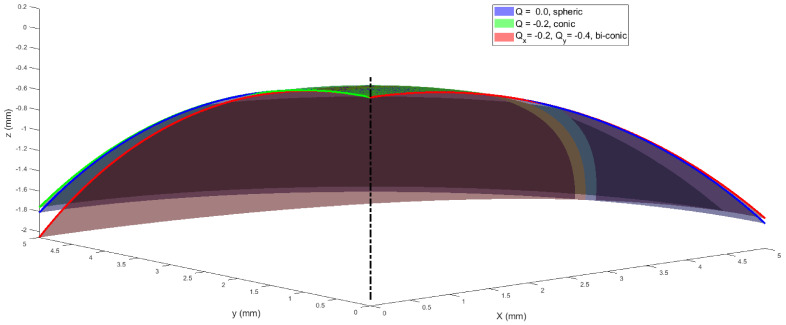
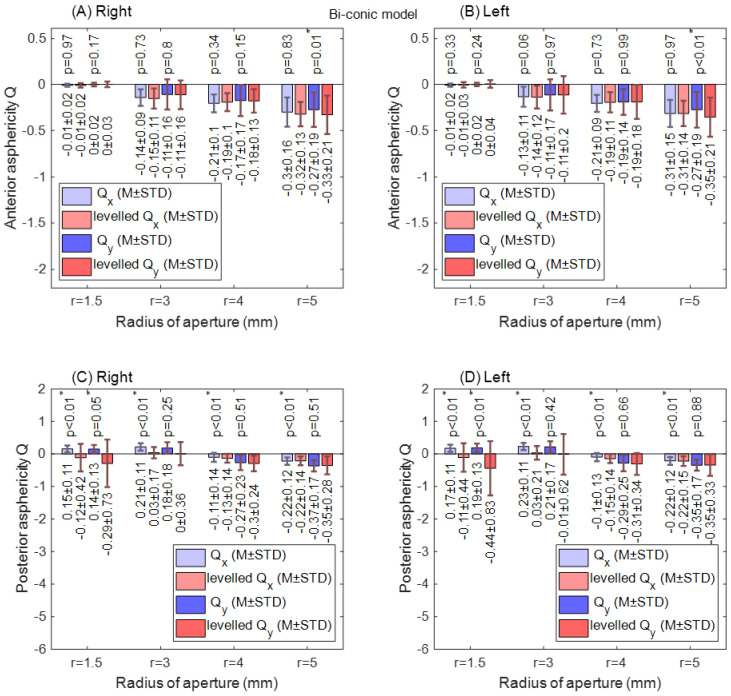
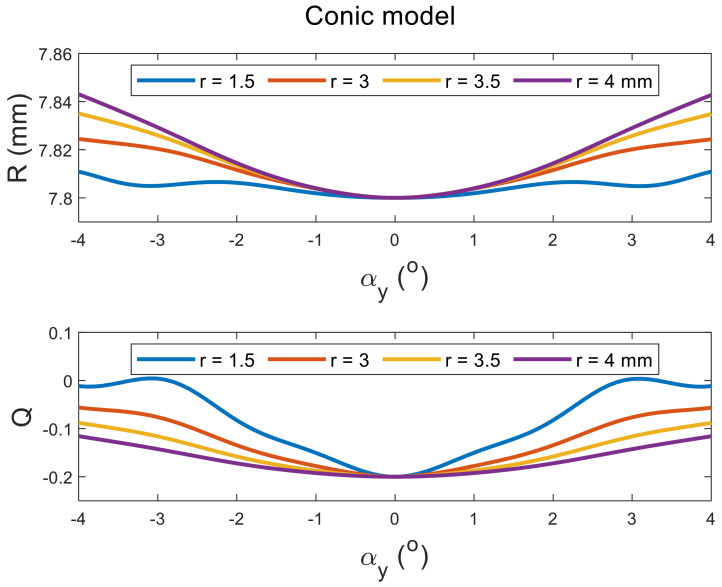
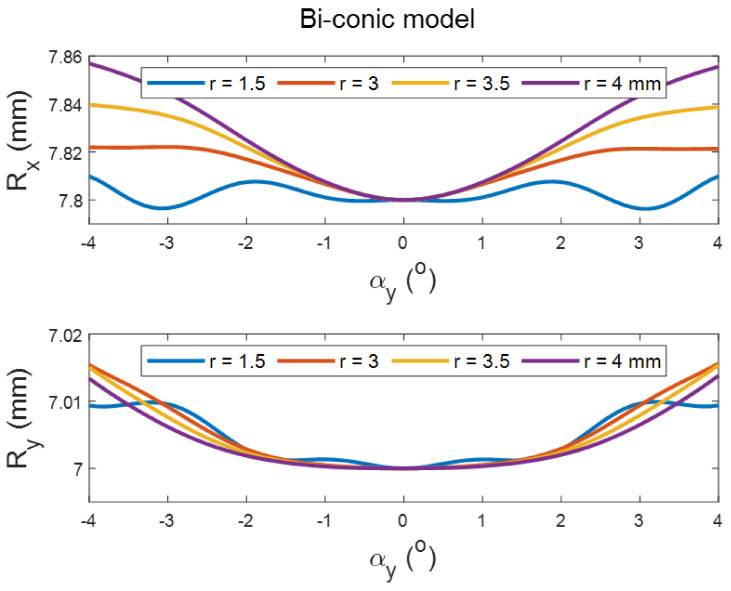
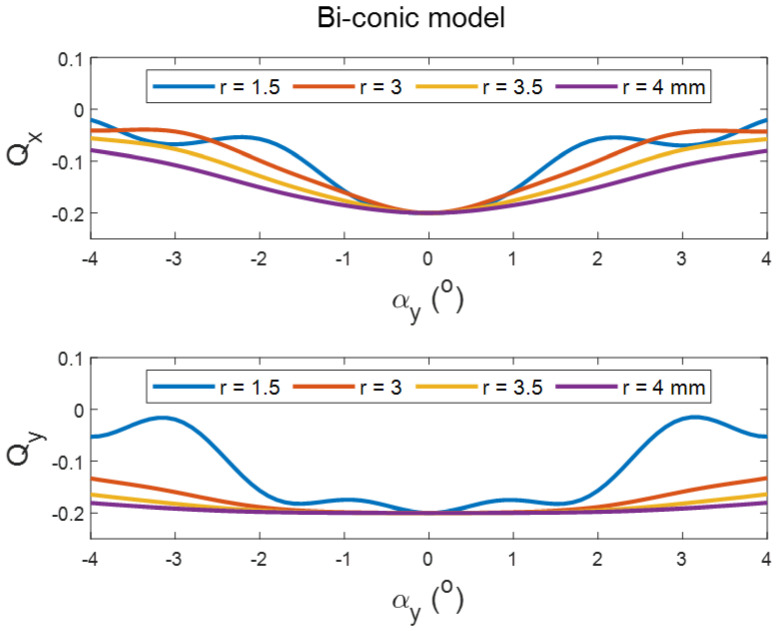
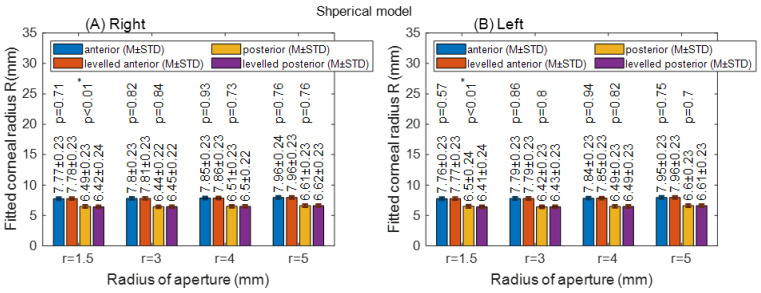
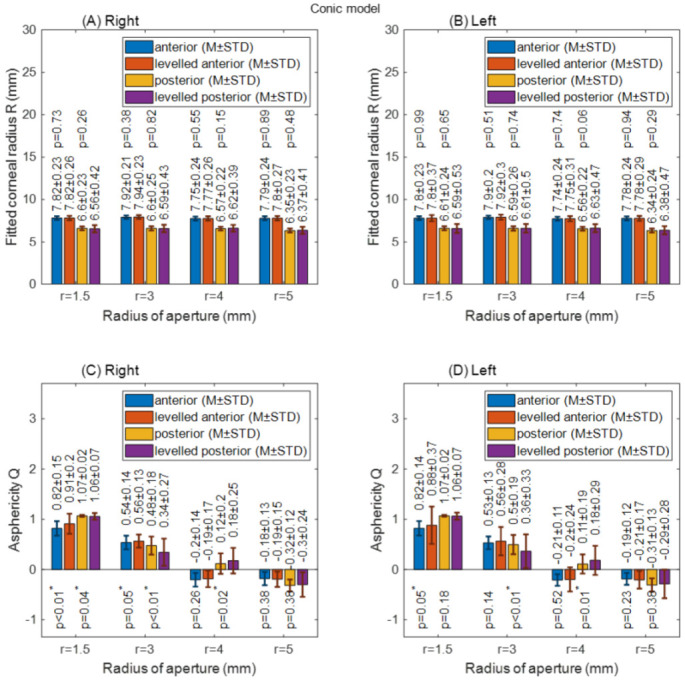
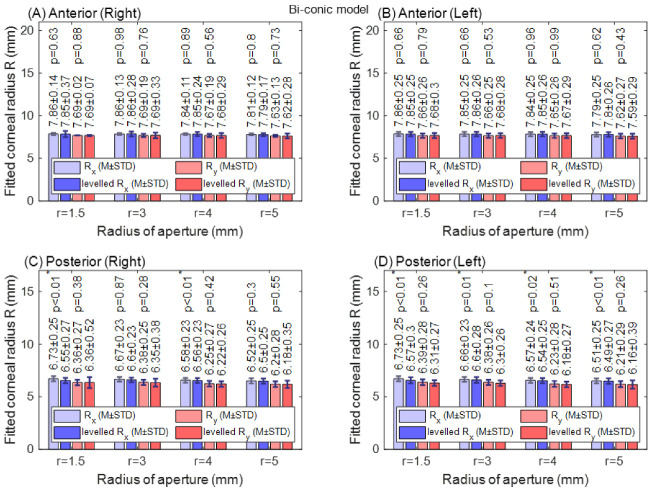
To quantify the effect of levelling the corneal surface around the optical axis on the calculated values of corneal asphericity when conic and biconic models are used to fit the anterior corneal surface. This cross-sectional study starts with a mathematical simulation proving the concept of the effect that the eye's tilt has on the corneal asphericity calculation. Spherical, conic and biconic models are considered and compared. Further, corneal asphericity is analysed in the eyes of 177 healthy participants aged 35.4 ± 15.2. The optical axis was determined using an optimization procedure via the Levenberg-Marquardt nonlinear least-squares algorithm, before fitting the corneal surface to spherical, conic and biconic models. The influence of pupil size (aperture radii of 1.5, 3.0, 4.0 and 5.0 mm) on corneal radius and asphericity was also analysed. In computer simulations, eye tilt caused an increase in the apical radii of the surface with the increase of the tilt angle in both positive and negative directions and aperture radii in all models. Fitting the cornea to spherical models did not show a significant difference between the raw-measured corneal surfaces and the levelled surfaces for right and left eyes. When the conic models were fitted to the cornea, changes in the radii of the cornea among the raw-measured corneal surfaces' data and levelled data were not significant; however, significant differences were recorded in the asphericity of the anterior surfaces at radii of aperture 1.5 mm ( < 0.01). With the biconic model, the posterior surfaces recorded significant asphericity differences at aperture radii of 1.5 mm, 3 mm, 4 mm and 5 mm ( = 0.01, < 0.01, < 0.01 & < 0.01, respectively) in the nasal temporal direction of right eyes and left eyes ( < 0.01, < 0.01, < 0.01 & < 0.01, respectively). In the superior-inferior direction, significant changes were only noticed at aperture radii of 1.5 mm for both right and left eyes ( = 0.05, < 0.01). Estimation of human corneal asphericity from topography or tomography data using conic and biconic models of corneas are affected by eyes' natural tilt. In contrast, the apical radii of the cornea are less affected. Using corneal asphericity in certain applications such as fitting contact lenses, corneal implant design, planning for refractive surgery and mathematical modelling when a geometrical centre of the eye is needed should be implemented with caution.
当使用圆锥和双圆锥模型拟合角膜前表面时,量化光轴周围角膜表面变平对角膜非球面度计算值的影响。这项横断面研究始于一项数学模拟,证明了眼睛倾斜对角膜非球面度计算的影响概念。研究考虑并比较了球面、圆锥和双圆锥模型。此外,对177名年龄在35.4±15.2岁的健康参与者的眼睛进行了角膜非球面度分析。在将角膜表面拟合到球面、圆锥和双圆锥模型之前,通过Levenberg-Marquardt非线性最小二乘法优化程序确定光轴。还分析了瞳孔大小(孔径半径分别为1.5、3.0、4.0和5.0mm)对角膜半径和非球面度的影响。在计算机模拟中,在所有模型中,眼睛倾斜导致表面顶点半径在正负方向上随倾斜角度增加以及孔径半径增加而增大。将角膜拟合到球面模型时,右眼和左眼原始测量的角膜表面与变平后的表面之间未显示出显著差异。当将圆锥模型拟合到角膜时,原始测量的角膜表面数据和平后数据之间角膜半径的变化不显著;然而,在孔径为1.5mm处前表面的非球面度记录到显著差异(<0.01)。对于双圆锥模型,右眼和左眼在鼻颞方向上,孔径半径为1.5mm、3mm、4mm和5mm时后表面记录到显著的非球面度差异(分别为=0.01、<0.01、<0.01和<0.01)(分别为<0.01、<0.01、<0.01和<0.01)。在上下方向上,仅在右眼和左眼孔径半径为1.5mm时注意到显著变化(=0.05、<0.01)。使用角膜圆锥和双圆锥模型从地形图或断层扫描数据估计人角膜非球面度受眼睛自然倾斜的影响。相比之下,角膜顶点半径受影响较小。在某些应用中,如拟合隐形眼镜、角膜植入物设计、屈光手术规划以及需要眼睛几何中心的数学建模中使用角膜非球面度时应谨慎。