Hiraoka Masanori
Usa Marine Biological Institute, Kochi University, Inoshiri, Usa, Tosa, Kochi 781-1164, Japan.
Plants (Basel). 2021 Nov 17;10(11):2482. doi: 10.3390/plants10112482.
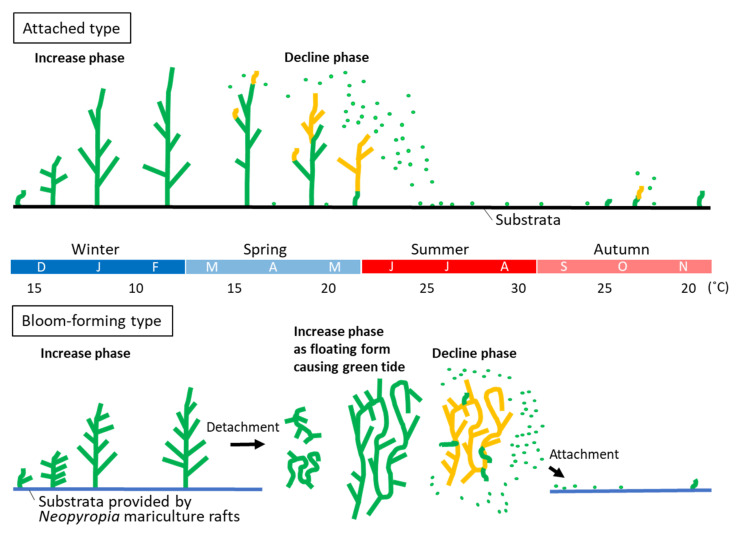
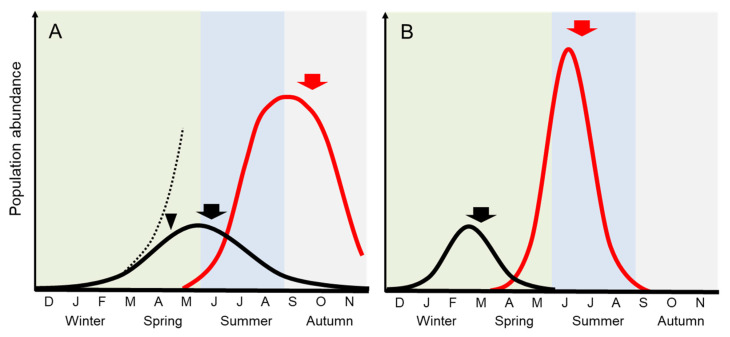
The green seaweed spp. constitute major primary producers in marine coastal ecosystems. Some populations have declined in response to ocean warming, whereas others cause massive blooms as a floating form of large thalli mostly composed of uniform somatic cells even under high temperature conditions-a phenomenon called "green tide". Such differences in population responses can be attributed to the fate of cells between alternative courses, somatic cell division (vegetative growth), and sporic cell division (spore production). In the present review, I attempt to link natural population dynamics to the findings of physiological in vitro research. Consequently, it is elucidated that the inhibition of biomass allocation to sporulation is an important key property for to cause a huge green tide.
绿藻物种是海洋沿岸生态系统中的主要初级生产者。一些种群因海洋变暖而减少,而另一些种群则会形成大规模水华,即使在高温条件下,也会以大多由均匀体细胞组成的大型藻体的漂浮形式出现——这种现象称为“绿潮”。种群反应的这种差异可归因于细胞在体细胞分裂(营养生长)和孢子细胞分裂(孢子产生)这两种不同过程之间的命运。在本综述中,我试图将自然种群动态与体外生理学研究结果联系起来。因此,阐明了抑制孢子形成的生物量分配是导致巨大绿潮的一个重要关键特性。