Yu Yanqiu, Lau Mason M C, Lau Joseph Tak-Fai
Center for Health Behaviours Research, Jockey Club School of Public Health and Primary Care, The Chinese University of Hong Kong, Hong Kong, China.
Vaccines (Basel). 2021 Oct 21;9(11):1225. doi: 10.3390/vaccines9111225.
Vaccination resistance is the key hurdle against herd immunity as it limits the final vaccination coverage. This study investigated the prevalence and factors of COVID-19 vaccination resistance (i.e., those indicating definitely not taking up COVID-19 vaccination), including individualism, perceived personal benefits (PPB) and perceived societal benefits (PSB) of COVID-19 vaccination, and related mechanisms of the association.
A random telephone survey interviewed 395 unvaccinated adults aged 18-75 not having scheduled for COVID-19 vaccination in May 2021 in Hong Kong, China (response rate = 56.8%).
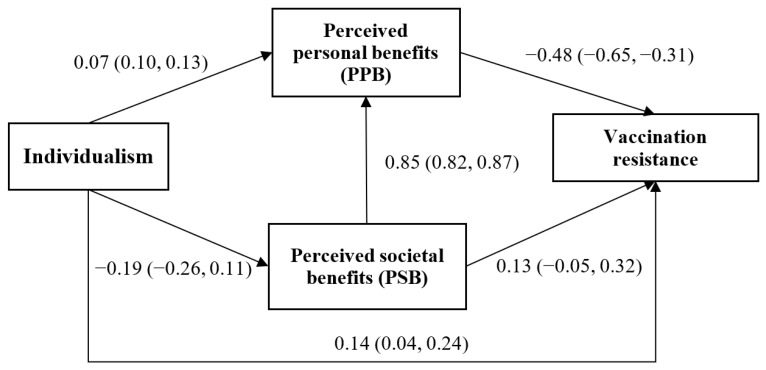
The prevalence of vaccination resistance was 56.5%. Adjusted for background factors, individualism, PPB, and PSB were significantly associated with vaccination resistance. Path analysis showed that individualism exhibited a direct effect on vaccination resistance and a 3-step indirect effect (individualism → PSB → PPB→ vaccination resistance) that explained 46.8% of the total effect. The two 2-step indirect paths via PPB only and via PSB only were non-significant.
High prevalence of vaccination resistance was observed. Individualism increased vaccination resistance via its direct and indirect effects. Health promotion may emphasize collective good to reduce the impact of individualism and promote PPB/PSB, which may reduce vaccination resistance directly and alleviate the impact of individualism on vaccination resistance indirectly.
疫苗接种抗拒是实现群体免疫的关键障碍,因为它限制了最终的疫苗接种覆盖率。本研究调查了新冠疫苗接种抗拒(即明确表示不会接种新冠疫苗)的患病率及相关因素,包括个人主义、对新冠疫苗接种的感知个人益处(PPB)和感知社会益处(PSB),以及它们之间关联的相关机制。
2021年5月,在中国香港对395名年龄在18 - 75岁、未接种新冠疫苗且未安排接种计划的成年人进行了随机电话调查(应答率 = 56.8%)。
疫苗接种抗拒的患病率为56.5%。在对背景因素进行调整后,个人主义、PPB和PSB与疫苗接种抗拒显著相关。路径分析表明,个人主义对疫苗接种抗拒有直接影响,且有一个三步间接影响(个人主义→PSB→PPB→疫苗接种抗拒),该间接影响解释了总效应的46.8%。仅通过PPB和仅通过PSB的两条两步间接路径不显著。
观察到疫苗接种抗拒的患病率较高。个人主义通过其直接和间接影响增加了疫苗接种抗拒。健康促进可强调集体利益,以减少个人主义的影响并促进PPB/PSB,这可能直接降低疫苗接种抗拒,并间接减轻个人主义对疫苗接种抗拒的影响。