Kodeš Zdeněk, Vrublevskaya Maria, Kulišová Markéta, Jaroš Petr, Paldrychová Martina, Pádrová Karolína, Lokočová Kristýna, Palyzová Andrea, Maťátková Olga, Kolouchová Irena
Department of Biotechnology, University of Chemistry and Technology, 166 28 Prague, Czech Republic.
Department of Biochemistry and Microbiology, University of Chemistry and Technology, 166 28 Prague, Czech Republic.
Microorganisms. 2021 Nov 19;9(11):2391. doi: 10.3390/microorganisms9112391.
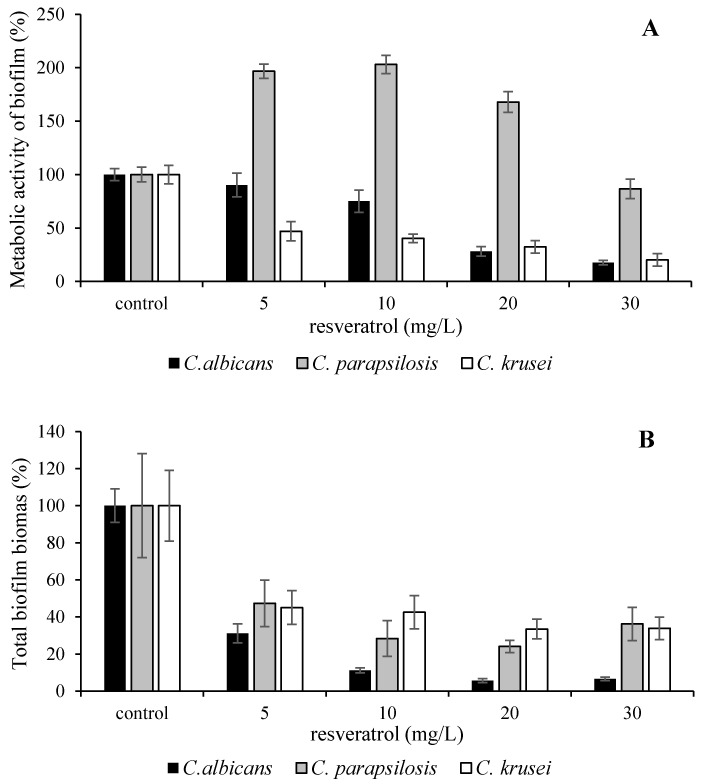
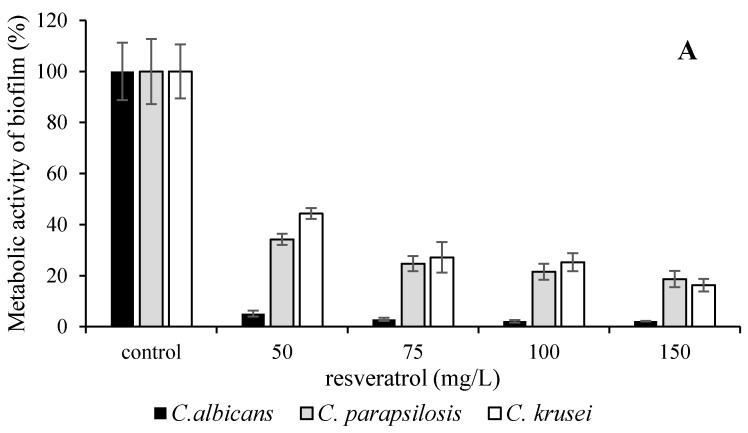
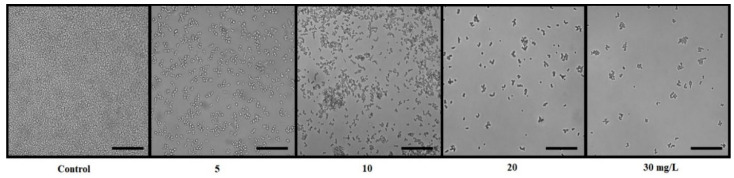
canes are waste material of grapevine pruning and thus represent cheap source of high-value polyphenols. In view of the fact that resistance of many pathogenic microorganisms to antibiotics is a growing problem, the antimicrobial activity of plant polyphenols is studied as one of the possible approaches. We have investigated the total phenolic content, composition, antioxidant activity, and antifungal activity against biofilm of an extract from winter canes and a commercially available extract from blue grapes. Light microscopy and confocal microscopy imaging as well as crystal violet staining were used to quantify and visualize the biofilm. We found a decrease in cell adhesion to the surface depending on the concentration of resveratrol in the cane extract. The biofilm formation was observed as metabolic activity of , and biofilm cells and the minimum biofilm inhibitory concentrations were determined. The highest inhibition of metabolic activity was observed in biofilm after treatment with the cane extract (30 mg/L) and blue grape extract (50 mg/L). The composition of cane extract was analyzed and found to be comparatively different from blue grape extract. In addition, the content of total phenolic groups in cane extract was three-times higher (12.75 g/L). The results showed that cane extract was more effective in preventing biofilm formation than blue grape extract and winter canes have proven to be a potential source of polyphenols for antimicrobial and antibiofilm treatment.
葡萄藤修剪废弃物藤茎是高价值多酚类物质的廉价来源。鉴于许多致病微生物对抗生素的耐药性问题日益严重,植物多酚的抗菌活性作为一种可能的解决方法受到研究。我们研究了冬藤茎提取物和市售蓝莓提取物的总酚含量、成分、抗氧化活性以及对生物膜的抗真菌活性。使用光学显微镜、共聚焦显微镜成像以及结晶紫染色来定量和可视化生物膜。我们发现,藤茎提取物中白藜芦醇浓度不同,细胞对表面的粘附力也会降低。观察到生物膜形成是作为、和生物膜细胞的代谢活性,并测定了最小生物膜抑制浓度。在用藤茎提取物(30毫克/升)和蓝莓提取物(50毫克/升)处理后的生物膜中,观察到代谢活性受到的抑制作用最强。对藤茎提取物的成分进行分析后发现,其与蓝莓提取物相比有较大差异。此外,藤茎提取物中总酚基团的含量高出三倍(12.75克/升)。结果表明,藤茎提取物在防止生物膜形成方面比蓝莓提取物更有效,并且已证明冬藤茎是用于抗菌和抗生物膜治疗的多酚类物质的潜在来源。