Nirachonkul Wariya, Ogonoki Siriporn, Thumvijit Tarika, Chiampanichayakul Supanimit, Panyajai Pawaret, Anuchapreeda Songyot, Tima Singkome, Chiampanichayakul Sawitree
Department of Medical Technology, Faculty of Associated Medical Sciences, Chiang Mai University, Chiang Mai 50200, Thailand.
Department of Pharmaceutical Sciences, Faculty of Pharmacy, Chiang Mai University, Chiang Mai 50200, Thailand.
Nanomaterials (Basel). 2021 Nov 5;11(11):2974. doi: 10.3390/nano11112974.
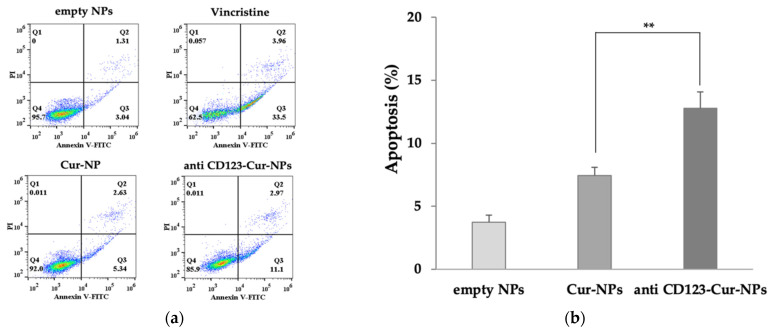
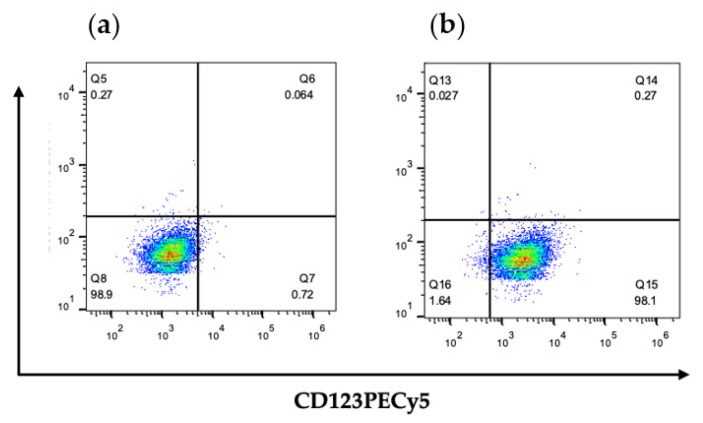
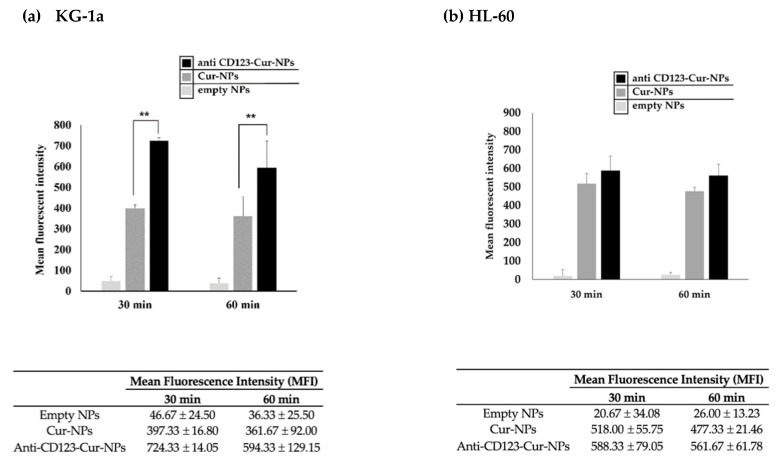
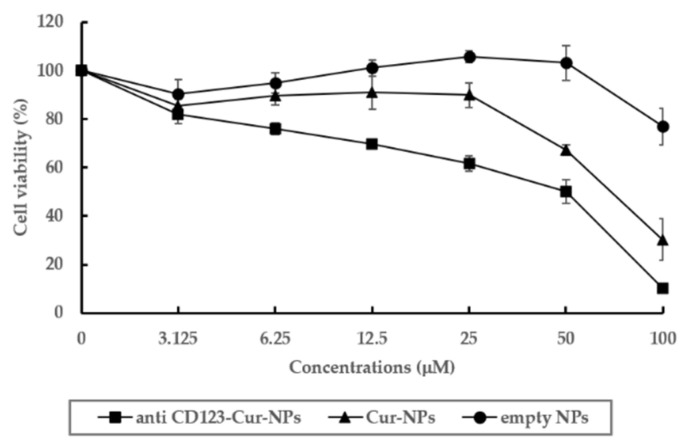
Acute myeloblastic leukemia (AML) is a disease with a high rate of relapse and drug resistance due to the remaining leukemic stem cells (LSCs). Therefore, LSCs are specific targets for the treatment of leukemia. CD123 is specifically expressed on LSCs and performs as a specific marker. Curcumin is the main active compound of a natural product with low toxicity for humans. It has been reported to inhibit leukemic cell growth. However, curcumin is practically insoluble in water and has low bioavailability. In this study, we aimed to formulate curcumin nanoparticles and conjugate with the anti-CD123 to overcome the low water solubility and improve the targeting of LSCs. The cytotoxicity of both curcumin-loaded PLGA/poloxamer nanoparticles (Cur-NPs) and anti-CD123-curcumin-loaded PLGA/poloxamer nanoparticles (anti-CD123-Cur-NPs) were examined in KG-1a cells. The results showed that Cur-NPs and Cur-NPs-CD123 exhibited cytotoxic effects on KG-1a cells with the IC values of 74.20 ± 6.71 and 41.45 ± 5.49 µM, respectively. Moreover, anti-CD123-Cur-NPs induced higher apoptosis than Cur-NPs. The higher uptake of anti-CD123-Cur-NPs in KG-1a cells was confirmed by using flow cytometry. In conclusion, the anti-CD123-Cur-NPs formulation improved curcumin's bioavailability and specific targeting of LSCs, suggesting that it is a promising drug delivery system for improving the therapeutic efficacy against AML.
急性髓系白血病(AML)是一种由于残留白血病干细胞(LSCs)而具有高复发率和耐药性的疾病。因此,LSCs是白血病治疗的特异性靶点。CD123在LSCs上特异性表达,并作为一种特异性标志物发挥作用。姜黄素是一种对人类毒性较低的天然产物的主要活性成分。据报道,它能抑制白血病细胞的生长。然而,姜黄素几乎不溶于水,生物利用度低。在本研究中,我们旨在制备姜黄素纳米颗粒并与抗CD123偶联,以克服其低水溶性并提高对LSCs的靶向性。在KG-1a细胞中检测了负载姜黄素的PLGA/泊洛沙姆纳米颗粒(Cur-NPs)和负载抗CD123-姜黄素的PLGA/泊洛沙姆纳米颗粒(抗CD123-Cur-NPs)的细胞毒性。结果表明,Cur-NPs和Cur-NPs-CD123对KG-1a细胞均表现出细胞毒性作用,IC值分别为74.20±6.71和41.45±5.49µM。此外,抗CD123-Cur-NPs诱导的凋亡高于Cur-NPs。通过流式细胞术证实了抗CD123-Cur-NPs在KG-1a细胞中的摄取更高。总之,抗CD123-Cur-NPs制剂提高了姜黄素的生物利用度和对LSCs的特异性靶向性,表明它是一种有前景的药物递送系统,可提高对AML的治疗效果。