Grigoriev Fedor Vasilievich, Sulimov Vladimir Borisovich, Tikhonravov Alexander Vladimirovich
Research Computing Center, M.V. Lomonosov Moscow State University, Leninskie Gory, 119234 Moscow, Russia.
Moscow Center for Fundamental and Applied Mathematics, M.V. Lomonosov Moscow State University, Leninskie Gory, 119234 Moscow, Russia.
Nanomaterials (Basel). 2021 Nov 6;11(11):2986. doi: 10.3390/nano11112986.
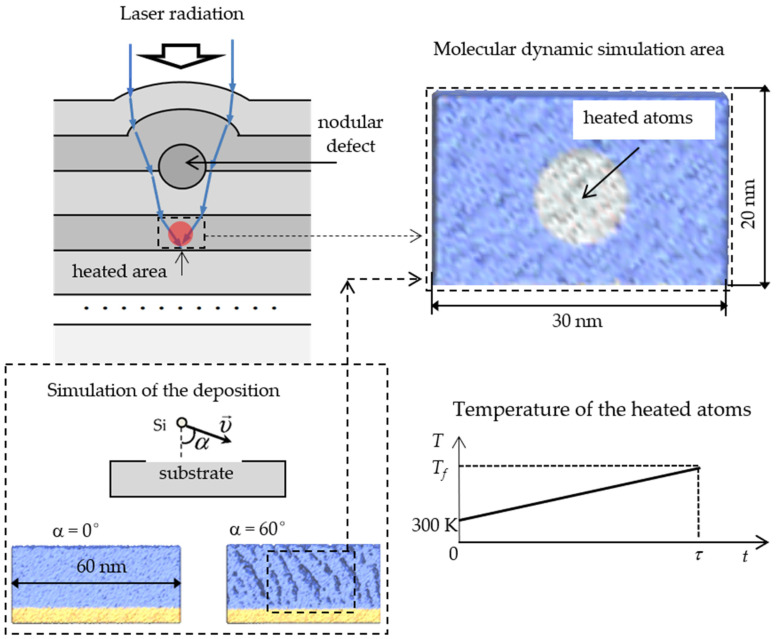
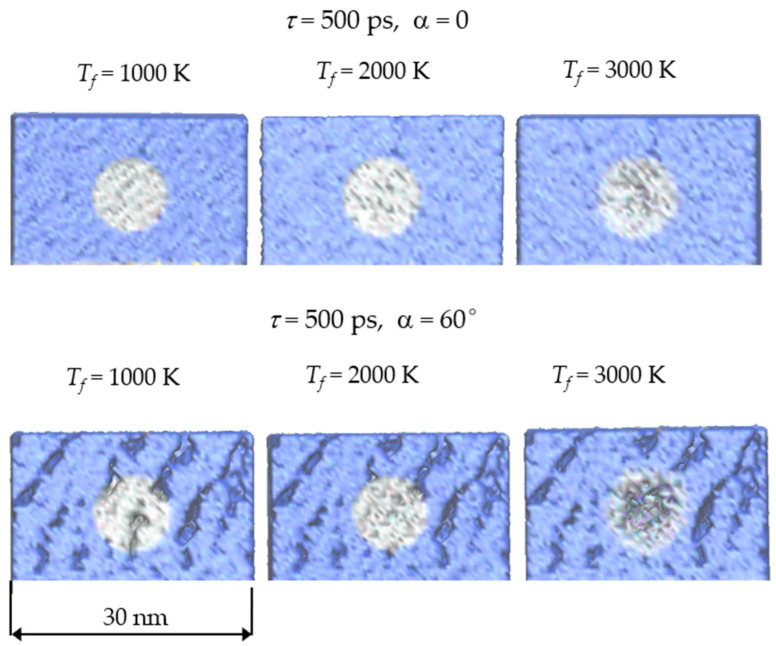
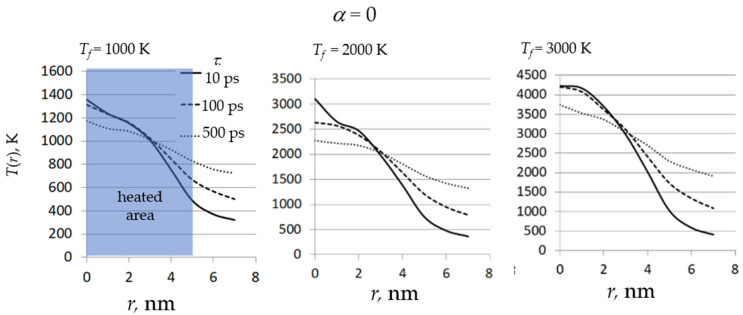
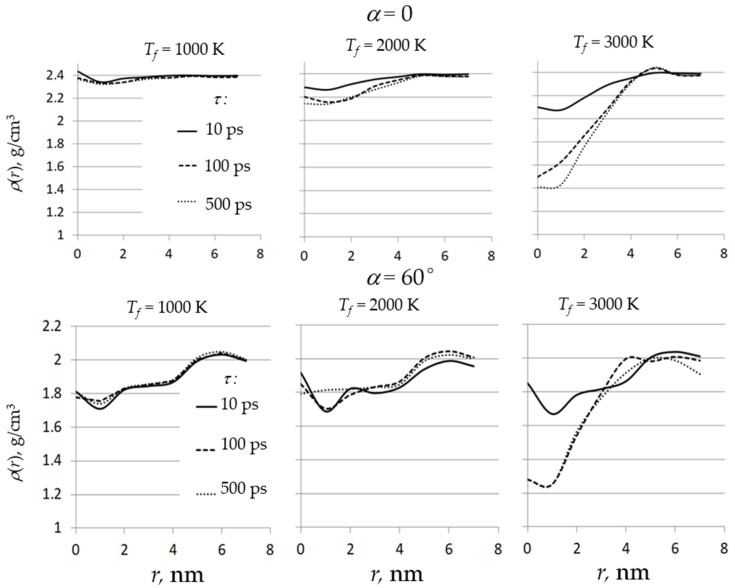
The full-atomistic classical molecular dynamics simulation of the laser heating of silicon dioxide thin films is performed. Both dense isotropic films and porous anisotropic films are investigated. It is assumed that heating occurs due to nodal structural defects, which are currently considered one of the possible causes of laser induced damage. It is revealed that heating to a temperature of 1000 K insignificantly affects the structure of the films and the concentration of point defects responsible for the radiation absorption. An increase in the heating temperature to 2000 K leads to the growth of the concentration of these defects. For "as deposited" films, this growth is greater in the case of a porous film deposited at a high deposition angle. Annealing of film reduces the difference in the concentration of laser induced defects in dense and porous films. The possible influence of optical active defects arising due to heating on the laser induced damage threshold is discussed.
进行了二氧化硅薄膜激光加热的全原子经典分子动力学模拟。研究了致密各向同性薄膜和多孔各向异性薄膜。假设加热是由于节点结构缺陷引起的,目前认为这是激光诱导损伤的可能原因之一。结果表明,加热到1000K的温度对薄膜结构和负责辐射吸收的点缺陷浓度影响不大。加热温度升高到2000K会导致这些缺陷浓度的增加。对于“沉积态”薄膜,在高沉积角度下沉积的多孔薄膜中这种增加更大。薄膜退火减少了致密薄膜和多孔薄膜中激光诱导缺陷浓度的差异。讨论了加热产生的光学活性缺陷对激光诱导损伤阈值的可能影响。