Department of Internal Medicine II, Medical University of Innsbruck, 6020 Innsbruck, Austria.
Division of Biological Chemistry, Biocenter, Medical University of Innsbruck, 6020 Innsbruck, Austria.
Nutrients. 2021 Oct 22;13(11):3732. doi: 10.3390/nu13113732.
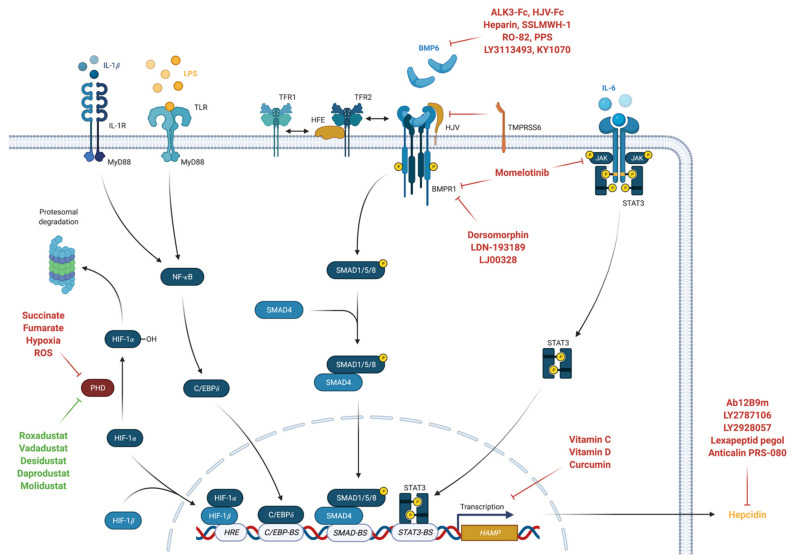
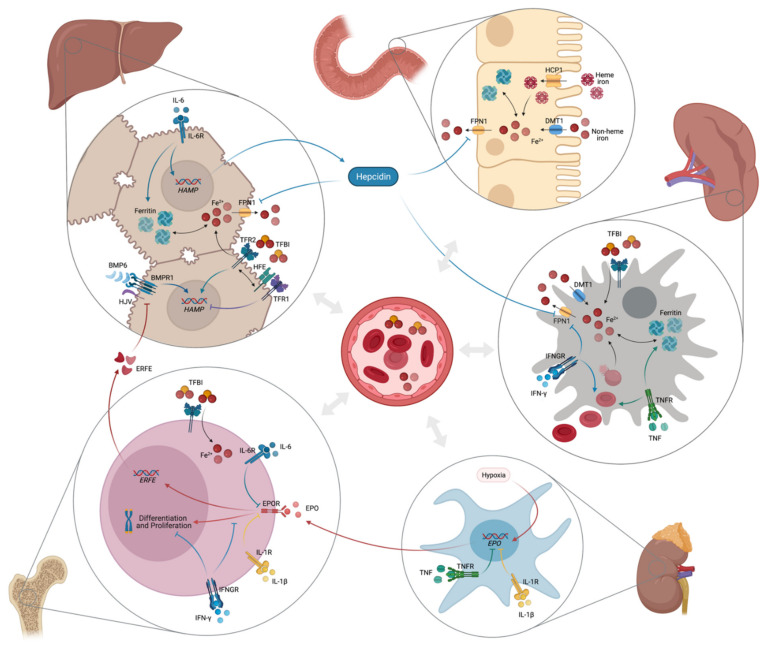
Anemia is very common in patients with inflammatory disorders. Its prevalence is associated with severity of the underlying disease, and it negatively affects quality of life and cardio-vascular performance of patients. Anemia of inflammation (AI) is caused by disturbances of iron metabolism resulting in iron retention within macrophages, a reduced erythrocyte half-life, and cytokine mediated inhibition of erythropoietin function and erythroid progenitor cell differentiation. AI is mostly mild to moderate, normochromic and normocytic, and characterized by low circulating iron, but normal and increased levels of the storage protein ferritin and the iron hormone hepcidin. The primary therapeutic approach for AI is treatment of the underlying inflammatory disease which mostly results in normalization of hemoglobin levels over time unless other pathologies such as vitamin deficiencies, true iron deficiency on the basis of bleeding episodes, or renal insufficiency are present. If the underlying disease and/or anemia are not resolved, iron supplementation therapy and/or treatment with erythropoietin stimulating agents may be considered whereas blood transfusions are an emergency treatment for life-threatening anemia. New treatments with hepcidin-modifying strategies and stabilizers of hypoxia inducible factors emerge but their therapeutic efficacy for treatment of AI in ill patients needs to be evaluated in clinical trials.
贫血在炎症性疾病患者中非常常见。其患病率与基础疾病的严重程度相关,它会降低患者的生活质量和心血管功能。炎症性贫血(AI)是由铁代谢紊乱引起的,导致铁在巨噬细胞内蓄积,红细胞半衰期缩短,细胞因子抑制促红细胞生成素功能和红系祖细胞分化。AI 大多为轻度至中度、正色素性和正细胞性贫血,其特点是循环铁低,但储存蛋白铁蛋白和铁激素hepcidin 的水平正常或升高。AI 的主要治疗方法是治疗基础炎症性疾病,随着时间的推移,这通常会导致血红蛋白水平正常化,除非存在其他病理情况,如维生素缺乏、基于出血事件的真正缺铁或肾功能不全。如果基础疾病和/或贫血未得到解决,则可能考虑补铁治疗和/或使用促红细胞生成素刺激剂治疗,而输血则是治疗危及生命的贫血的紧急治疗方法。新的 hepcidin 修饰策略和缺氧诱导因子稳定剂的治疗方法已经出现,但它们在治疗疾病患者的 AI 方面的治疗效果需要在临床试验中进行评估。