Department of Psychiatry, Psychosomatics and Psychotherapy, Centre of Mental Health, Julius-Maximilians-University, Margarete-Höppel-Platz 1, 97080, Würzburg, Germany.
Department of Psychiatry, University of California San Diego, La Jolla, CA, USA.
J Neural Transm (Vienna). 2022 Jun;129(5-6):661-674. doi: 10.1007/s00702-021-02446-5. Epub 2021 Nov 27.
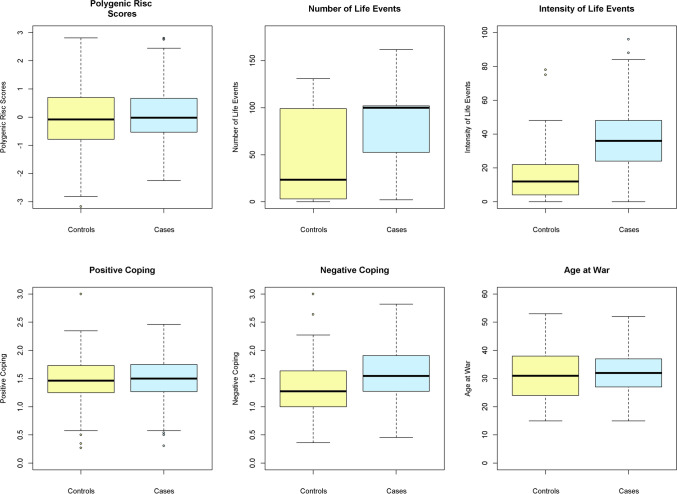
Posttraumatic stress disorder (PTSD) is triggered by extremely stressful environmental events and characterized by high emotional distress, re-experiencing of trauma, avoidance and hypervigilance. The present study uses polygenic risk scores (PRS) derived from the UK Biobank (UKBB) mega-cohort analysis as part of the PGC PTSD GWAS effort to determine the heritable basis of PTSD in the South Eastern Europe (SEE)-PTSD cohort. We further analyzed the relation between PRS and additional disease-related variables, such as number and intensity of life events, coping, sex and age at war on PTSD and CAPS as outcome variables.
Association of PRS, number and intensity of life events, coping, sex and age on PTSD were calculated using logistic regression in a total of 321 subjects with current and remitted PTSD and 337 controls previously subjected to traumatic events but not having PTSD. In addition, PRS and other disease-related variables were tested for association with PTSD symptom severity, measured by the Clinician Administrated PTSD Scale (CAPS) by liner regression. To assess the relationship between the main outcomes PTSD diagnosis and symptom severity, each of the examined variables was adjusted for all other PTSD related variables.
The categorical analysis showed significant polygenic risk in patients with remitted PTSD and the total sample, whereas no effects were found on symptom severity. Intensity of life events as well as the individual coping style were significantly associated with PTSD diagnosis in both current and remitted cases. The dimensional analyses showed as association of war-related frequency of trauma with symptom severity, whereas the intensity of trauma yielded significant results independently of trauma timing in current PTSD.
The present PRS application in the SEE-PTSD cohort confirms modest but significant polygenic risk for PTSD diagnosis. Environmental factors, mainly the intensity of traumatic life events and negative coping strategies, yielded associations with PTSD both categorically and dimensionally with more significant p-values. This suggests that, at least in the present cohort of war-related trauma, the association of environmental factors and current individual coping strategies with PTSD psychopathology was stronger than the polygenic risk.
创伤后应激障碍(PTSD)是由极其紧张的环境事件引发的,其特征是高度情绪困扰、创伤再体验、回避和过度警惕。本研究使用来自英国生物库(UKBB)大型队列分析的多基因风险评分(PRS)作为 PGC PTSD GWAS 工作的一部分,以确定东南欧(SEE)-PTSD 队列中 PTSD 的遗传基础。我们进一步分析了 PRS 与其他与疾病相关的变量(如生活事件的数量和强度、应对方式、性别和战争年龄)之间的关系,这些变量作为 PTSD 和 CAPS 的结果变量。
使用逻辑回归分析了 PRS、生活事件的数量和强度、应对方式、性别和战争年龄对 PTSD 的影响,共纳入了 321 名有当前和缓解性 PTSD 的患者和 337 名以前经历过创伤事件但没有 PTSD 的对照者。此外,还通过线性回归测试了 PRS 和其他与疾病相关的变量与 PTSD 症状严重程度(用临床医生管理 PTSD 量表(CAPS)测量)的相关性。为了评估主要结局 PTSD 诊断和症状严重程度之间的关系,对每个被检查的变量进行了调整,以调整所有其他与 PTSD 相关的变量。
分类分析显示,在缓解性 PTSD 患者和总样本中,PRS 存在显著的多基因风险,但在症状严重程度上没有发现影响。生活事件的强度以及个体应对方式与当前和缓解性病例中的 PTSD 诊断显著相关。在维度分析中,与战争相关的创伤频率与症状严重程度相关,而创伤强度在当前 PTSD 中独立于创伤时间产生显著结果。
本研究在 SEE-PTSD 队列中应用 PRS 证实了 PTSD 诊断的多基因风险适度但显著。环境因素,主要是创伤性生活事件的强度和消极应对策略,与 PTSD 无论是在分类还是在维度上都有显著的关联,且具有更显著的 p 值。这表明,至少在本研究的与战争相关的创伤队列中,环境因素与当前个体应对策略与 PTSD 病理的关联强于多基因风险。