Department of Population, Family and Reproductive Health, Johns Hopkins Bloomberg School of Public Health, Baltimore, USA.
Department of Epidemiology and Biostatistics, School of Public Health, Makerere University, Kampala, Uganda.
Reprod Health. 2021 Nov 27;18(1):239. doi: 10.1186/s12978-021-01287-5.
There is substantial evidence that contraceptive side-effects are a major deterrent to consistent use of contraception but few studies in low- or middle-income countries explore the role of specific side-effects on contraceptive use dynamics. This study used population-based, longitudinal data to explore the effect of specific side-effects on contraceptive continuation, discontinuation, and switching in Uganda.
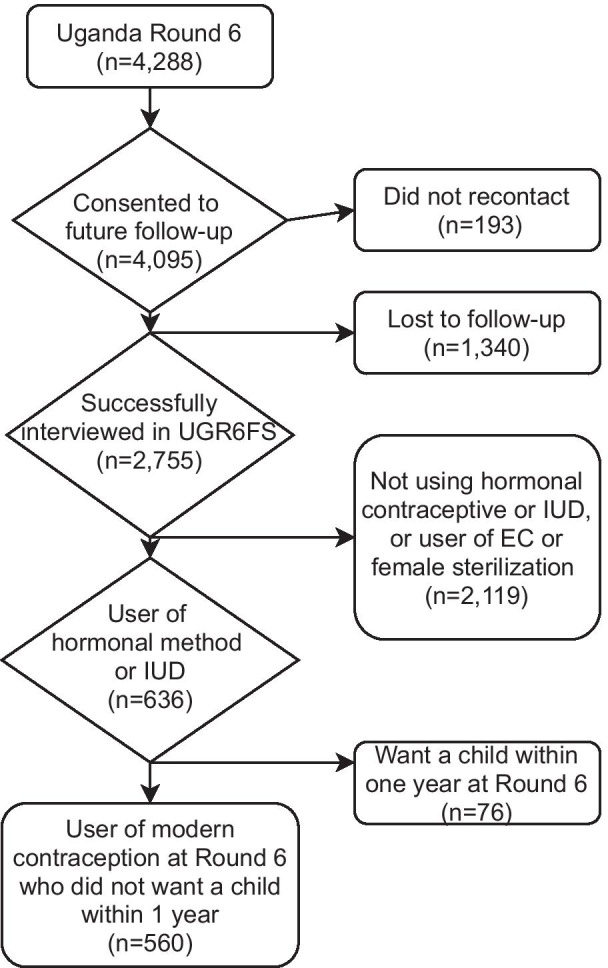
Data for this study come from two rounds of survey data collection in Uganda: PMA2020's sixth cross-sectional survey and a follow-up survey conducted 1 year later. The main outcomes of interest were discontinuation and switching among users of hormonal contraceptive methods (implants, injectables and oral pill) and the IUD at baseline (n = 560). Multivariable logistic regressions assessed the association of experiencing specific side-effects (more bleeding, less bleeding, irregular bleeding, increased dryness/reduced libido, and physical discomfort) with discontinuation and switching 1 year later, adjusting for socio-demographic characteristics, type of method, and length of use. We also examined the differential effects of side-effects between discontinuation and switching risks.
About 23% of hormonal and IUD contraceptive users reported experiencing side-effects at baseline survey. Overall, discontinuation and switching were higher among injectables and pill users, compared to IUD and implants users. Reporting more bleeding or less bleeding increased the odds of discontinuation and switching by 2.74 (95% CI 1.00-7.51) and 1.86 (1.04-3.34), respectively. There was no significant difference in discontinuation and switching by side-effects.
Greater attention should be paid to understanding the unique contributions of side-effects to contraceptive behavior using population-based data. While about a quarter of women reported experiencing side effects, those who experienced bleeding specific side effects were at higher risk of contraceptive discontinuation and switching. Providing greater individualized care that includes information and counseling about common side-effects, how they may impact daily life, and how tolerable these effects may be is necessary.
有大量证据表明,避孕副作用是影响人们持续使用避孕措施的主要因素,但在中低收入国家,很少有研究探讨具体副作用对避孕使用动态的影响。本研究使用基于人群的纵向数据,探索了特定副作用对乌干达避孕持续使用、停止使用和转换的影响。
本研究的数据来自乌干达两轮调查数据收集:PMA2020 的第六次横断面调查和一年后进行的一次随访调查。主要研究结果是在基线时使用激素避孕方法(植入物、注射剂和口服避孕药)和宫内节育器的使用者中停止使用和转换(n=560)。多变量逻辑回归评估了在调整了社会人口特征、方法类型和使用时间后,经历特定副作用(更多出血、更少出血、不规则出血、干燥/性欲降低和身体不适)与一年后停止使用和转换的关系。我们还检查了副作用对停止使用和转换风险的差异影响。
约 23%的激素和宫内节育器避孕使用者在基线调查时报告有副作用。总体而言,与宫内节育器和植入物使用者相比,注射剂和避孕药使用者的停止使用和转换率更高。报告更多出血或更少出血会使停止使用和转换的几率分别增加 2.74 倍(95%CI 1.00-7.51)和 1.86 倍(1.04-3.34)。副作用对停止使用和转换的影响没有显著差异。
应更加重视利用基于人群的数据来理解副作用对避孕行为的独特贡献。尽管约有四分之一的女性报告有副作用,但那些经历过特定出血副作用的女性更有可能停止使用和转换避孕方法。提供更个性化的护理,包括有关常见副作用的信息和咨询,了解它们如何影响日常生活,以及这些副作用的耐受性如何,是必要的。