Institut Pasteur, Université de Paris, CNRS, UMR3525, Microbial Evolutionary Genomics, Paris 75015, France.
Philos Trans R Soc Lond B Biol Sci. 2022 Jan 17;377(1842):20200475. doi: 10.1098/rstb.2020.0475. Epub 2021 Nov 29.
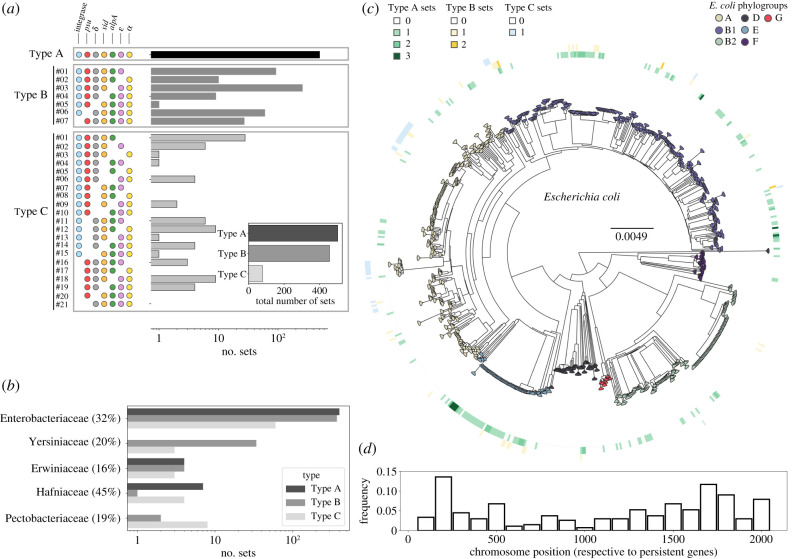
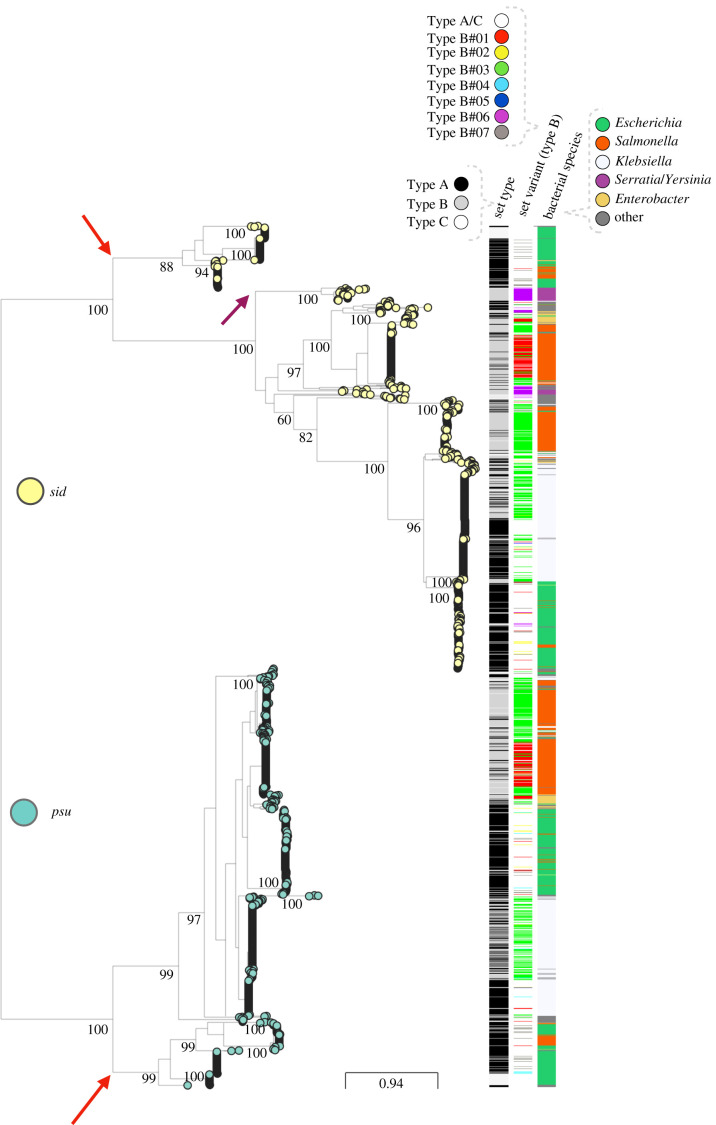
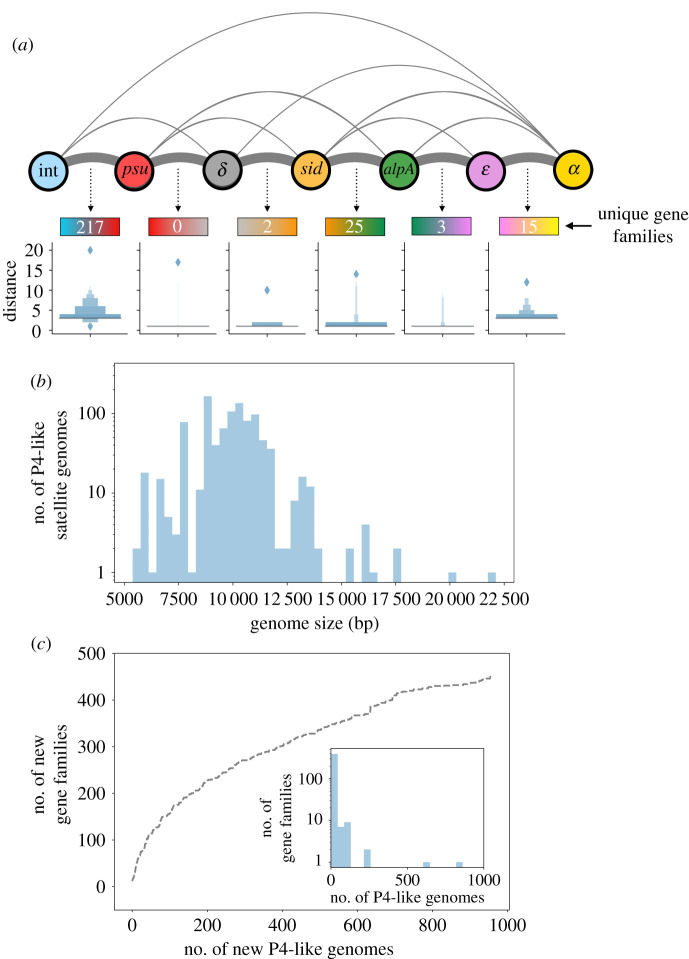
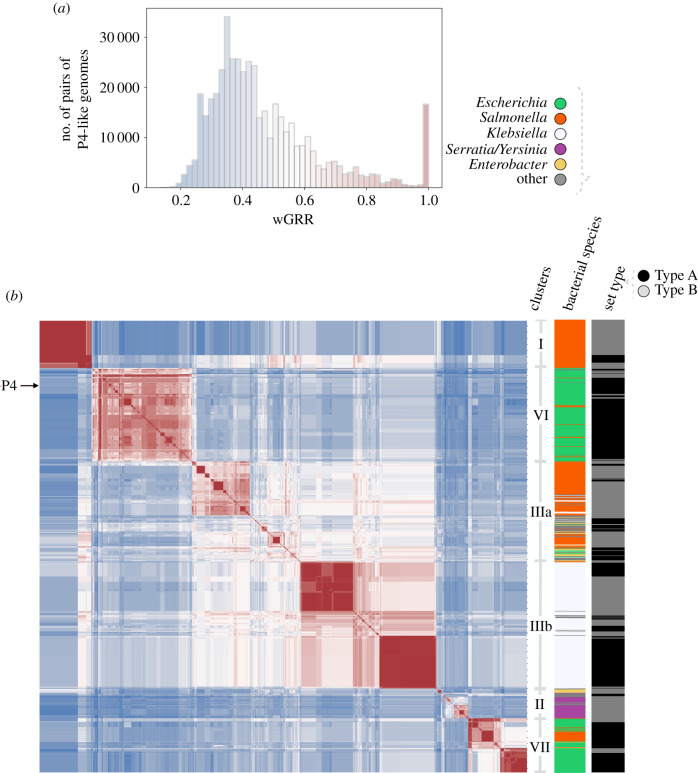
Bacteriophages (phages) are bacterial parasites that can themselves be parasitized by phage satellites. The molecular mechanisms used by satellites to hijack phages are sometimes understood in great detail, but the origins, abundance, distribution and composition of these elements are poorly known. Here, we show that P4-like elements are present in more than 30% of the genomes of Enterobacterales, and in almost half of those of , sometimes in multiple distinct copies. We identified over 1000 P4-like elements with very conserved genetic organization of the core genome and a few hotspots with highly variable genes. These elements are never found in plasmids and have very little homology to known phages, suggesting an independent evolutionary origin. Instead, they are scattered across chromosomes, possibly because their integrases are often exchanged with other elements. The rooted phylogenies of hijacking functions are correlated and suggest longstanding coevolution. They also reveal broad host ranges in P4-like elements, as almost identical elements can be found in distinct bacterial genera. Our results show that P4-like phage satellites constitute a very distinct, widespread and ancient family of mobile genetic elements. They pave the way for studying the molecular evolution of antagonistic interactions between phages and their satellites. This article is part of the theme issue 'The secret lives of microbial mobile genetic elements'.
噬菌体(phages)是一种可以被噬菌体卫星寄生的细菌寄生虫。卫星劫持噬菌体所使用的分子机制有时被详细地理解,但这些元素的起源、丰度、分布和组成却知之甚少。在这里,我们表明 P4 样元件存在于肠杆菌目中超过 30%的基因组中,并且在近一半的基因组中存在,有时存在多个不同的拷贝。我们鉴定了 1000 多个 P4 样元件,它们具有核心基因组非常保守的遗传组织和少数具有高度可变基因的热点。这些元件从未在质粒中发现,与已知的噬菌体几乎没有同源性,这表明它们具有独立的进化起源。相反,它们散布在染色体上,可能是因为它们的整合酶经常与其他元件交换。劫持功能的有根系统发育是相关的,这表明它们有长期的共同进化。它们还揭示了 P4 样元件广泛的宿主范围,因为在不同的细菌属中可以发现几乎相同的元件。我们的研究结果表明,P4 样噬菌体卫星构成了一个非常独特、广泛和古老的移动遗传元件家族。它们为研究噬菌体及其卫星之间的拮抗相互作用的分子进化铺平了道路。本文是主题为“微生物移动遗传元件的秘密生活”特刊的一部分。