Pediatric Oncology Branch, Center for Cancer Research, National Cancer Institute, National Institutes of Health, Bethesda, Maryland, USA.
Curr Opin Pediatr. 2022 Feb 1;34(1):39-47. doi: 10.1097/MOP.0000000000001088.
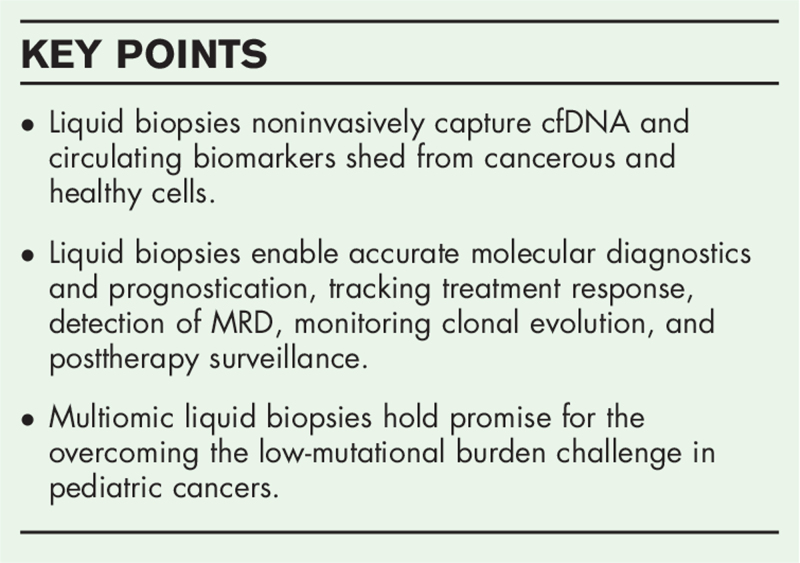
Liquid biopsies have emerged as a noninvasive alternative to tissue biopsy with potential applications during all stages of pediatric oncology care. The purpose of this review is to provide a survey of pediatric cell-free DNA (cfDNA) studies, illustrate their potential applications in pediatric oncology, and to discuss technological challenges and approaches to overcome these hurdles.
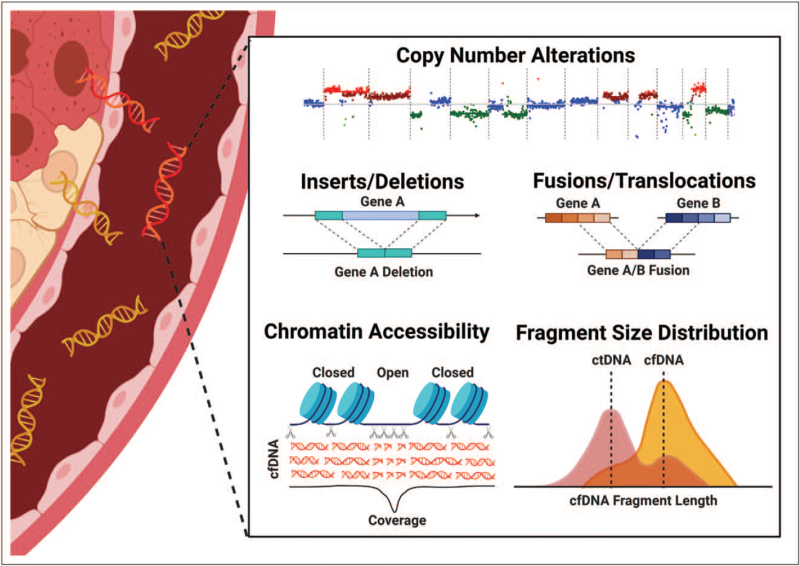
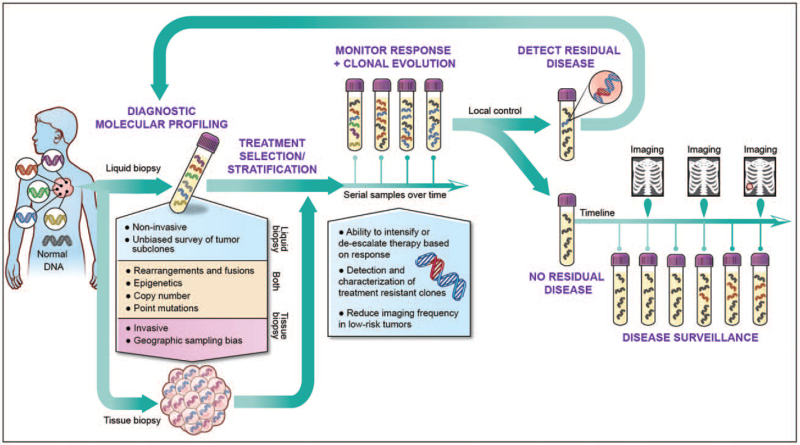
Recent literature has demonstrated liquid biopsies' ability to inform treatment selection at diagnosis, monitor clonal evolution during treatment, sensitively detect minimum residual disease following local control, and provide sensitive posttherapy surveillance. Advantages include reduced procedural anesthesia, molecular profiling unbiased by tissue heterogeneity, and ability to track clonal evolution. Challenges to wider implementation in pediatric oncology, however, include blood volume restrictions and relatively low mutational burden in childhood cancers. Multiomic approaches address challenges presented by low-mutational burden, and novel bioinformatic analyses allow a single assay to yield increasing amounts of information, reducing blood volume requirements.
Liquid biopsies hold tremendous promise in pediatric oncology, enabling noninvasive serial surveillance with adaptive care. Already integrated into adult care, recent advances in technologies and bioinformatics have improved applicability to the pediatric cancer landscape.
液体活检作为组织活检的一种非侵入性替代方法已经出现,具有在儿科肿瘤治疗的所有阶段应用的潜力。本文的目的是对儿科游离 DNA(cfDNA)的研究进行综述,说明其在儿科肿瘤学中的潜在应用,并讨论克服这些障碍的技术挑战和方法。
最近的文献表明,液体活检能够在诊断时提供治疗选择信息,在治疗过程中监测克隆进化,灵敏地检测局部控制后的微小残留疾病,并进行敏感的治疗后监测。其优点包括减少程序麻醉、不受组织异质性影响的分子分析,以及能够跟踪克隆进化。然而,在儿科肿瘤学中广泛应用的挑战包括血量限制和儿童癌症中相对较低的突变负担。多组学方法解决了低突变负担带来的挑战,而新型生物信息学分析允许单次检测产生越来越多的信息,从而减少了血量需求。
液体活检在儿科肿瘤学中具有巨大的潜力,能够进行非侵入性的连续监测和适应性治疗。液体活检已经整合到成人护理中,最近技术和生物信息学的进步提高了其在儿科癌症领域的适用性。