Pinto Rita, Pires Madalena Lemos, Borges Mariana, Pinto Mariana Liñan, Sousa Guerreiro Catarina, Miguel Sandra, Santos Olga, Ricardo Inês, Cunha Nelson, Alves da Silva Pedro, Correia Ana Luísa, Fiúza Sílvia, Caldeira Edite, Salazar Fátima, Rodrigues Carla, Cordeiro Ferreira Mariana, Afonso Gisela, Araújo Graça, Martins Joana, Ramalhinho Marta, Sousa Paula, Pires Susana, Jordão Alda, Pinto Fausto J, Abreu Ana
Serviço de Cardiologia, Departamento Coração e Vasos, Centro Hospitalar Universitário Lisboa Norte, CAML, CCUL, Faculdade de Medicina, Universidade de Lisboa, Lisboa, Portugal.
Serviço de Cardiologia, Departamento Coração e Vasos, Centro Hospitalar Universitário Lisboa Norte, CAML, CCUL, Faculdade de Medicina, Universidade de Lisboa, Lisboa, Portugal.
Rev Port Cardiol. 2022 Mar;41(3):209-218. doi: 10.1016/j.repc.2021.05.013. Epub 2021 Nov 20.
Center-based cardiac rehabilitation (CR) programs have been forced to close due to COVID-19. Alternative delivery models to maintain access to CR programs and to avoid physical inactivity should be considered. The aim of this study was to assess physical activity (PA) levels after completing a home-based digital CR program.
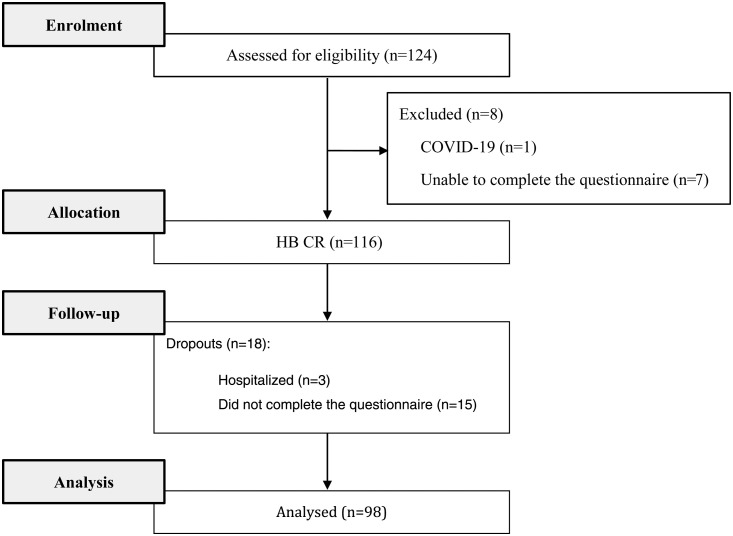
A total of 116 cardiovascular disease (CVD) patients (62.6±8.9 years, 95 male) who had been attending a face-to-face CR program were recruited and assessed (baseline and at three months) on the following parameters: PA, sedentary behavior, adherence, cardiovascular and non-cardiovascular symptoms, feelings toward the pandemic, dietary habits, risk factor control, safety and adverse events. The intervention consisted of a multidisciplinary digital CR program, including regular patient assessment, and exercise, educational and psychological group sessions.
Ninety-eight CVD patients successfully completed all the online assessments (15.5% drop-out rate). A favorable main effect of time was an increase in moderate to vigorous PA and a decrease in sedentary time at three months. Almost half of the participants completed at least one online exercise training session per week and attended at least one of the online educational sessions. No major adverse events were reported and only one minor event occurred.
During the pandemic, levels of moderate to vigorous PA improved after three months of home-based CR in CVD patients with previous experience in a face-to-face CR model. Diversified CR programs with a greater variety of content tailored to individual preferences are needed to meet the motivational and clinical requirements of CVD patients.
由于新冠疫情,以中心为基础的心脏康复(CR)项目被迫关闭。应考虑采用替代交付模式,以维持对CR项目的参与并避免身体活动不足。本研究的目的是评估完成家庭数字化CR项目后的身体活动(PA)水平。
共招募了116名曾参加面对面CR项目的心血管疾病(CVD)患者(年龄62.6±8.9岁,男性95名),并对以下参数进行了评估(基线和三个月时):PA、久坐行为、依从性、心血管和非心血管症状、对疫情的感受、饮食习惯、危险因素控制、安全性和不良事件。干预措施包括多学科数字化CR项目,包括定期患者评估以及运动、教育和心理小组课程。
98名CVD患者成功完成了所有在线评估(脱落率为15.5%)。时间的有利主要影响是三个月时中度至剧烈PA增加,久坐时间减少。几乎一半的参与者每周至少完成一次在线运动训练课程,并参加了至少一次在线教育课程。未报告重大不良事件,仅发生了一起轻微事件。
在疫情期间,有面对面CR模式经验的CVD患者在家进行CR三个月后,中度至剧烈PA水平有所改善。需要多样化的CR项目,包含更多根据个人喜好量身定制的内容,以满足CVD患者的动机和临床需求。