Gu Yanfeng, Wang Zhongyuan
Fudan Institute for Advanced Study in Social Sciences, Shanghai, China.
J Chin Polit Sci. 2022;27(2):375-398. doi: 10.1007/s11366-021-09772-1. Epub 2021 Nov 23.
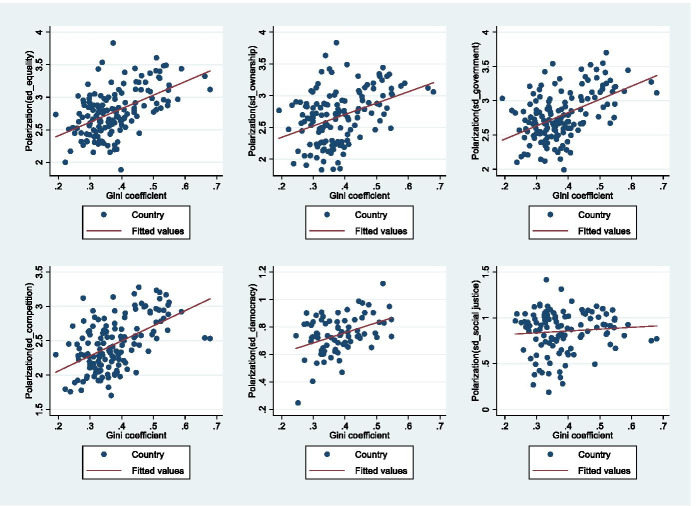
Both income inequality and political polarization have increased dramatically in much of the world over the past few decades. One might wonder how these two phenomena correlate with each other. Are there any striking similarities in the correlated patterns of income inequality and polarization across the globe? More importantly, how can improved equality in income distribution contribute to mitigate political polarization? Although the potential polarizing effects of income inequality is a growing concern, the evidence provided by the existing literature, however, has been mixed and incomplete. This research seeks to address the shortcomings of the current scholarship by using the repeated cross-sectional data from six waves of the World Values Survey from 1990 to 2020, to investigate whether and how widened income inequality and growing political polarization are linked globally. The findings indicate that there is a positive and statistically significant cross-country association between levels of income inequality and political polarization. The results remain robust to different specifications. This research has the potential for advancing the study of linkages between income inequality and its political consequences.
在过去几十年里,世界上许多地方的收入不平等和政治两极分化都急剧加剧。人们可能会好奇这两种现象是如何相互关联的。全球范围内,收入不平等和两极分化的相关模式是否存在显著相似之处?更重要的是,收入分配平等性的改善如何有助于缓解政治两极分化?尽管收入不平等潜在的两极分化效应日益受到关注,但现有文献提供的证据却参差不齐且不完整。本研究旨在通过使用1990年至2020年六轮世界价值观调查的重复横截面数据来弥补当前学术研究的不足,以调查全球范围内收入不平等加剧与政治两极分化加剧是否以及如何相互关联。研究结果表明,收入不平等程度与政治两极分化之间存在正向且具有统计学意义的跨国关联。不同的设定下结果依然稳健。本研究有潜力推动关于收入不平等及其政治后果之间联系的研究。