Metin Barış, Somer Eli, Abu-Rayya Hisham M, Schimmenti Adriano, Göçmen Buse
Psychology Department, Üsküdar University, Altunizade Haluk Türksoy Sk. No:14, 34662 Üsküdar-İstanbul, Turkey.
School of Social Work, University of Haifa, Haifa, Israel.
Int J Ment Health Addict. 2021 Nov 22:1-13. doi: 10.1007/s11469-021-00678-w.
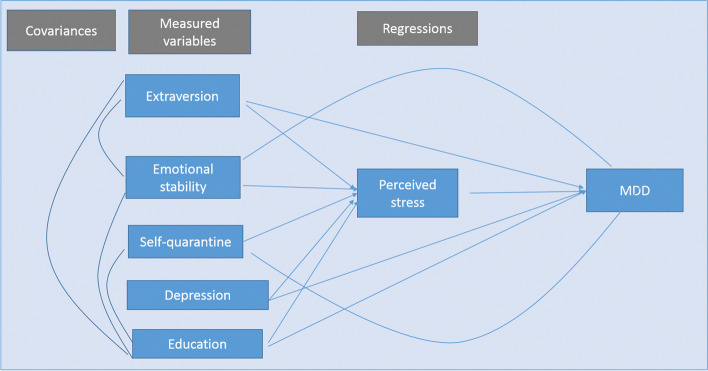
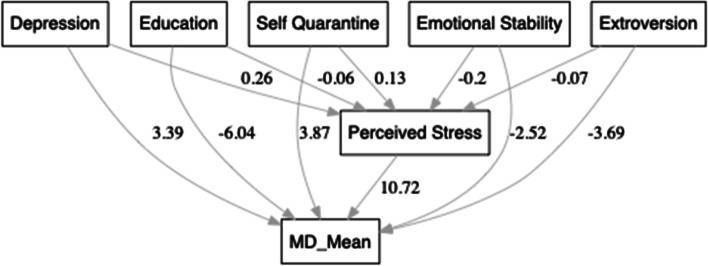
Since the emergence of the COVID-19 pandemic, almost all countries have employed varying degrees of lockdown measures to limit the spread of the infection. Previous studies showed that individuals with maladaptive daydreaming (MD) are affected negatively by the lockdown. In this study, we explored a set of lockdown measures (e.g., self-quarantine) and personal factors (e.g., education, history of depression, and personality traits) that might potentially exacerbate MD experienced during the lockdown period. We also examined whether perceived stress acted as a mediator in the relationship between these factors and MD. During the first lockdown from April to June, we analyzed data provided by 1083 individuals from the USA, the UK, Italy, and Turkey. A path analysis revealed that perceived stress mediated the effects on MD of self-quarantine, previous episodes of depression, low education level, and introversion and emotional instability. Our study suggests a conceptual framework for the factors that intensify maladaptive daydreaming under the threats of the pandemic and forced home confinement, offering implications for interventions with vulnerable populations.
自新冠疫情出现以来,几乎所有国家都采取了不同程度的封锁措施以限制感染传播。先前的研究表明,患有适应不良性白日梦(MD)的个体受到封锁的负面影响。在本研究中,我们探究了一系列可能会在封锁期间加剧适应不良性白日梦的封锁措施(如自我隔离)和个人因素(如教育程度、抑郁病史和人格特质)。我们还研究了感知压力是否在这些因素与适应不良性白日梦之间的关系中起中介作用。在4月至6月的首次封锁期间,我们分析了来自美国、英国、意大利和土耳其的1083名个体提供的数据。路径分析显示,感知压力在自我隔离、既往抑郁发作、低教育水平以及内向和情绪不稳定对适应不良性白日梦的影响中起中介作用。我们的研究提出了一个概念框架,用于解释在疫情威胁和强制居家隔离情况下加剧适应不良性白日梦的因素,为针对弱势群体的干预措施提供了启示。