Huang Zhongwei, Lei Haijun, Chen Guoliang, Li Haimei, Li Chuandong, Gao Wenwen, Chen Yue, Wang Yaofa, Xu Haibo, Ma Guolin, Lei Baiying
Key Laboratory of Service Computing and Applications, Guangdong Province Key Laboratory of Popular High Performance Computers, Guangdong Province Engineering Center of China-made High Performance Data Computing System, Guangdong Laboratory of Artificial-Intelligence and Cyber-Economics, College of Computer Science and Software Engineering, Shenzhen University, Shenzhen, China.
Department of Radiology, Fu Xing Hospital, Capital Medical University, Beijing, China.
Appl Soft Comput. 2022 Jan;115:108088. doi: 10.1016/j.asoc.2021.108088. Epub 2021 Nov 24.
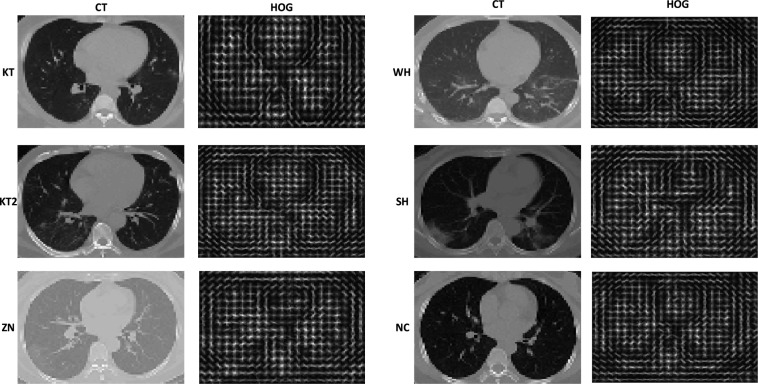
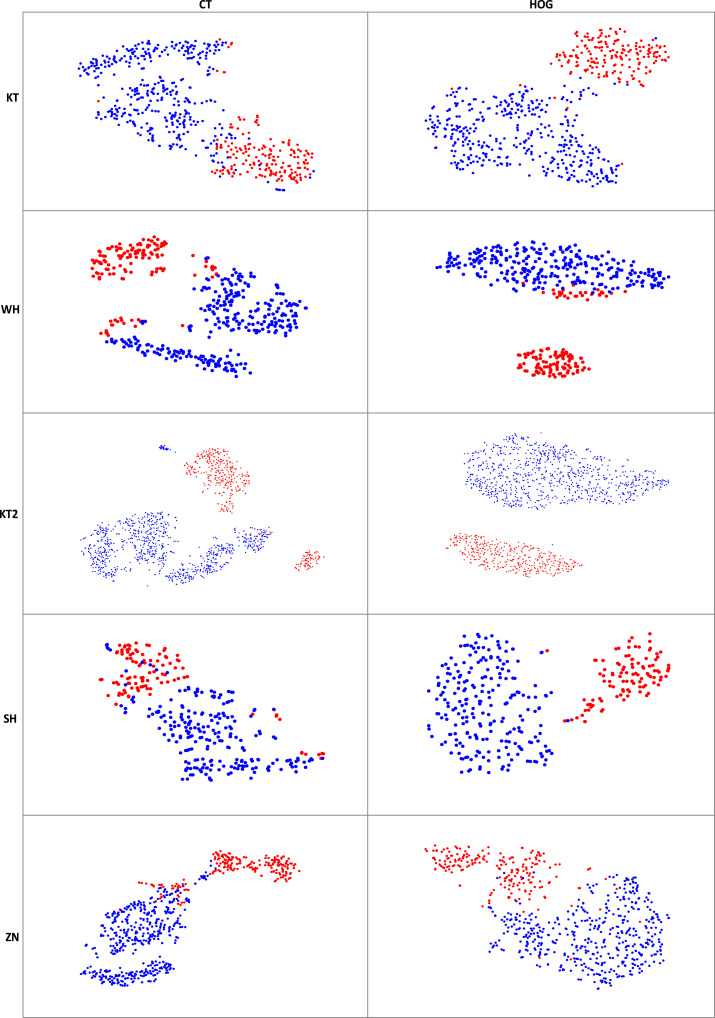
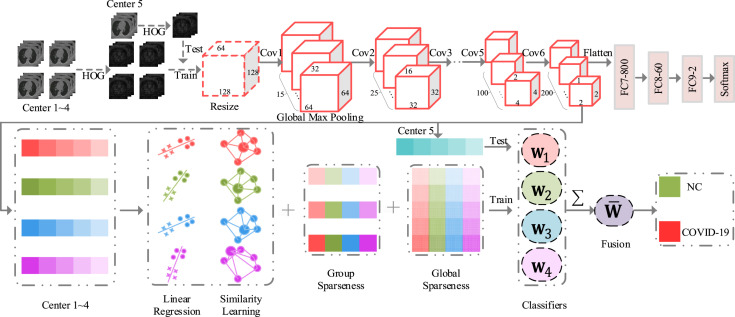
The coronavirus disease 2019 (COVID-19) pandemic caused by the novel severe acute respiratory syndrome coronavirus 2 (SARS-CoV-2) has led to a sharp increase in hospitalized patients with multi-organ disease pneumonia. Early and automatic diagnosis of COVID-19 is essential to slow down the spread of this epidemic and reduce the mortality of patients infected with SARS-CoV-2. In this paper, we propose a joint multi-center sparse learning (MCSL) and decision fusion scheme exploiting chest CT images for automatic COVID-19 diagnosis. Specifically, considering the inconsistency of data in multiple centers, we first convert CT images into histogram of oriented gradient (HOG) images to reduce the structural differences between multi-center data and enhance the generalization performance. We then exploit a 3-dimensional convolutional neural network (3D-CNN) model to learn the useful information between and within 3D HOG image slices and extract multi-center features. Furthermore, we employ the proposed MCSL method that learns the intrinsic structure between multiple centers and within each center, which selects discriminative features to jointly train multi-center classifiers. Finally, we fuse these decisions made by these classifiers. Extensive experiments are performed on chest CT images from five centers to validate the effectiveness of the proposed method. The results demonstrate that the proposed method can improve COVID-19 diagnosis performance and outperform the state-of-the-art methods.
由新型严重急性呼吸综合征冠状病毒2(SARS-CoV-2)引起的2019冠状病毒病(COVID-19)大流行导致多器官疾病肺炎住院患者急剧增加。COVID-19的早期自动诊断对于减缓这种流行病的传播和降低感染SARS-CoV-2患者的死亡率至关重要。在本文中,我们提出了一种利用胸部CT图像进行COVID-19自动诊断的联合多中心稀疏学习(MCSL)和决策融合方案。具体而言,考虑到多个中心数据的不一致性,我们首先将CT图像转换为定向梯度直方图(HOG)图像,以减少多中心数据之间的结构差异并增强泛化性能。然后,我们利用三维卷积神经网络(3D-CNN)模型来学习3D HOG图像切片之间和内部的有用信息,并提取多中心特征。此外,我们采用所提出的MCSL方法,该方法学习多个中心之间以及每个中心内部的内在结构,选择有区分力的特征来联合训练多中心分类器。最后,我们融合这些分类器做出的决策。在来自五个中心的胸部CT图像上进行了广泛的实验,以验证所提出方法的有效性。结果表明,所提出的方法可以提高COVID-19诊断性能,并且优于现有方法。