Wang Jingjing, Yang Yiyang, Peng Jiandong, Yang Linchuan, Gou Zhonghua, Lu Yi
School of Urban Design, Wuhan University, Wuhan, China.
Department of Architecture and Civil Engineering, City University of Hong Kong, Hong Kong.
Sustain Cities Soc. 2021 Sep;72:103058. doi: 10.1016/j.scs.2021.103058. Epub 2021 May 29.
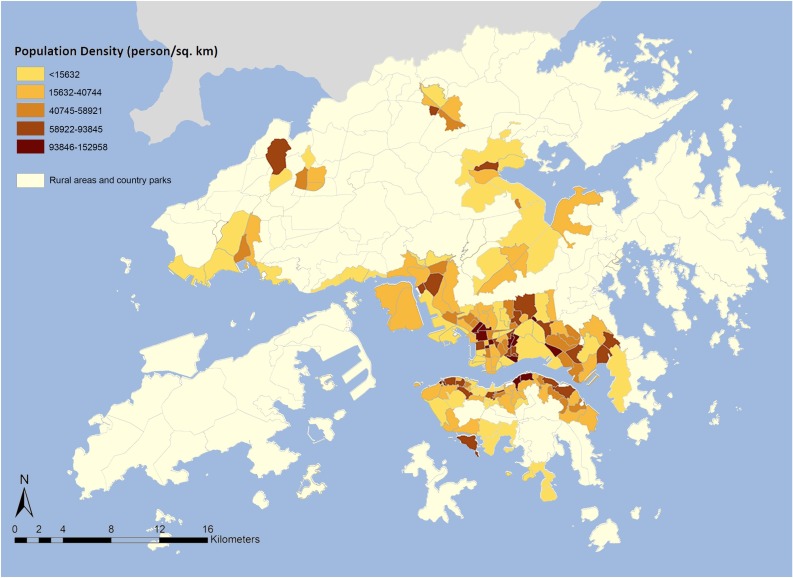
Various social distancing measures were carried out in many cities worldwide during the coronavirus disease 2019 pandemic (COVID-19). These measures have led to decreased physical activity levels and higher health risks among urban populations. Strong evidence has been established that built environment characteristics can stimulate physical activity and thus improve public health during non-pandemic periods. Urban density was arguably one of the most important built environment characteristics. However, little is known about whether high urban density amplifies or attenuates the decline in physical activity during the pandemic. Based on two-wave physical activity data collected before and during the pandemic (in January and May 2020, respectively), we used moderation analysis to compare the changes in physical activity levels between people living in low- and high-density neighborhoods. Our results showed that people living in low-density areas have a smaller decrease in physical activity conducted in neighborhood, compared to those living in high-density areas. Our findings suggest that a flexible and porous urban development strategy could enhance the resilience of a city during the coronavirus pandemic and beyond.
在2019冠状病毒病大流行(COVID-19)期间,全球许多城市都采取了各种社交距离措施。这些措施导致城市人口的身体活动水平下降,健康风险增加。有力的证据表明,在非大流行时期,建筑环境特征可以促进身体活动,从而改善公众健康。城市密度可以说是最重要的建筑环境特征之一。然而,对于高城市密度在大流行期间是加剧还是减轻身体活动的下降,人们知之甚少。基于在大流行之前和期间(分别在2020年1月和5月)收集的两波身体活动数据,我们使用调节分析来比较生活在低密度和高密度社区的人们之间身体活动水平的变化。我们的结果表明,与生活在高密度地区的人相比,生活在低密度地区的人在社区内进行的身体活动减少幅度较小。我们的研究结果表明,灵活且多孔的城市发展战略可以增强城市在冠状病毒大流行期间及之后的复原力。