Social, Genetic and Developmental Psychiatry Centre.
Department of Psychology.
Health Psychol. 2022 Jan;41(1):76-84. doi: 10.1037/hea0001129. Epub 2021 Nov 29.
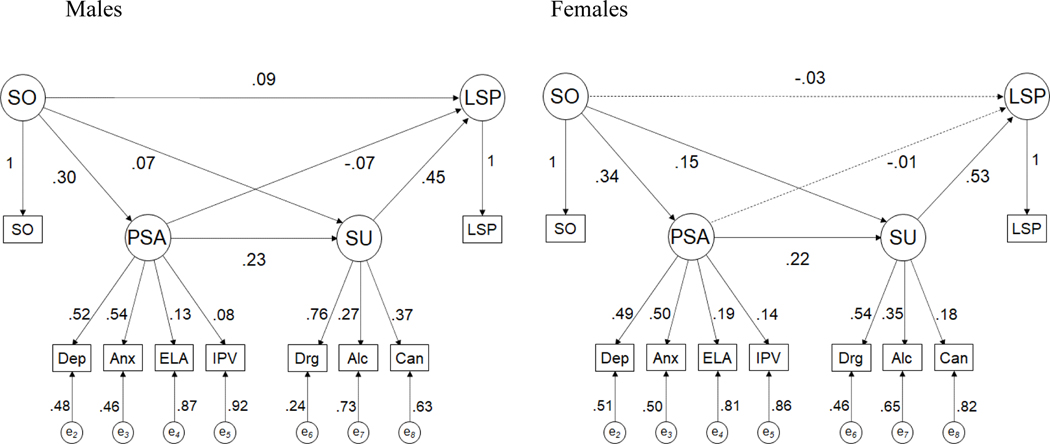
Risky sexual behavior among sexual minorities (lesbian, gay, and bisexual individuals) are partly attributed to mental health and other social disparities; but this may be confounded by correlated genetic and environmental influences. As preregistered, the present study investigated indirect associations between sexual minority status and increased lifetime sexual partners through increased psychosocial adversity (depressive and anxiety symptoms, intimate partner violence, and early life adversities) and substance use (alcohol, cannabis, and other illicit drugs), confounding by correlated genetic and environmental influences, and sex differences in these relationships.
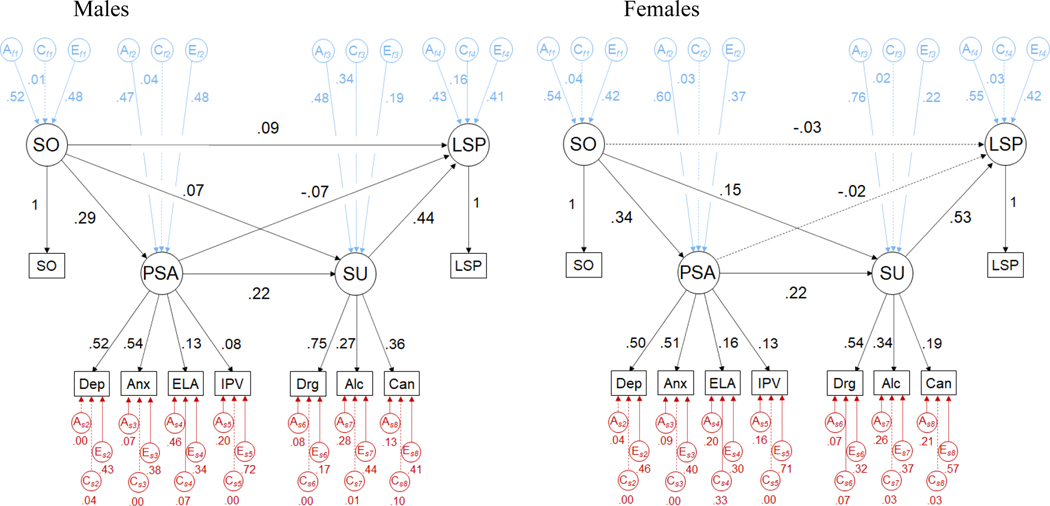
The sample comprised sexual minority and heterosexual twins who participated in the first and second phases of the latest wave of data collection in the U.K. population-based Twins Early Development study cohort (June 2017 through February 2019; = 9,697 and 8,718, respectively, = 22.3 ± .92 years). Structural equation modeling was used to specify psychosocial adversity and substance use as mediators while genetic and environmental confounding was further determined by biometrical genetic analyses in which similarities in identical and nonidentical twins were compared.
Increased psychosocial adversity and substance use fully mediated increased lifetime sexual partners in sexual minority women while this effect was partial (31.1%) in men. The best-fitting genetic models indicated that these relationships were not confounded by correlated genetic and environmental influences.
The relationships between sexual minority status, psychosocial adversity, substance use, and sexual health disparities appeared independent of genetic and environmental influences. Individual and systemic interventions to reduce psychosocial disadvantage and substance use can also decrease sexual health disparities among sexual minorities. (PsycInfo Database Record (c) 2022 APA, all rights reserved).
性少数群体(女同性恋、男同性恋和双性恋者)的危险性行为部分归因于心理健康和其他社会差异;但这可能与相关的遗传和环境影响有关。根据预先注册,本研究通过增加心理社会逆境(抑郁和焦虑症状、亲密伴侣暴力和早期生活逆境)和物质使用(酒精、大麻和其他非法药物)来间接研究性少数群体身份与增加终身性伴侣之间的关系,同时考虑相关的遗传和环境影响以及这些关系中的性别差异。
该样本包括参加英国基于人群的双胞胎早期发展研究队列最新数据收集第一和第二阶段的性少数群体和异性恋双胞胎(2017 年 6 月至 2019 年 2 月;分别为 9697 名和 8718 名,平均年龄为 22.3±0.92 岁)。结构方程模型用于指定心理社会逆境和物质使用作为中介,同时通过生物测量遗传分析进一步确定遗传和环境混杂,其中比较同卵和非同卵双胞胎的相似性。
在女性性少数群体中,增加的心理社会逆境和物质使用完全中介了增加的终身性伴侣,而在男性中,这种影响是部分的(31.1%)。最佳拟合的遗传模型表明,这些关系不受相关遗传和环境影响的影响。
性少数群体身份、心理社会逆境、物质使用与性健康差异之间的关系似乎独立于遗传和环境影响。减少心理社会劣势和物质使用的个体和系统干预也可以减少性少数群体的性健康差异。