Healthcare Systems Engineering Institute, Northeastern University, Boston, Massachusetts, USA.
Bowdoin Street Health Center, Beth Israel Deaconess Medical Center, Dorchester, Massachusetts, USA.
BMJ Open Qual. 2021 Nov;10(4). doi: 10.1136/bmjoq-2021-001603.
Closing loops to complete diagnostic referrals remains a significant patient safety problem in most health systems, with 65%-73% failure rates and significant delays common despite years of improvement efforts, suggesting new approaches may be useful. Systems engineering (SE) methods increasingly are advocated in healthcare for their value in studying and redesigning complex processes.
Conduct a formative SE analysis of process logic, variation, reliability and failures for completing diagnostic referrals originating in two primary care practices serving different demographics, using dermatology as an illustrating use case.
An interdisciplinary team of clinicians, systems engineers, quality improvement specialists, and patient representatives collaborated to understand processes of initiating and completing diagnostic referrals. Cross-functional process maps were developed through iterative group interviews with an urban community-based health centre and a teaching practice within a large academic medical centre. Results were used to conduct an engineering process analysis, assess variation within and between practices, and identify common failure modes and potential solutions.
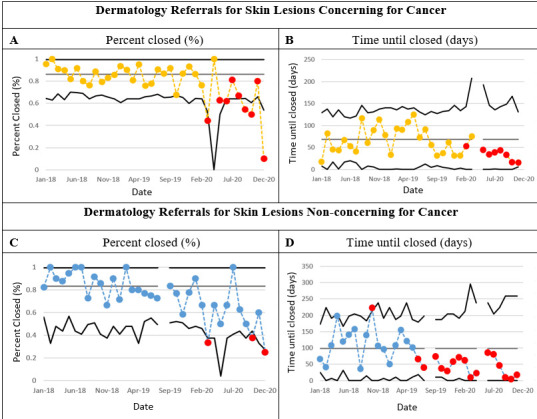
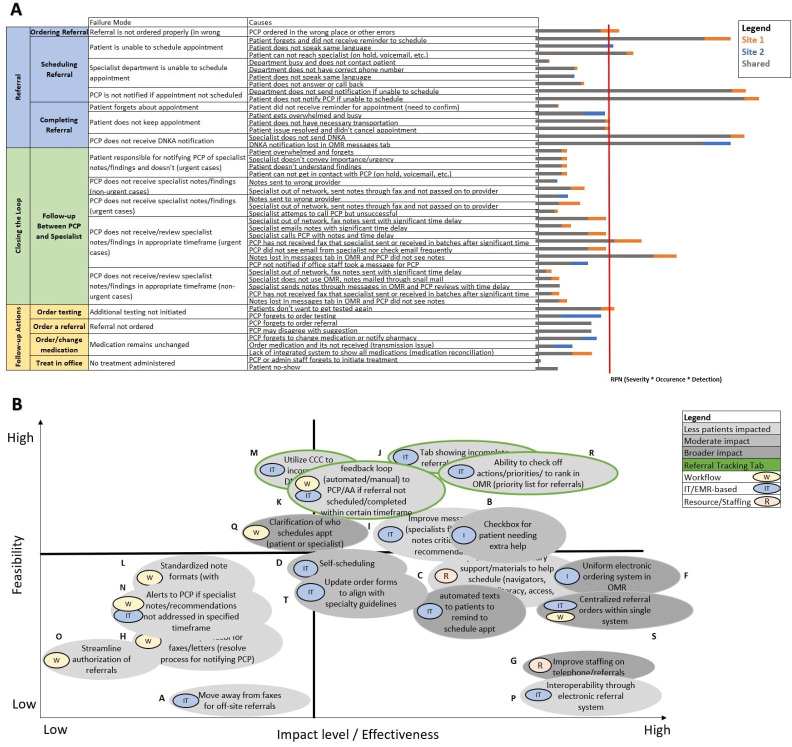
Processes to complete diagnostic referrals involve many sub-standard design constructs, with significant workflow variation between and within practices, statistical instability and special cause variation in completion rates and timeliness, and only 21% of all process activities estimated as value-add. Failure modes were similar between the two practices, with most process activities relying on low-reliability concepts (eg, reminders, workarounds, education and verification/inspection). Several opportunities were identified to incorporate higher reliability process constructs (eg, simplification, consolidation, standardisation, forcing functions, automation and opt-outs).
From a systems science perspective, diagnostic referral processes perform poorly in part because their fundamental designs are fraught with low-reliability characteristics and mental models, including formalised workaround and rework activities, suggesting a need for different approaches versus incremental improvement of existing processes. SE perspectives and methods offer new ways of thinking about patient safety problems, failures and potential solutions.
在大多数医疗系统中,完成诊断转介的闭环仍然是一个重大的患者安全问题,尽管多年来一直在努力改进,但失败率仍高达 65%-73%,且普遍存在显著延迟,这表明可能需要新的方法。系统工程(SE)方法在医疗保健领域越来越受到推崇,因为它们在研究和重新设计复杂流程方面具有价值。
针对来自两家服务于不同人群的初级保健诊所的诊断转介,使用皮肤病学作为说明性用例,对完成诊断转介的过程逻辑、变异性、可靠性和故障进行形成性 SE 分析。
一个由临床医生、系统工程师、质量改进专家和患者代表组成的跨学科团队合作,以了解启动和完成诊断转介的流程。通过对城市社区健康中心和大型学术医疗中心的教学实践进行迭代组访谈,开发了跨职能流程图。结果用于进行工程流程分析、评估实践内和实践间的变异性、识别常见故障模式和潜在解决方案。
完成诊断转介的流程涉及许多不符合标准的设计结构,实践内和实践间的工作流程存在显著差异,完成率和及时性存在统计不稳定和特殊原因变异性,只有 21%的所有流程活动被估计为增值。两个实践之间存在相似的故障模式,大多数流程活动依赖于低可靠性概念(例如,提醒、权宜之计、教育和验证/检查)。确定了几个机会来纳入更高可靠性的流程结构(例如,简化、整合、标准化、强制功能、自动化和选择退出)。
从系统科学的角度来看,诊断转介流程表现不佳,部分原因是其基本设计存在低可靠性特征和思维模式,包括正式的权宜之计和返工活动,这表明需要采用不同的方法,而不是对现有流程进行增量改进。SE 观点和方法为思考患者安全问题、故障和潜在解决方案提供了新的思路。