Department of Gynecologic Oncology, Fudan University Shanghai Cancer Center, Shanghai, China.
Department of Gynecologic Oncology, Cancer Hospital of the University of Chinese Academy of Sciences (Zhejiang Cancer Hospital), Hangzhou, China.
Clin Cancer Res. 2022 Feb 15;28(4):653-661. doi: 10.1158/1078-0432.CCR-21-1186.
Phase I results of this phase I/II study showed that pamiparib 60 mg twice a day had antitumor activity and an acceptable safety profile in Chinese patients with advanced cancer, including epithelial ovarian cancer.
This open-label phase II study was conducted in China and enrolled adult (≥18 years) patients with platinum-sensitive ovarian cancer (PSOC; disease progression occurring ≥6 months after last platinum treatment) or platinum-resistant ovarian cancer (PROC; disease progression occurring <6 months after last platinum treatment). Eligible patients had known or suspected deleterious germline BRCA mutation (gBRCAmut) and had previously received ≥2 lines of therapy. Pamiparib 60 mg orally twice a day was administered until disease progression, toxicity, or patient withdrawal. The primary endpoint was objective response rate (ORR) assessed by independent review committee (IRC) per RECIST version 1.1.
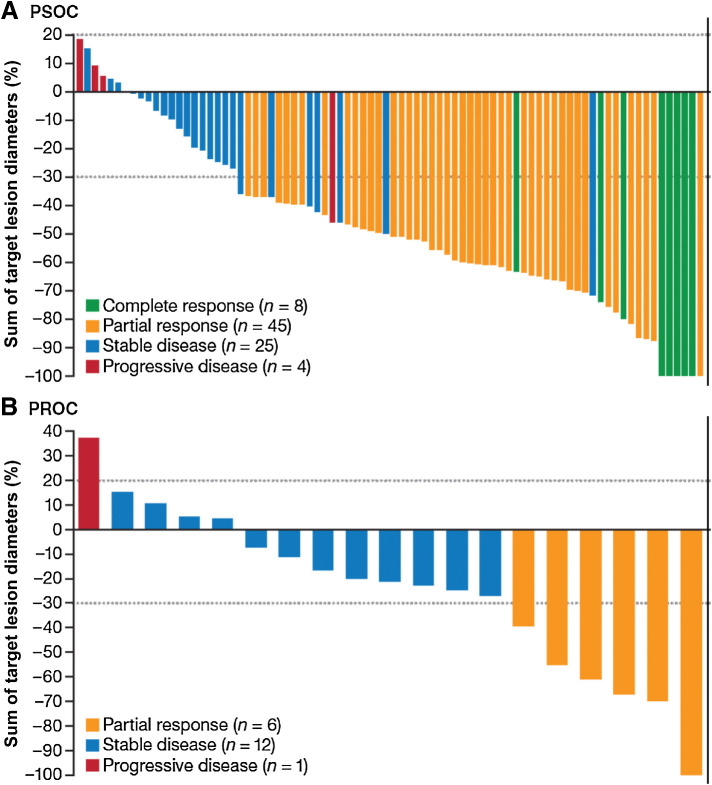
In the total patient population (N = 113; PSOC, n = 90; PROC, n = 23), median age was 54 years (range, 34-79) and 25.6% of patients received ≥4 prior systemic chemotherapy lines. Median study follow-up was 12.2 months (range, 0.2-21.5). Eighty-two patients with PSOC and 19 patients with PROC were evaluable for efficacy. In patients with PSOC, 8 achieved a complete response (CR) and 45 achieved a partial response (PR); ORR was 64.6% [95% confidence interval (CI), 53.3-74.9]. In patients with PROC, 6 achieved a PR; ORR was 31.6% (95% CI, 12.6-56.6). Frequently reported grade ≥3 adverse events were hematologic toxicities, including anemia and decreased neutrophil count.
Pamiparib 60 mg twice a day showed antitumor activity with durable responses in patients with PSOC or PROC with gBRCAmut, and had a manageable safety profile.
这项 I 期/II 期研究的 I 期结果表明,在包括上皮性卵巢癌在内的中国晚期癌症患者中,每日两次给予 60 毫克帕米帕利具有抗肿瘤活性和可接受的安全性。
这项在中国开展的开放标签 II 期研究纳入了成年(≥18 岁)铂类敏感卵巢癌(PSOC;末次铂类治疗后≥6 个月疾病进展)或铂类耐药卵巢癌(PROC;末次铂类治疗后<6 个月疾病进展)患者。合格患者具有已知或疑似有害种系 BRCA 突变(gBRCAmut),并且先前接受过≥2 线治疗。患者每日口服帕米帕利 60mg,2 次/天,直至疾病进展、毒性或患者退出。主要终点是独立审查委员会(IRC)根据 RECIST 版本 1.1 评估的客观缓解率(ORR)。
在总患者人群(N=113;PSOC,n=90;PROC,n=23)中,中位年龄为 54 岁(范围,34-79),25.6%的患者接受了≥4 线既往全身化疗。中位研究随访时间为 12.2 个月(范围,0.2-21.5)。82 例 PSOC 患者和 19 例 PROC 患者可评估疗效。在 PSOC 患者中,8 例达到完全缓解(CR),45 例达到部分缓解(PR);ORR 为 64.6%(95%CI,53.3-74.9)。在 PROC 患者中,6 例达到 PR;ORR 为 31.6%(95%CI,12.6-56.6)。报告的常见≥3 级不良事件为血液学毒性,包括贫血和中性粒细胞计数减少。
每日两次给予 60 毫克帕米帕利在具有 gBRCAmut 的 PSOC 或 PROC 患者中具有抗肿瘤活性,可获得持久缓解,且安全性可管理。