Jugniot Natacha, Bam Rakesh, Paulmurugan Ramasamy
Department of Radiology, Molecular Imaging Program at Stanford (MIPS), Canary Center for Cancer Early Detection at Stanford, Stanford University School of Medicine, Stanford University, 3155 Porter Drive, Palo Alto, CA, 94304, USA.
Sci Rep. 2021 Nov 29;11(1):23026. doi: 10.1038/s41598-021-02445-2.
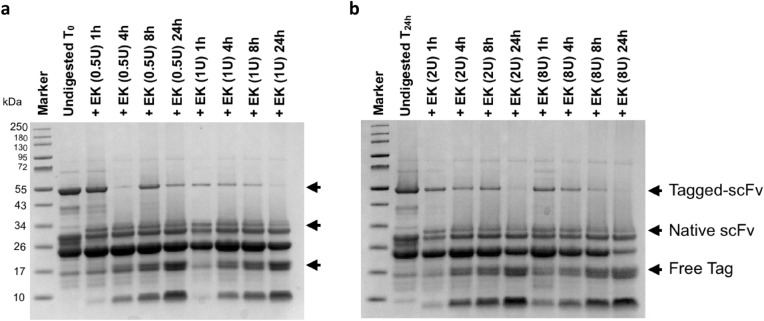
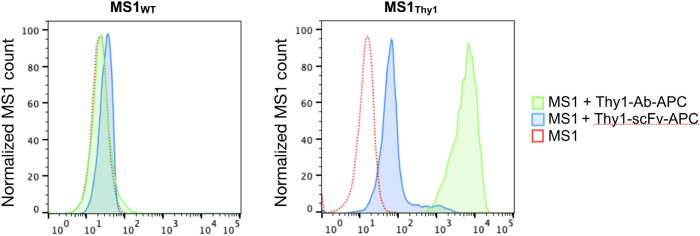
Molecular imaging using singlechain variable fragments (scFv) of antibodies targeting cancer specific antigens have been considered a non-immunogenic approach for early diagnosis in the clinic. Usually, production of proteins is performed within Escherichia coli. Recombinant proteins are either expressed in E. coli cytoplasm as insoluble inclusion bodies, that often need cumbersome denaturation and refolding processes, or secreted toward the periplasm as soluble proteins that highly reduce the overall yield. However, production of active scFvs in their native form, without any heterologous fusion, is required for clinical applications. In this study, we expressed an anti-thymocyte differentiation antigen-scFv (Thy1-scFv) as a fusion protein with a N-terminal sequence including 3 × hexa-histidines, as purification tags, together with a Trx-tag and a S-tag for enhanced-solubility. Our strategy allowed to recover ~ 35% of Thy1-scFv in the soluble cytoplasmic fraction. An enterokinase cleavage site in between Thy1-scFv and the upstream tags was used to regenerate the protein with 97.7 ± 2.3% purity without any tags. Thy1-scFv showed functionality towards its target on flow cytometry assays. Finally, in vivo molecular imaging using Thy1-scFv conjugated to an ultrasound contrast agent (MB) demonstrated signal enhancement on a transgenic pancreatic ductal adenocarcinoma (PDAC) mouse model (3.1 ± 1.2 a.u.) compared to non-targeted control (0.4 ± 0.4 a.u.) suggesting potential for PDAC early diagnosis. Overall, our strategy facilitates the expression and purification of Thy1-scFv while introducing its ability for diagnostic molecular imaging of pancreatic cancer. The presented methodology could be expanded to other important eukaryotic proteins for various applications, including but not limited to molecular imaging.
使用靶向癌症特异性抗原的抗体单链可变片段(scFv)进行分子成像,已被认为是临床上一种非免疫原性的早期诊断方法。通常,蛋白质在大肠杆菌中生产。重组蛋白要么在大肠杆菌细胞质中作为不溶性包涵体表达,这通常需要繁琐的变性和复性过程;要么作为可溶性蛋白分泌到周质中,但这会大大降低总产量。然而,临床应用需要以天然形式生产无任何异源融合的活性scFv。在本研究中,我们将抗胸腺细胞分化抗原scFv(Thy1-scFv)表达为一种融合蛋白,其N端序列包含3×六组氨酸作为纯化标签,以及用于增强溶解性的Trx标签和S标签。我们的策略使可溶性细胞质部分中约35%的Thy1-scFv得以回收。在Thy1-scFv和上游标签之间使用肠激酶切割位点来再生纯度为97.7±2.3%且无任何标签的蛋白质。Thy1-scFv在流式细胞术检测中对其靶标显示出功能活性。最后,使用与超声造影剂(MB)偶联的Thy1-scFv进行体内分子成像,结果表明,与非靶向对照(0.4±0.4任意单位)相比,转基因胰腺导管腺癌(PDAC)小鼠模型上有信号增强(3.1±1.2任意单位),提示其在PDAC早期诊断方面具有潜力。总体而言,我们的策略促进了Thy1-scFv的表达和纯化,同时赋予其对胰腺癌进行诊断性分子成像的能力。所提出的方法可扩展到其他重要的真核蛋白用于各种应用,包括但不限于分子成像。