Hafiz Rakibul, Gandhi Tapan Kumar, Mishra Sapna, Prasad Alok, Mahajan Vidur, Di Xin, Natelson Benjamin H, Biswal Bharat B
Department of Biomedical Engineering, New Jersey Institute of Technology (NJIT), 323 Dr Martin Luther King Jr Blvd, Newark, NJ 07102, USA.
Department of Electrical Engineering, Indian Institute of Technology (IIT), Block II, IIT Delhi Main Rd, IIT Campus, Hauz Khas, New Delhi, Delhi 110016, India.
medRxiv. 2022 Mar 1:2021.11.23.21266761. doi: 10.1101/2021.11.23.21266761.
Among systemic abnormalities caused by the novel coronavirus, little is known about the critical attack on the central nervous system (CNS). Few studies have shown cerebrovascular pathologies that indicate CNS involvement in acute patients. However, replication studies are necessary to verify if these effects persist in COVID-19 survivors more conclusively. Furthermore, recent studies indicate fatigue is highly prevalent among 'long-COVID' patients. How morphometry in each group relate to work-related fatigue need to be investigated.
COVID survivors were MRI scanned two weeks after hospital discharge. We hypothesized, these survivors will demonstrate altered gray matter volume (GMV) and experience higher fatigue levels when compared to healthy controls, leading to stronger correlation of GMV with fatigue. Voxel-based morphometry was performed on T1-weighted MRI images between 46 survivors and 30 controls. Unpaired two-sample t-test and multiple linear regression were performed to observe group differences and correlation of fatigue with GMV.
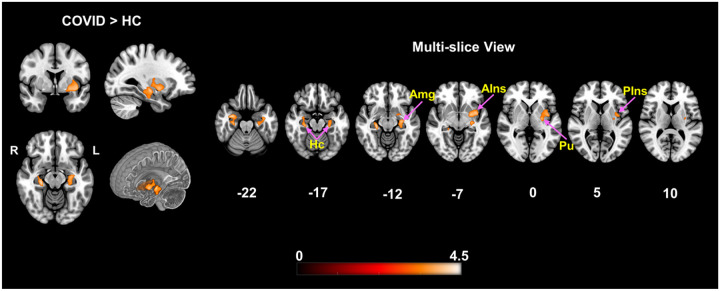
The COVID group experienced significantly higher fatigue levels and GMV of this group was significantly higher within the and when compared to healthy controls. Moreover, while a significant positive correlation was observed across the whole group between GMV and self-reported fatigue, COVID subjects showed stronger effects within the and .
Brain regions with GMV alterations in our analysis align with both single case acute patient reports and current group level neuroimaging findings. We also newly report a stronger positive correlation of GMV with fatigue among COVID survivors within brain regions associated with fatigue, indicating a link between structural abnormality and brain function in this cohort.
在新型冠状病毒引起的全身异常中,对中枢神经系统(CNS)的严重攻击了解甚少。很少有研究显示脑血管病变表明急性患者存在中枢神经系统受累。然而,需要进行重复研究以更确凿地验证这些影响在新冠病毒疾病(COVID-19)幸存者中是否持续存在。此外,最近的研究表明疲劳在“长期新冠”患者中非常普遍。需要研究每组的形态测量与工作相关疲劳之间的关系。
新冠病毒疾病幸存者在出院两周后接受磁共振成像(MRI)扫描。我们假设,与健康对照组相比,这些幸存者将表现出灰质体积(GMV)改变,并经历更高水平的疲劳,从而导致GMV与疲劳之间的更强相关性。对46名幸存者和30名对照组的T1加权MRI图像进行基于体素的形态测量。进行非配对双样本t检验和多元线性回归以观察组间差异以及疲劳与GMV的相关性。
新冠病毒疾病组经历了显著更高水平的疲劳,并且与健康对照组相比,该组的GMV在[具体脑区1]和[具体脑区2]内显著更高。此外,虽然在整个组中观察到GMV与自我报告的疲劳之间存在显著正相关,但新冠病毒疾病受试者在[具体脑区1]和[具体脑区2]内表现出更强的效应。
我们分析中GMV改变的脑区与单例急性患者报告以及当前组水平的神经影像学发现一致。我们还首次报告了在与疲劳相关的脑区内,新冠病毒疾病幸存者中GMV与疲劳之间存在更强的正相关,表明该队列中结构异常与脑功能之间存在联系。