Division of Human Nutrition and Health Wageningen University Wageningen the Netherlands.
Department of Epidemiology University Medical Center Groningen Groningen the Netherlands.
J Am Heart Assoc. 2021 Dec 7;10(23):e022617. doi: 10.1161/JAHA.121.022617. Epub 2021 Nov 30.
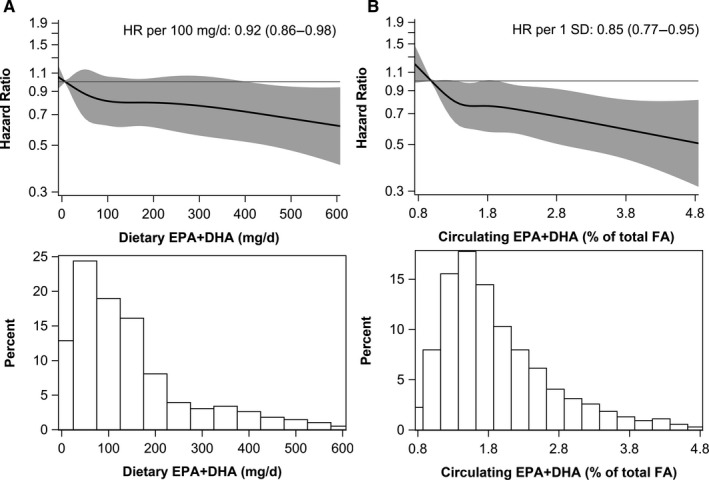
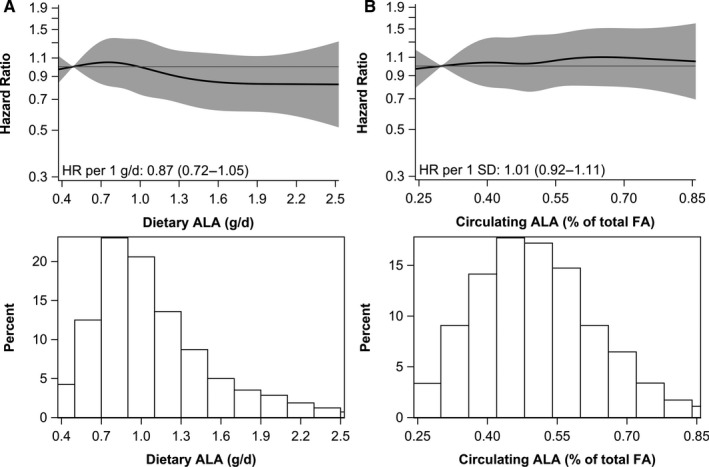
Background Habitual intake of long-chain omega-3 fatty acids, especially eicosapentaenoic and docosahexaenoic acid (EPA+DHA) from fish, has been associated with a lower risk of fatal coronary heart disease (CHD) in population-based studies. Whether that is also the case for patients with CHD is not yet clear. We studied the associations of dietary and circulating EPA+DHA and alpha-linolenic acid, a plant-derived omega-3 fatty acids, with long-term mortality risk after myocardial infarction. Methods and Results We analyzed data from 4067 Dutch patients with prior myocardial infarction aged 60 to 80 years (79% men, 86% on statins) enrolled in the Alpha Omega Cohort from 2002 to 2006 (baseline) and followed through 2018. Baseline intake of fish and omega-3 fatty acids were assessed through a validated 203-item food frequency questionnaire and circulating omega-3 fatty acids were assessed in plasma cholesteryl esters. Hazard ratios (HRs) with 95% CIs were obtained from Cox regression analyses. During a median follow-up period of 12 years, 1877 deaths occurred, of which 515 were from CHD and 834 from cardiovascular diseases. Dietary intake of EPA+DHA was significantly inversely associated with only CHD mortality (HR, 0.69 [0.52-0.90] for >200 versus ≤50 mg/d; HR, 0.92 [0.86-0.98] per 100 mg/d). Similar results were obtained for fish consumption (HR, 0.74 [0.53-1.03] for >40 versus ≤5 g/d; : 0.031). Circulating EPA+DHA was inversely associated with CHD mortality (HR, 0.71 [0.53-0.94] for >2.52% versus ≤1.29%; 0.85 [0.77-0.95] per 1-SD) and also with cardiovascular diseases and all-cause mortality. Dietary and circulating alpha-linolenic acid were not significantly associated with mortality end points. Conclusions In a cohort of Dutch patients with prior myocardial infarction, higher dietary and circulating EPA+DHA and fish intake were consistently associated with a lower CHD mortality risk. Registration URL: https://www.clinicaltrials.gov; Unique identifier: NCT03192410.
在基于人群的研究中,习惯性摄入长链欧米伽 3 脂肪酸,尤其是来自鱼类的二十碳五烯酸和二十二碳六烯酸(EPA+DHA),与致命性冠心病(CHD)风险降低有关。但对于 CHD 患者是否也是如此,目前尚不清楚。我们研究了饮食和循环中的 EPA+DHA 和α-亚麻酸(一种植物来源的欧米伽 3 脂肪酸)与心肌梗死后长期死亡率之间的关系。
我们分析了 4067 名年龄在 60 至 80 岁(79%为男性,86%服用他汀类药物)的荷兰既往心肌梗死患者的数据,这些患者来自 2002 年至 2006 年(基线)期间的 Alpha Omega 队列,并随访至 2018 年。通过经过验证的 203 项食物频率问卷评估基线时的鱼类和欧米伽 3 脂肪酸摄入量,通过血浆胆固醇酯评估循环中的欧米伽 3 脂肪酸。通过 Cox 回归分析获得危害比(HR)及其 95%置信区间。在中位随访 12 年期间,有 1877 人死亡,其中 515 人死于 CHD,834 人死于心血管疾病。饮食中 EPA+DHA 的摄入量与 CHD 死亡率呈显著负相关(与 >200 与 ≤50mg/d 相比,HR 为 0.69[0.52-0.90];与每 100mg/d 相比,HR 为 0.92[0.86-0.98])。鱼类摄入量也有类似的结果(与 >40 与 ≤5g/d 相比,HR 为 0.74[0.53-1.03];与每增加 1g/d 相比,HR 为 0.031)。循环中的 EPA+DHA 与 CHD 死亡率呈负相关(与 >2.52%与 ≤1.29%相比,HR 为 0.71[0.53-0.94];与每增加 1-SD 相比,HR 为 0.85[0.77-0.95]),与心血管疾病和全因死亡率也呈负相关。饮食和循环中的α-亚麻酸与死亡率终点无显著相关性。
在荷兰既往心肌梗死患者队列中,较高的饮食和循环 EPA+DHA 和鱼类摄入量与较低的 CHD 死亡率风险相关。