Molecular Crop Research Unit, Department of Biochemistry, Faculty of Science, Chulalongkorn University, Bangkok, Thailand.
Institut de Biologie Moléculaire des Plantes, Centre National de la Recherche Scientifique, Université de Strasbourg, Strasbourg, France.
PLoS One. 2021 Nov 30;16(11):e0260665. doi: 10.1371/journal.pone.0260665. eCollection 2021.
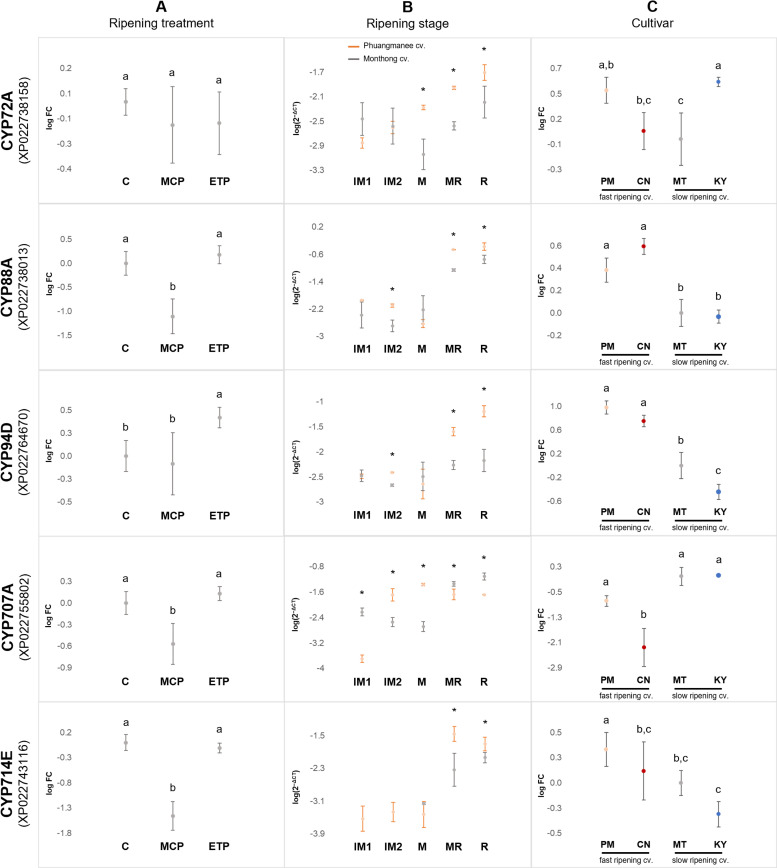
Durian (Durio zibethinus L.) is a major economic crop native to Southeast Asian countries, including Thailand. Accordingly, understanding durian fruit ripening is an important factor in its market worldwide, owing to the fact that it is a climacteric fruit with a strikingly limited shelf life. However, knowledge regarding the molecular regulation of durian fruit ripening is still limited. Herein, we focused on cytochrome P450, a large enzyme family that regulates many biosynthetic pathways of plant metabolites and phytohormones. Deep mining of the durian genome and transcriptome libraries led to the identification of all P450s that are potentially involved in durian fruit ripening. Gene expression validation by RT-qPCR showed a high correlation with the transcriptome libraries at five fruit ripening stages. In addition to aril-specific and ripening-associated expression patterns, putative P450s that are potentially involved in phytohormone metabolism were selected for further study. Accordingly, the expression of CYP72, CYP83, CYP88, CYP94, CYP707, and CYP714 was significantly modulated by external treatment with ripening regulators, suggesting possible crosstalk between phytohormones during the regulation of fruit ripening. Interestingly, the expression levels of CYP88, CYP94, and CYP707, which are possibly involved in gibberellin, jasmonic acid, and abscisic acid biosynthesis, respectively, were significantly different between fast- and slow-post-harvest ripening cultivars, strongly implying important roles of these hormones in fruit ripening. Taken together, these phytohormone-associated P450s are potentially considered additional molecular regulators controlling ripening processes, besides ethylene and auxin, and are economically important biological traits.
榴莲(Durio zibethinus L.)是原产于东南亚国家的主要经济作物,包括泰国。因此,了解榴莲果实的成熟过程是其在全球市场上的一个重要因素,因为它是一种呼吸跃变型果实,货架期极短。然而,关于榴莲果实成熟的分子调控机制的知识仍然有限。在此,我们重点研究了细胞色素 P450,这是一个调节植物代谢物和植物激素许多生物合成途径的大型酶家族。对榴莲基因组和转录组文库进行深度挖掘,鉴定出所有可能参与榴莲果实成熟的 P450。通过 RT-qPCR 进行的基因表达验证与五个果实成熟阶段的转录组文库高度相关。除了种皮特异性和成熟相关的表达模式外,还选择了可能参与植物激素代谢的假定 P450 进行进一步研究。因此,CYP72、CYP83、CYP88、CYP94、CYP707 和 CYP714 的表达在外源处理成熟调节剂后显著调节,表明在果实成熟调控过程中植物激素之间可能存在串扰。有趣的是,CYP88、CYP94 和 CYP707 的表达水平(分别可能涉及赤霉素、茉莉酸和脱落酸的生物合成)在快速和慢速后熟品种之间差异显著,强烈暗示这些激素在果实成熟过程中具有重要作用。综上所述,这些与植物激素相关的 P450 可能被视为除乙烯和生长素之外,控制成熟过程的额外分子调控因子,是具有经济重要性的生物学特征。