School of Public Health, National Health Commission Key Laboratory of Reproductive Health, Institute of Child and Adolescent Health, Peking University, Beijing, China.
Department of Plant Science and Landscape Architecture, University of Maryland, College Park, Maryland, USA.
J Clin Hypertens (Greenwich). 2021 Dec;23(12):2053-2064. doi: 10.1111/jch.14393. Epub 2021 Nov 30.
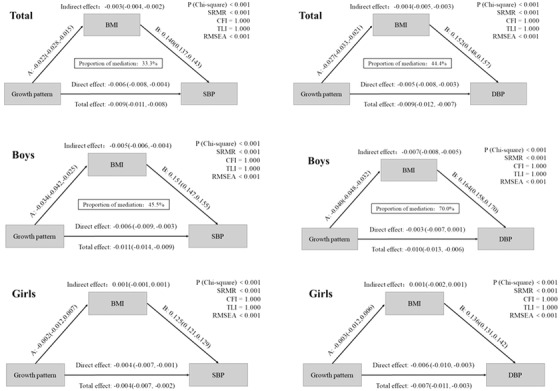
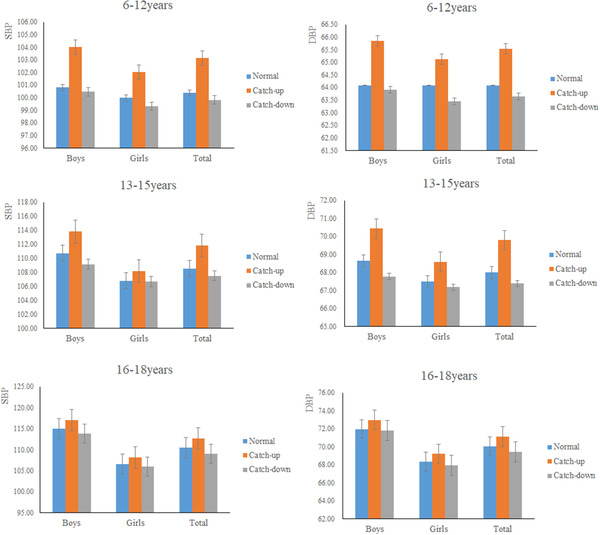
Aimed to investigate the associations between different growth patterns with high blood pressure, and further examine the mediation effect of BMI between growth patterns and high blood pressure among children and adolescents. A total of 31581 children and adolescents aged 7-18 years were selected based on the stratified cluster sampling method. Logistics regression models were used to calculate the odds rations (ORs) and 95% confidence interval (95%CI) of the association between different growth patterns and high blood pressure. Mediation effect analyses were applied to estimate the effect of BMI on the increase of blood pressure levels in different growth patterns. In different sex and ages, compared to reference group of normal growth, blood pressure levels and prevalence of high blood pressure of the catch-up growth were higher, but that of the catch-down growth were lower. The prevalence of high blood pressure was 11.69%, 16.06%, and 9.68% in normal growth, catch-up growth, and catch-down growth, respectively. In total, compared with the normal growth pattern, the ORs (95%CI) of high blood pressure, high systolic blood pressure and high diastolic blood pressure in the catch-up growth were 1.171(1.073,1.280), 1.110(1.001,1.230) and 1.141(1.025,1.270) (p < .05), respectively. Additionally, the mediation effect of current BMI existed in the association between blood pressure levels and different growth patterns, particularly in boys. Our findings suggested that different growth patterns after birth could modify blood pressure, and the potential risks of high blood pressure could be increased by catch-up growth at childhood and adolescence.
探讨不同生长模式与高血压的相关性,并进一步检验 BMI 在儿童青少年生长模式与高血压之间的中介效应。
采用分层整群抽样方法,选取了 31581 名 7-18 岁的儿童和青少年。采用逻辑回归模型计算不同生长模式与高血压之间的关联的优势比(OR)和 95%置信区间(95%CI)。采用中介效应分析估计 BMI 对不同生长模式下血压水平升高的影响。
在不同性别和年龄段,与正常生长参考组相比,追赶生长组的血压水平和高血压患病率较高,而下降生长组的血压水平和高血压患病率较低。正常生长、追赶生长和下降生长的高血压患病率分别为 11.69%、16.06%和 9.68%。总体而言,与正常生长模式相比,追赶生长模式的高血压、收缩压和舒张压的 ORs(95%CI)分别为 1.171(1.073,1.280)、1.110(1.001,1.230)和 1.141(1.025,1.270)(p<.05)。此外,当前 BMI 在血压水平与不同生长模式之间的关联中存在中介效应,尤其是在男孩中。
出生后不同的生长模式可以改变血压,儿童和青少年时期的追赶生长会增加高血压的潜在风险。