Valldeoriola Francesc, Catalán María José, Escamilla-Sevilla Francisco, Freire Eric, Olivares Jesús, Cubo Esther, García Diego Santos, Calopa Matilde, Martínez-Martín Pablo, Parra Juan Carlos, Arroyo Gloria, Arbelo José Matías
Movement Disorders Unit, Neurology Service, Clínic Hospital, 170, Villarroel St., 08036, Barcelona, Spain.
Neurology Service, Clínico San Carlos Hospital, Profesor Martín Lagos St., 28040, Madrid, Spain.
NPJ Parkinsons Dis. 2021 Nov 30;7(1):108. doi: 10.1038/s41531-021-00246-y.
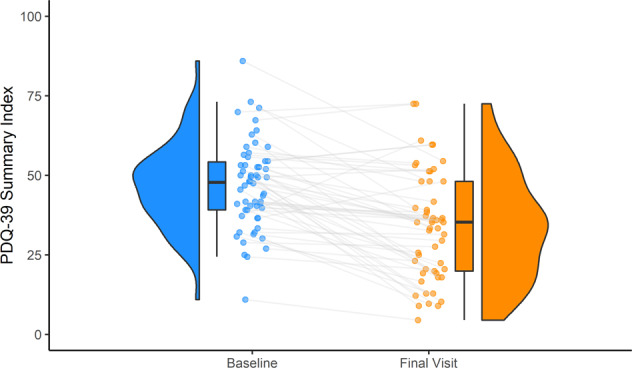
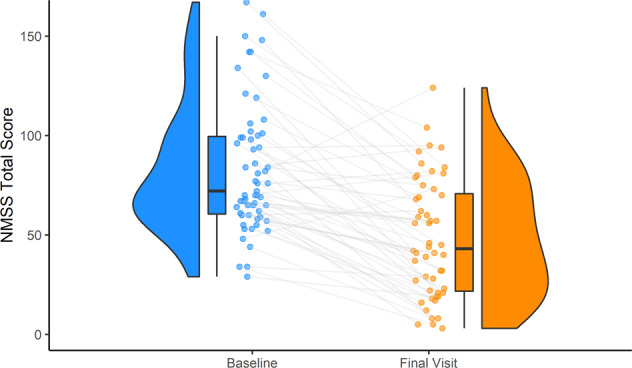
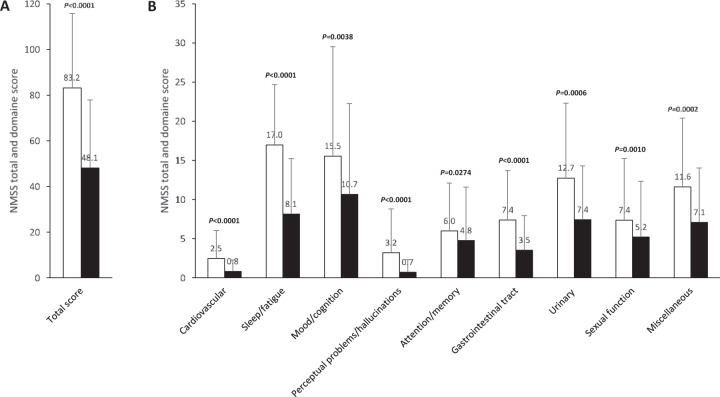
Levodopa-carbidopa intestinal gel (LCIG) has shown to be efficacious in motor and non-motor symptoms (NMS). Nevertheless, studies with patient Quality of Life (QoL) as a primary endpoint are scarce. To assess the effect of LCIG on Advanced Parkinson's Disease (APD) patients QoL. Secondarily, the impact on motor symptoms and NMS, emotional well-being, treatment satisfaction, and caregiver QoL, stress, disease burden, anxiety, depression, and work impairment were also investigated. In this prospective, 6-month multicenter postmarketing observational study, LCIG was administered to 59 patients with APD. Endpoints were assessed using validated scales and questionnaires. LCIG significantly improved patient QoL (PDQ-39 mean change ± standard deviation from baseline, -12.8 ± 14.6; P < 0.0001), motor symptoms (UPDRS-III in "On," -6.5 ± 11.8; P = 0.0002), NMS (NMSS, -35.7 ± 31.1; P < 0.0001), mood (Norris/Bond-Lader VAS, -6.6 ± 21.1; P = 0.0297), fatigue (PFS-16, -0.6 ± 1.0; P = 0.0003), depression (BDI-II, -5.1 ± 9.4; P = 0.0002), anxiety (BAI, -6.2 ± 9.6; P < 0.0001), and patient treatment satisfaction (SATMED-Q, 16.1 ± 16.8; P < 0.0001). There were significant correlations between the change from baseline to 6 months between PDQ-39 and UPDRS-IV, NMSS, BAI, BDI-II, AS, and PFS-16 scores, and Norris/Bond-Lader alertness/sedation factor. Caregiver anxiety also improved (Goldberg anxiety scale, -1.1 ± 1.0; P = 0.0234), but the clinical relevance of this finding is questionable. The serious adverse events reported were similar to those previously described for LCIG. In patients with APD, LCIG improves QoL, motor symptoms and NMS, emotional well-being, and satisfaction with the treatment. Improvement in patient QoL is associated with improvements in motor complications, NMS, anxiety, depression, apathy and fatigue. Improvements in patients' QoL does not correspond with improvements in caregivers' QoL or burden.
左旋多巴-卡比多巴肠凝胶(LCIG)已被证明对运动症状和非运动症状(NMS)有效。然而,以患者生活质量(QoL)作为主要终点的研究却很少。为了评估LCIG对晚期帕金森病(APD)患者生活质量的影响。其次,还研究了其对运动症状和非运动症状、情绪健康、治疗满意度以及照料者生活质量、压力、疾病负担、焦虑、抑郁和工作障碍的影响。在这项为期6个月的前瞻性多中心上市后观察性研究中,对59例APD患者使用了LCIG。使用经过验证的量表和问卷对终点进行评估。LCIG显著改善了患者的生活质量(帕金森病问卷-39 [PDQ-39] 从基线的平均变化±标准差,-12.8±14.6;P<0.0001)、运动症状(“开”期统一帕金森病评定量表第三部分 [UPDRS-III],-6.5±11.8;P = 0.0002)、非运动症状(非运动症状量表 [NMSS],-35.7±31.1;P<0.0001)、情绪(诺里斯/邦德-拉德视觉模拟量表 [Norris/Bond-Lader VAS],-6.6±21.1;P = 0.0297)、疲劳(疲劳严重程度量表-16 [PFS-16],-0.6±1.0;P = 0.0003)、抑郁(贝克抑郁量表第二版 [BDI-II],-5.1±9.4;P = 0.0002)、焦虑(贝克焦虑量表 [BAI],-6.2±9.6;P<0.0001)以及患者治疗满意度(药物治疗满意度问卷 [SATMED-Q],16.1±16.8;P<0.0001)。从基线到6个月,PDQ-39与UPDRS-IV、NMSS、BAI、BDI-II、淡漠评分量表 [AS] 和PFS-16评分以及Norris/Bond-Lader警觉/镇静因子之间的变化存在显著相关性。照料者的焦虑也有所改善(戈德堡焦虑量表,-1.1±1.0;P = 0.0234),但这一发现的临床相关性值得怀疑。报告的严重不良事件与先前描述的LCIG的不良事件相似。在APD患者中,LCIG改善了生活质量、运动症状和非运动症状、情绪健康以及对治疗的满意度。患者生活质量的改善与运动并发症、非运动症状、焦虑、抑郁、淡漠和疲劳的改善相关。患者生活质量的改善与照料者生活质量或负担的改善并不对应。