Department of Animal Medicine, Production and Health, University of Padova, Viale dell'Università, 16, 35020, Legnaro, PD, Italy.
School of Natural and Environmental Science, Newcastle University, Newcastle Upon Tyne, NE1 7RU, UK.
Sci Rep. 2021 Dec 1;11(1):23201. doi: 10.1038/s41598-021-02600-9.
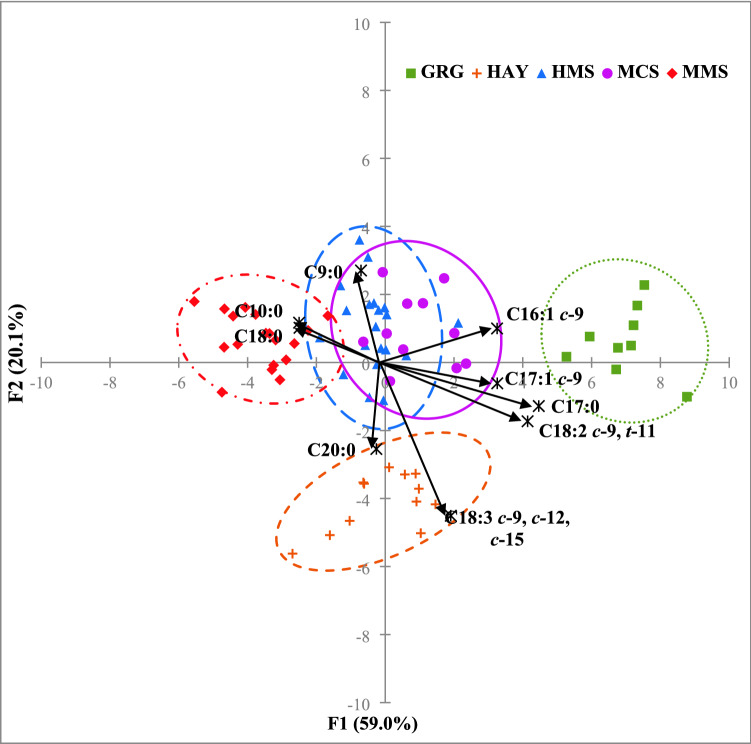
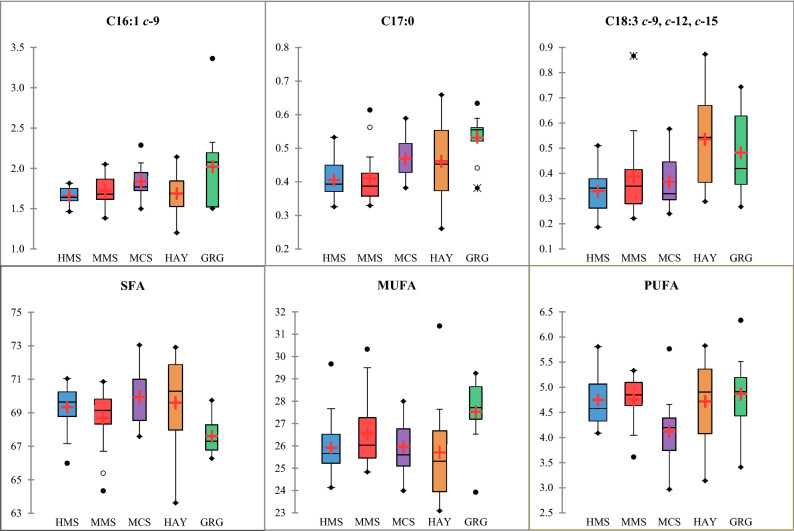
Although there are many studies on the importance of fatty acids (FA) in our diet and on the influence of dairy diets on FA metabolism, only a few investigate their predictive capacity to discriminate the type, amount and conservation method of farm forages. This research quantifies differences in milk FA concentrations and, using a supervised factorial discriminant analysis, assesses potential biomarkers when replacing maize with other silages, grass/lucerne hays or fresh grass. The statistical modelling identified three main clusters of milk FA profiles associated with silages, hays and fresh grass as dominant roughages. The main implication of a dairy cow feeding system based on poliphytic forages from permanent meadows is enhancing milk's nutritional quality due to an increase in beneficial omega-3 polyunsaturated FA, conjugated linoleic acids and odd chain FA, compared to feeding maize silage. The study also identified a small but powerful and reliable pool of milk FA that can act as biomarkers to authenticate feeding systems: C16:1 c-9, C17:0, C18:0, C18:3 c-9, c-12, c-15, C18:1 c-9, C18:1 t-11 and C20:0.
尽管有许多关于脂肪酸(FA)在我们饮食中的重要性以及乳制品饮食对 FA 代谢影响的研究,但只有少数研究调查了它们预测能力,以区分农场饲料的类型、数量和保存方法。本研究量化了牛奶 FA 浓度的差异,并使用有监督的因子判别分析,评估了用其他青贮料、草/紫花苜蓿干草或新鲜草替代玉米时的潜在生物标志物。统计模型确定了与青贮料、干草和新鲜草相关的三个主要牛奶 FA 谱簇,这些饲料是主要的粗饲料。基于永久性草地的多营养牧草的奶牛饲养系统的主要意义是通过增加有益的 omega-3 多不饱和脂肪酸、共轭亚油酸和奇数链脂肪酸来提高牛奶的营养价值,与饲喂玉米青贮料相比。该研究还确定了一小部分但功能强大且可靠的牛奶 FA 池,可以作为生物标志物来验证饲养系统:C16:1 c-9、C17:0、C18:0、C18:3 c-9、c-12、c-15、C18:1 c-9、C18:1 t-11 和 C20:0。