
中医药治疗骨关节炎的探索性配伍规律:基于数据挖掘和随机游走的识别
Exploratory Compatibility Regularity of Traditional Chinese Medicine on Osteoarthritis Treatment: A Data Mining and Random Walk-Based Identification.
作者信息
Zhou Qiao, Liu Jian, Xin Ling, Fang Yanyan, Wan Lei, Huang Dan, Guo Jinchen, Wen Jianting, Wang Bing
机构信息
Institute of Rheumatism Prevention and Treatment of Traditional Chinese Medicine, Anhui Academy of Chinese Medicine Sciences, Hefei 230031, China.
Geriatrics Department, The Second Affiliated Hospital, Anhui University of Chinese Medicine, Hefei 230061, China.
出版信息
Evid Based Complement Alternat Med. 2021 Nov 22;2021:2361512. doi: 10.1155/2021/2361512. eCollection 2021.
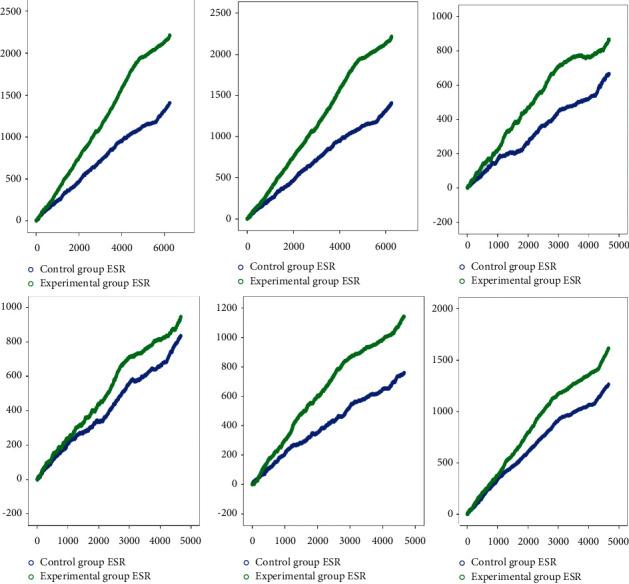
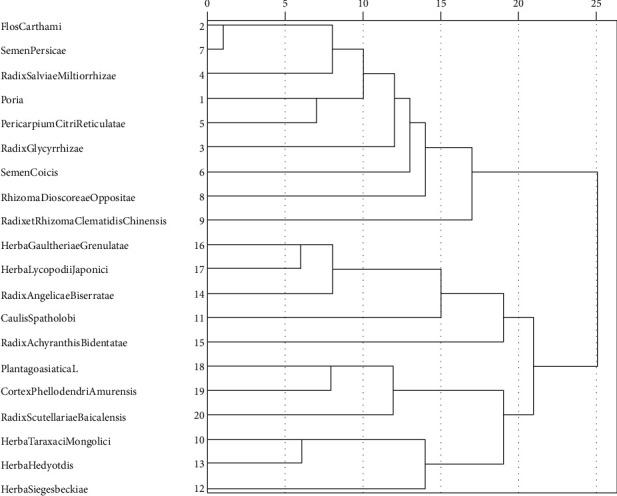
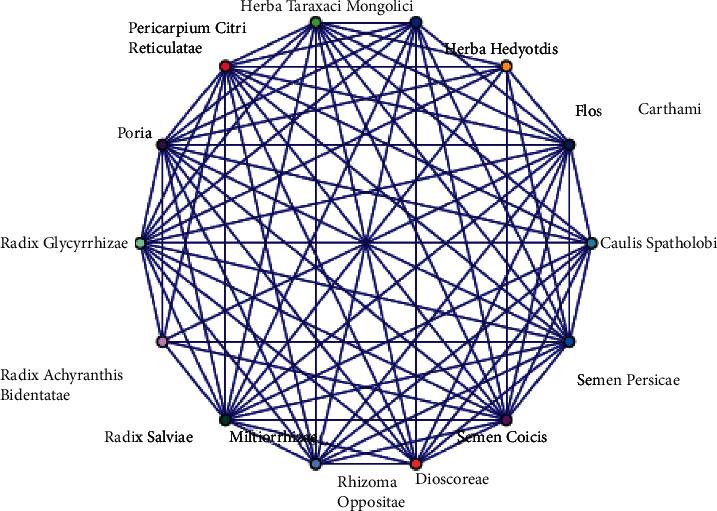
Osteoarthritis (OA) is a degressive and complex disease which is a growing public health problem on a global scale. On basis of an in-house database consisting of clinical records of 13,083 OA patients, the Traditional Chinese Medicine (TCM) was divided into 4 categories of medicines on the basis of the curative properties of herbs. Due to the lack of depth and internal relationship in the calculation results of TCM compatibility law data mining methods such as statistics and frequency analysis, we use a variety of multidimensional complex network methods that can efficaciously find the compatibility law of TCM, including similarity measure, graphical visualization of network diagram, random walking, and propensity score methods. We summarize common couplet medicines utilized for the treatment of osteoarthritis. The similarity measure method was used to investigate the commonly used drugs for the treatment of osteoarthritis. The method of association rule analysis is used to recognize the compatibility between the components. On basis of the propensity score methods, the evaluation displayed that, compared with single drug, the drug group increased ESR, CRP, C3, C4, IgG, and IgA more efficiently. Concluding, a random walk model was constructed to assess drug efficacy. After applying a random walk model, while revealing the compatibility among different components of TCM, their therapeutic efficacy against OA is analyzed. We obtained four groups of drug combination clusters by similarity measure and 11 pairs of highly connected drugs by association rules, which are cardinal drug combinations in the prescription for the treatment of OA. We also found that different traditional drug pairs were associated with different laboratory indexes, and drug combinations could better optimize laboratory indexes. This study presented that the TCM constituents complement one another. Besides, the therapeutic effects resulting from a variety of combinations of these constituents are quite different.
骨关节炎(OA)是一种退行性复杂疾病,在全球范围内,它正成为一个日益严重的公共卫生问题。基于一个包含13083例骨关节炎患者临床记录的内部数据库,根据草药的治疗特性,将中药分为4类药物。由于统计和频率分析等中药配伍规律数据挖掘方法的计算结果缺乏深度和内在联系,我们使用了多种能够有效发现中药配伍规律的多维复杂网络方法,包括相似性度量、网络图的图形可视化、随机游走和倾向得分方法。我们总结了用于治疗骨关节炎的常见对药。采用相似性度量方法研究了治疗骨关节炎的常用药物。运用关联规则分析方法识别各成分之间的配伍关系。基于倾向得分方法的评估显示,与单一药物相比,药物组合更有效地提高了血沉、C反应蛋白、C3、C4、免疫球蛋白G和免疫球蛋白A。结论是,构建了一个随机游走模型来评估药物疗效。应用随机游走模型后,在揭示中药不同成分之间配伍关系的同时,分析了它们对骨关节炎的治疗效果。通过相似性度量得到了4组药物组合聚类,通过关联规则得到了11对高连接药物,这些都是治疗骨关节炎方剂中的主要药物组合。我们还发现不同的传统药对与不同的实验室指标相关,药物组合可以更好地优化实验室指标。本研究表明中药成分相互补充。此外,这些成分的各种组合所产生的治疗效果差异很大。
 Zotero 插件