Levvel, Academic Center for Child and Adolescent Psychiatry, Meibergdreef 5, 1105 AZ, Amsterdam, The Netherlands.
Amsterdam UMC, Department of Child and Adolescent Psychiatry, Amsterdam Public Health, University of Amsterdam, Amsterdam, The Netherlands.
Eur Child Adolesc Psychiatry. 2023 Oct;32(10):1821-1839. doi: 10.1007/s00787-021-01907-2. Epub 2021 Dec 1.
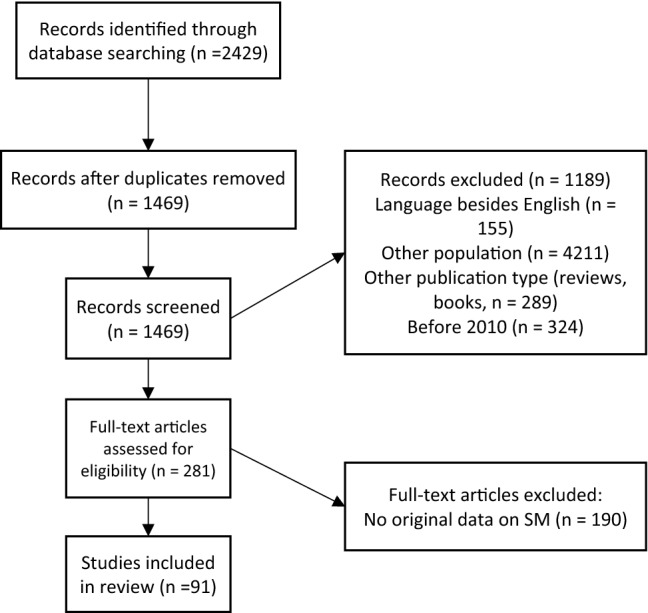
Selective mutism (SM) is an anxiety disorder (prevalence 1-2%), characterized by the consistent absence of speaking in specific situations (e.g., in school), while adequately speaking in other situations (e.g., at home). SM can have a debilitating impact on the psychosocial and academic functioning in childhood. The use of psychometrically sound and cross-culturally valid instruments is urgently needed.The aim of this paper is to identify and review the available assessment instruments for screening or diagnosing the core SM symptomatology. We conducted a systematic search in 6 databases. We identified 1469 studies from the last decade and investigated the measures having been used in a diagnostic assessment of SM. Studies were included if original data on the assessment or treatment of SM were reported. It was found that 38% of published studies on SM reporting original data did not report the use of any standardized or objective measure to investigate the core symptomatology. The results showed that many different questionnaires, interviews and observational instruments were used, many of these only once. The Selective Mutism Questionnaire (SMQ), Anxiety Disorders Interview Schedule (ADIS) and School Speech Questionnaire (SSQ) were used most often. Psychometric data on these instruments are emerging. Beyond these commonly used instruments, more recent developed instruments, such as the Frankfurt Scale of SM (FSSM) and the Teacher Telephone Interview for SM (TTI-SM), are described, as well as several interesting observational measures. The strengths and weaknesses of the instruments are discussed and recommendations are made for their use in clinical practice and research.
选择性缄默症 (SM) 是一种焦虑障碍(患病率为 1-2%),其特征是在特定情况下(例如在学校)持续不说话,而在其他情况下(例如在家)则能正常说话。SM 会对儿童的社会心理和学业功能产生严重影响。因此,迫切需要使用具有良好心理测量学特性和跨文化有效性的工具。本文旨在确定和回顾现有的用于筛查或诊断核心 SM 症状的评估工具。我们在 6 个数据库中进行了系统搜索。从过去十年中确定了 1469 项研究,并调查了在 SM 诊断评估中使用的措施。如果报告了有关 SM 的评估或治疗的原始数据,则将研究纳入。结果发现,在报告原始数据的 SM 研究中,有 38%的研究未报告使用任何标准化或客观的措施来调查核心症状。结果表明,使用了许多不同的问卷、访谈和观察工具,其中许多只是一次性使用。选择性缄默症问卷 (SMQ)、焦虑症访谈量表 (ADIS) 和学校言语问卷 (SSQ) 使用最频繁。这些工具的心理测量学数据正在出现。除了这些常用的工具,还描述了一些最近开发的工具,如法兰克福选择性缄默症量表 (FSSM) 和教师电话访谈用于选择性缄默症 (TTI-SM),以及一些有趣的观察性措施。讨论了这些工具的优缺点,并就其在临床实践和研究中的使用提出了建议。