Child, Family, & Population Health Nursing, University of Washington, Seattle, WA, USA.
Department of Preventive Medicine, Rush University Medical Center, Chicago, IL, USA.
Health Soc Care Community. 2022 May;30(3):1199-1211. doi: 10.1111/hsc.13671. Epub 2021 Dec 1.
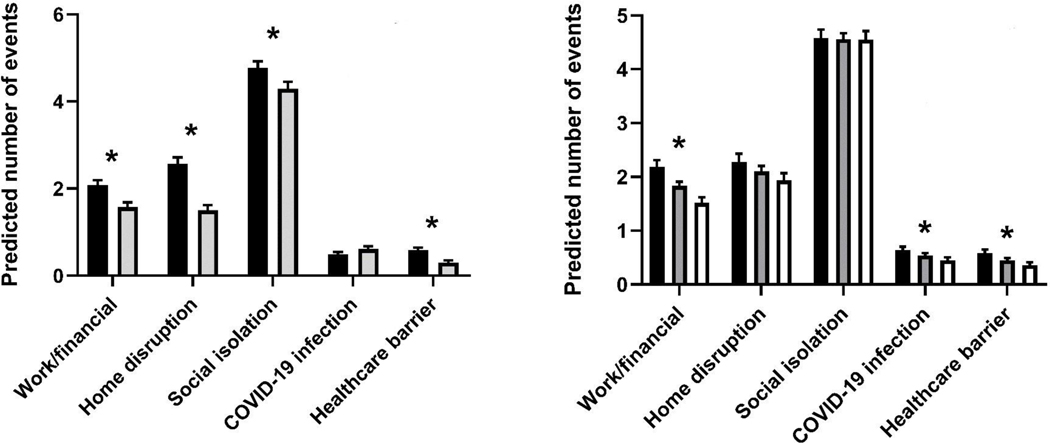
Impacts of the COVID-19 pandemic in the United States have been exacerbated by pre-existing inequities in resources and opportunities, leaving the most vulnerable to face a multitude of hardships. The goal of the current study was to characterise COVID-19-related stressful life events in specific life domains and to identify the sociodemographic characteristics of individuals who are more likely to experience such events. Participants (n = 372, 57% female) in a follow-up study of the NICHD Study of Early Child Care and Youth Development completed the Epidemic-Pandemic Impacts Inventory (June-August 2020) to assess COVID-19-related stressors. Sociodemographic factors (gender, race/ethnicity, socioeconomic status and wealth) were examined simultaneously as predictors of the number of stressful life events in separate categories of work/finances, home life, social activity, health and healthcare, adjusted for covariates (household size, community COVID-19 transmission risk). In negative binomial regression analyses, being female (vs. male) predicted a 31%, 64%, 13% and 94% increase in the number of stressful life events in domains of work/finances, home life, social activity and healthcare, respectively, whereas each one standard deviation increase in wealth predicted a 17%, 16% and 21% reduction in the number of stressful life events in domains of work/finances, COVID-19 infection and healthcare, respectively. Findings highlight the pronounced and far-reaching impacts of the COVID-19 pandemic on women as well as the unique role wealth may play in lessening such impacts. This new knowledge may be leveraged to develop intervention and policy-related strategies to remediate impacts of COVID-19-related stressors on those most vulnerable.
美国 COVID-19 疫情的影响因资源和机会方面先前存在的不平等而加剧,使最脆弱的群体面临多种困难。本研究的目的是描述特定生活领域中与 COVID-19 相关的压力性生活事件,并确定更有可能经历此类事件的个体的社会人口学特征。在 NICHD 早期儿童保育和青年发展研究的一项随访研究中,参与者(n=372,57%为女性)完成了流行病大流行影响清单(2020 年 6 月至 8 月),以评估与 COVID-19 相关的压力源。社会人口学因素(性别、种族/族裔、社会经济地位和财富)同时作为工作/财务、家庭生活、社会活动、健康和医疗保健等类别的压力性生活事件数量的预测因素进行了检查,调整了协变量(家庭规模、社区 COVID-19 传播风险)。在负二项回归分析中,与男性相比,女性(与男性相比)分别预测工作/财务、家庭生活、社会活动和医疗保健领域的压力性生活事件数量增加 31%、64%、13%和 94%,而财富每增加一个标准差分别预测工作/财务、COVID-19 感染和医疗保健领域的压力性生活事件数量减少 17%、16%和 21%。研究结果强调了 COVID-19 大流行对女性的明显而深远的影响,以及财富在减轻此类影响方面可能发挥的独特作用。这些新知识可用于制定干预和政策相关战略,以减轻与 COVID-19 相关压力源对最脆弱群体的影响。