Department of Orthopedics, Sir Run Run Shaw Hospital, Medical College of Zhejiang University, Hangzhou, China.
Spine (Phila Pa 1976). 2022 Mar 15;47(6):E233-E242. doi: 10.1097/BRS.0000000000004303.
Prospective cohort study.
To assess the differences in the clinical and radiological outcomes between oblique lateral interbody fusion (OLIF) and minimally invasive transforaminal lumbar interbody fusion (MI-TLIF).
Nowadays, there is still a controversy regarding whether OLIF is superior to MI-TLIF in the management of degenerative lumbar disease.
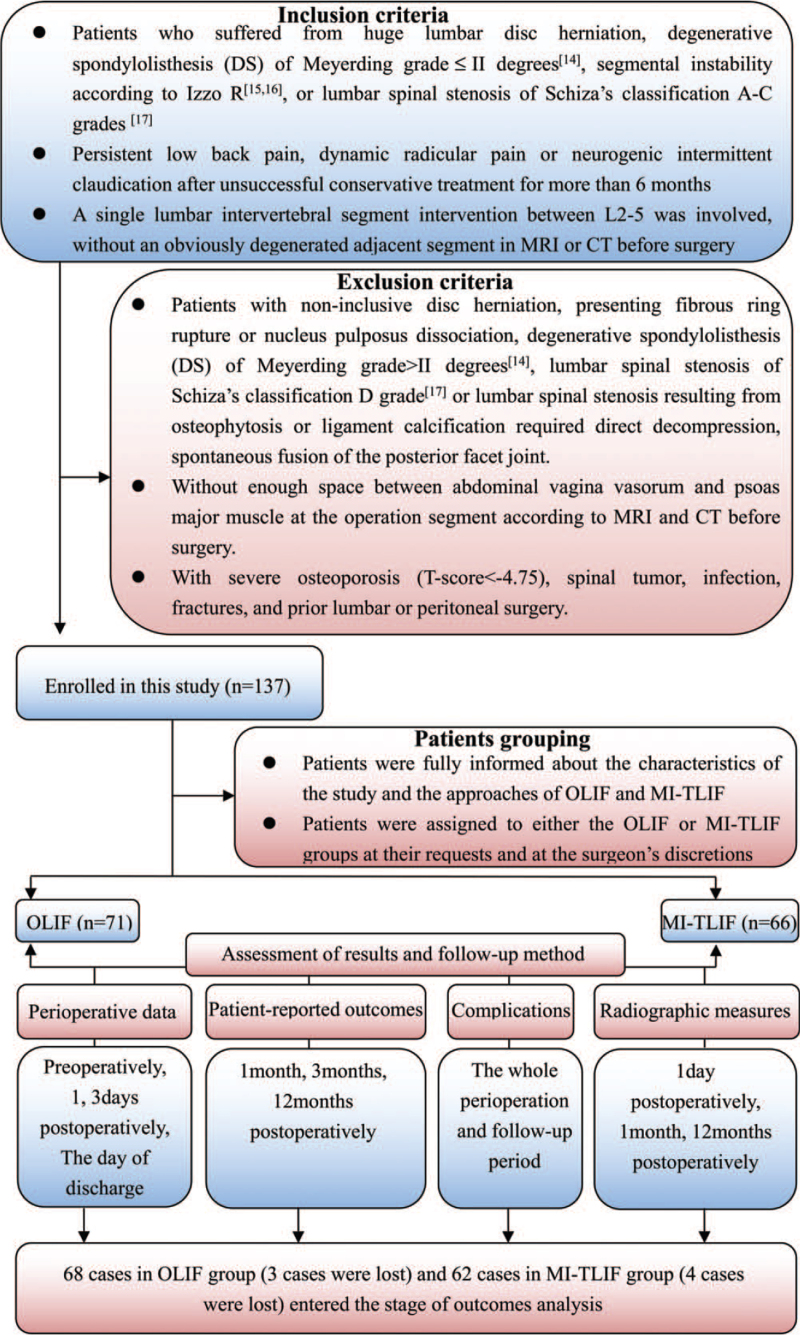
Between August 3, 2019 and February 3, 2020, 137 patients were assigned to OLIF or MI-TLIF at their request and the surgeon's discretion: 71 in the OLIF group and 66 in the MI-TLIF group. The perioperative data, patient-reported outcomes, radiographic outcomes, and complications were compared between the two groups.
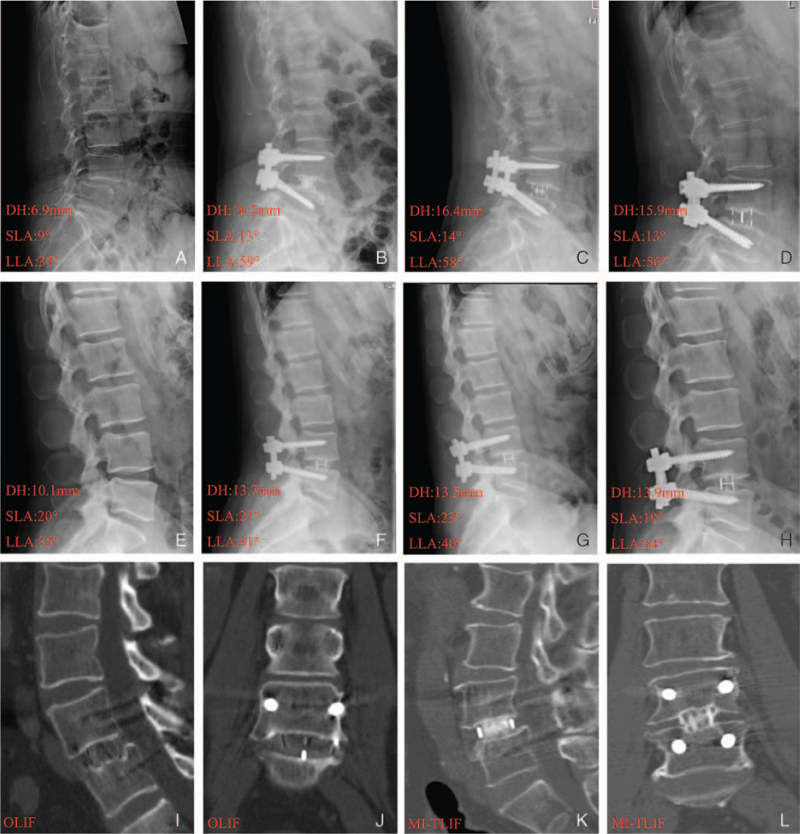
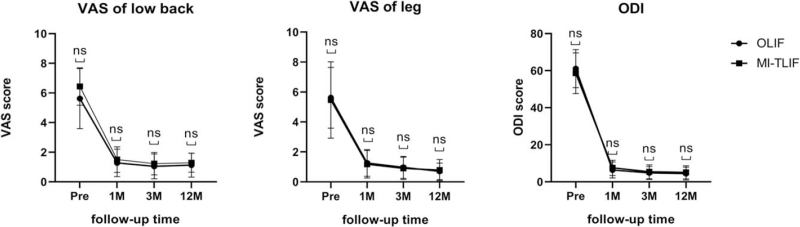
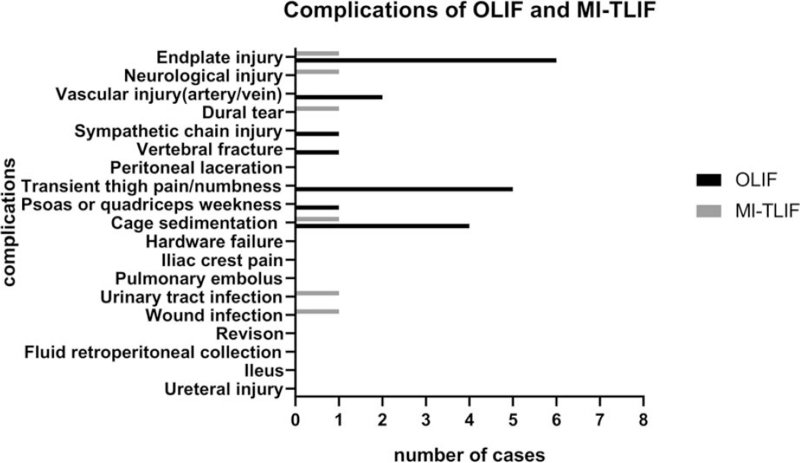
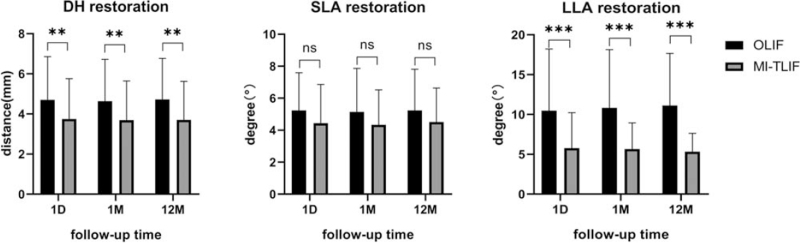
The OLIF group showed shorter operation time (110.5 vs.183.8 minutes, P < 0.001), lesser estimated blood loss (123.1 vs. 232.0 mL, P < 0.001), shorter length of hospital stay (5.5 vs. 6.7 days, P < 0.001), and lower serum creatine kinase (CK) (1 day postoperatively) (376.0 vs. 541.8 IU/L, P < 0.01) than that of MI-TLIF group. Both groups showed no significant differences in the visual analog scale (VAS) scores of lower back and leg pain and the Oswestry Disability Index (ODI) scores preoperatively and at 1, 3, and 12 months postoperatively, respectively (P > 0.05). Compared with the MI-TLIF group, the OLIF group showed better restoration of disc height (DH) (4.7/4.6/4.7 vs. 3.7/3.7/3.7 mm, P < 0.01) and lumbar lordosis angle (LLA) (10.5°/10.8°/11.1° vs. 5.8°/5.7°/5.3°, P < 0.001), but not the value of segmental lordosis angle (SLA) (P > 0.05) at 1 day, 1 month, and 1 year postoperatively, respectively. The complication rate of OLIF was higher than that of MI-TLIF (29.4% vs. 9.7%, P < 0.01).
Compared with MI-TLIF, OLIF showed similar results in terms of patient-reported outcomes, restoration of SLA and fusion rate, and superior results with respect to restoration of DH and LLA, operation time, estimated blood loss, length of hospital stay, and serum CK levels (1 day postoperatively). Even though the complication rate of OLIF is higher than that of MI-TLIF, it does not bring persistent and substantial damage to the patients.Level of Evidence: 3.
前瞻性队列研究。
评估斜外侧腰椎间融合术(OLIF)与微创经椎间孔腰椎间融合术(MI-TLIF)在临床和影像学结果方面的差异。
目前,OLIF 在退行性腰椎疾病的治疗中是否优于 MI-TLIF 仍存在争议。
2019 年 8 月 3 日至 2020 年 2 月 3 日,根据患者和外科医生的要求和判断,将 137 名患者分配至 OLIF 或 MI-TLIF 组:OLIF 组 71 例,MI-TLIF 组 66 例。比较两组患者围手术期数据、患者报告的结果、影像学结果和并发症。
OLIF 组的手术时间更短(110.5 分钟比 183.8 分钟,P<0.001)、估计失血量更少(123.1 毫升比 232.0 毫升,P<0.001)、住院时间更短(5.5 天比 6.7 天,P<0.001)、术后第 1 天血清肌酸激酶(CK)水平更低(376.0 国际单位/升比 541.8 国际单位/升,P<0.01)。两组患者的下腰痛和腿痛的视觉模拟量表(VAS)评分以及术后 1、3 和 12 个月的 Oswestry 残疾指数(ODI)评分均无显著差异(P>0.05)。与 MI-TLIF 组相比,OLIF 组在术后 1 天、1 个月和 1 年时的椎间盘高度(DH)恢复更好(4.7/4.6/4.7 毫米比 3.7/3.7/3.7 毫米,P<0.01)和腰椎前凸角(LLA)恢复更好(10.5°/10.8°/11.1°比 5.8°/5.7°/5.3°,P<0.001),但术后第 1 天、1 个月和 1 年时的节段前凸角(SLA)值无显著差异(P>0.05)。OLIF 的并发症发生率高于 MI-TLIF(29.4%比 9.7%,P<0.01)。
与 MI-TLIF 相比,OLIF 在患者报告的结果、SLA 和融合率的恢复方面具有相似的结果,在 DH 和 LLA 的恢复、手术时间、估计失血量、住院时间和术后第 1 天的血清 CK 水平方面表现更优。尽管 OLIF 的并发症发生率高于 MI-TLIF,但不会对患者造成持续和实质性的损害。
3。